
Quick Verdict
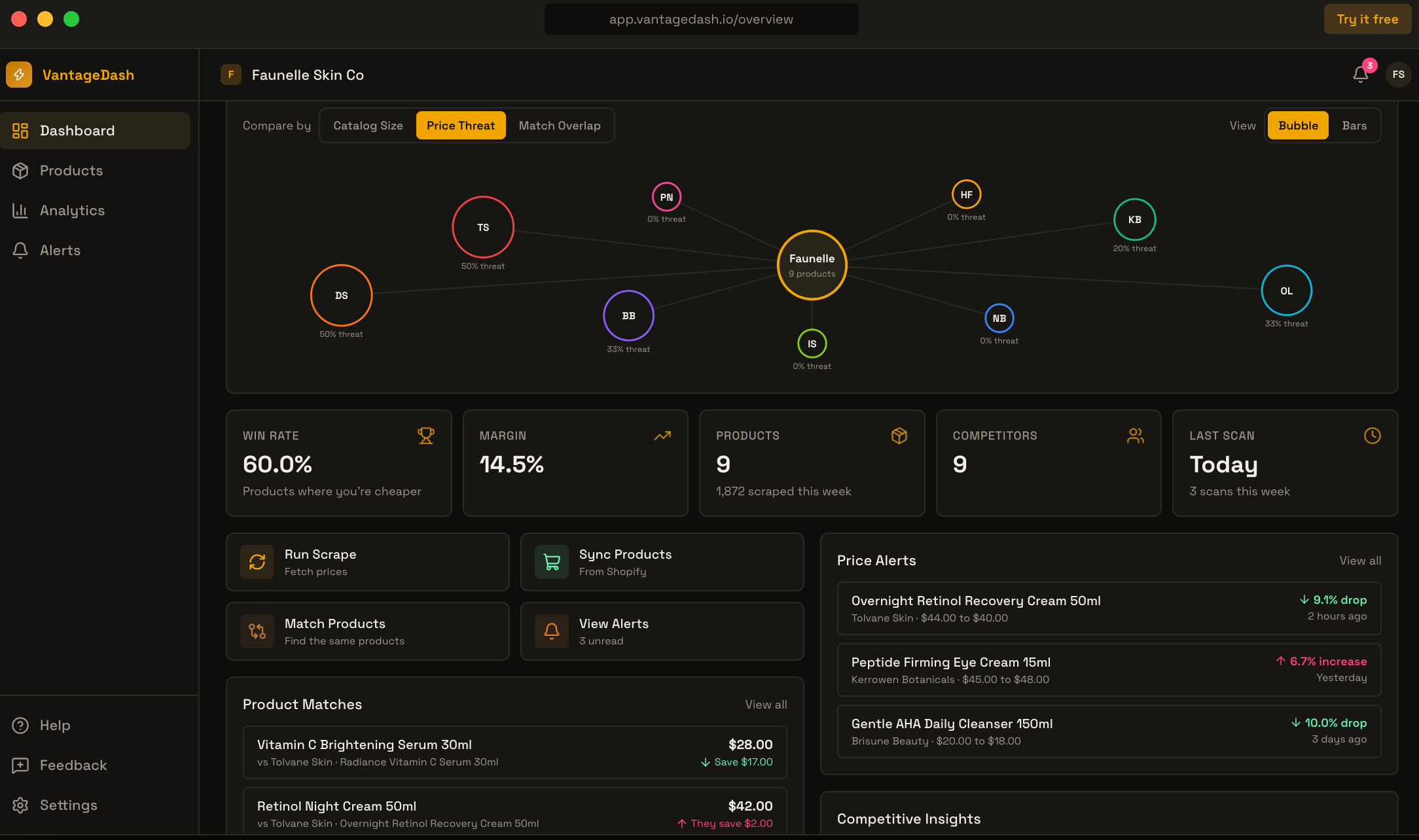
VantageDash is a competitor price monitoring tool for ecommerce stores that need to compare their catalog with a defined set of rival sites. Its clearest use case is a small merchant that wants scheduled price checks, product matching, alerts, and price-per-item comparisons when pack counts differ.
The product is less suitable if your pricing workflow depends on Amazon, competitor stock, shipping costs, or automatic repricing. VantageDash’s developer has also described the product as early stage and warned that suggested product matches can be wrong. Merchants should review every important match before using the data to make pricing decisions.
Key Features
- Competitor catalog monitoring: Add a competitor’s public store address and VantageDash reads its products and prices. The official website lists Shopify, WooCommerce, BigCommerce, Wix, Squarespace, Square Online, Ecwid, and custom-built stores among the supported storefront types.
- Product matching with review controls: Scout includes basic product matching. Paid plans add AI matching. The matching documentation says AI matches receive confidence scores, while lower-confidence suggestions can be confirmed, edited, or deleted. Manual matching is also available.
- Pack-count comparison: VantageDash can read item counts such as a 24-pack or 1,000-count case and compare the price per item instead of relying on the shelf price alone. Its price-per-unit explanation describes how merchants can mark a competitor’s listed price as already being per item to avoid dividing it twice.
- Price history and alerts: The product records price history and can send price-change alerts. Available channels and team features depend on the plan.
- Scheduled checks on paid plans: Basecamp checks automatically every 48 hours, Vantage checks daily, and Summit supports checks as often as hourly under the current public pricing.
How the pack-count workflow helps
A shelf-price comparison can be misleading when two stores sell the same item in different quantities. VantageDash’s published price-per-unit documentation gives the example of a 24-pack priced at $28.80 and an 18-pack priced at $23.40. Its documented workflow calculates the price per item so the merchant can compare $1.20 per can with $1.30 per can.
This workflow supports price-per-item comparisons across different pack sizes. For stores selling food and drink, pet food, supplements, or cosmetics, VantageDash also documents normalized price comparisons by weight or volume—such as per kilogram, per 100 ml, per pound, or per fluid ounce—when both matched listings provide the required measurements. These are vendor-documented capabilities, not independently tested ATFE results. Merchants should verify that product measurements, units, and matches are captured correctly before relying on the comparisons.
Matching quality still matters. A clean calculation on the wrong product, variant, or pack produces a bad comparison. Review the product identity, pack count, currency, and displayed price before acting on a price gap.
Ecommerce use cases
- Track a focused group of competitors without maintaining a large spreadsheet of product URLs.
- Compare wholesale packs or cases where different item counts make shelf prices hard to interpret.
- Review competitor price history and receive alerts when a monitored price changes.
- Share selected comparison data through current plan-dependent exports or team access.
- Use monitoring as an input to a manual pricing review while keeping price changes inside the merchant’s existing approval process.
VantageDash supplies monitoring data. It does not establish that a price change will improve conversion, revenue, or margin.
Best for
VantageDash is worth considering for a small Shopify or DTC merchant with a manageable catalog and a defined set of competitor stores. It may be especially relevant when products are sold in different pack counts and the team wants a low-cost way to compare prices per item.
The free Scout plan can be used to check whether the basic workflow fits before paying for scheduled checks or AI matching. The free offer is a current vendor offer, not a permanent guarantee.
When VantageDash is not the right fit
Look elsewhere if you need any of the following as a required part of the workflow:
- Amazon or marketplace monitoring
- competitor stock monitoring
- shipping-cost capture
- automatic repricing
- independent evidence of match accuracy at your catalog’s scale
The developer’s public description says the product does not currently cover the first four functions. VantageDash also has limited independent usage evidence. A larger retailer or pricing team may need broader channel coverage, governed repricing, service commitments, or independently validated data quality.
Pricing
The VantageDash pricing page listed four plans when checked in October 2026:
| Plan | Listed plan price | Competitor and product limits | Check frequency and matching |
|---|---|---|---|
| Scout | $0 | 3 competitors; 50 products | 5 manually started checks per month; basic matching |
| Basecamp | $19/month | 10 competitors; 200 products | Automatic checks every 48 hours; AI matching; 20 AI matches per month |
| Vantage | $49/month | 25 competitors; 500 products | Daily automatic checks; AI matching |
| Summit | $199/month | Unlimited competitors and products | Checks as often as hourly |
The current billing documentation lists competitor limits consistent with the public pricing page: 3 for Scout, 10 for Basecamp, 25 for Vantage, and unlimited competitors for Summit. However, the billing documentation states that paid plans for accounts created directly on vantagedash.io are not yet open. Stores connected through the Shopify app are billed through Shopify. Confirm the available signup route and paid-plan availability before purchasing.
The public pricing page does not establish an AI-match allowance for Vantage or Summit. Do not assume those plans include unlimited AI matching. Confirm the allowance, billing terms, supported sites, and current entitlements before subscribing.
The pricing page describes Scout as free with no time limit and no credit card. That describes the vendor’s current offer and may change.
Limitations and checks before choosing
- Matches require review. The developer says suggested pairs can be wrong, and the documentation provides confidence scores and manual correction tools. Check high-value products and low-confidence suggestions yourself.
- Website extraction varies. VantageDash says it reads public storefront pricing and can use a different method for some blocked sites on paid plans. This does not prove that every public store can be read reliably. Login-only or wholesale-only prices are outside the documented public-data workflow.
- Unit-price normalization: VantageDash documents per-item comparisons across pack sizes. It also describes weight/volume comparisons for food and drink, pet food, supplements, and cosmetics when the required measurements are available. Verify the supported units and extracted product data for your catalog. Tax, currency, shipping, variants, and bundle assumptions may still affect the comparison.
- Monitoring stops before price execution. VantageDash does not change store prices. Teams that require automatic repricing need another product or a separate controlled process.
- The product is early stage. Public independent evidence is limited, so support, extraction coverage, match quality, and operational reliability should be checked against the merchant’s own catalog.
Alternatives
Merchants that need stock monitoring, marketplace coverage, or rule-based repricing can review Prisync. Its starting price and operating scope are different, so it is not a direct replacement for every small-store use case.
For a broader shortlist, see ATFE’s competitor price monitoring software guide. The guide compares tools by matching quality, data coverage, alerts, repricing controls, and team requirements. VantageDash should be assessed as a branded product-fit option, not as a ranked winner in that guide.
Official sources
- VantageDash official website
- VantageDash pricing
- How VantageDash compares prices per item
- VantageDash product matching documentation
- Plans and billing documentation — current plan tiers, competitor limits, and billing-route availability.
- VantageDash FAQ and troubleshooting
- Developer statement in the Shopify Community
Editorial disclosure
This profile is based on VantageDash’s official website, public documentation, and a public statement from its developer. ATFE did not run a hands-on performance test and has not independently verified matching accuracy, extraction reliability, or merchant outcomes. Features, limits, and prices can change. Fact-checked Oct 2026.