

What is Triple Whale?
Triple Whale is an ecommerce intelligence and measurement platform that brings store, marketing, customer, product, and operational data into one workspace. It combines real-time dashboards, the Triple Pixel, attribution models, post-purchase surveys, product and cohort analysis, creative reporting, customer segments, benchmarks, and Moby, its ecommerce-focused AI operator.
The platform is designed to help ecommerce teams understand what is driving revenue and profit, then turn those findings into reports, audiences, campaign actions, and recurring workflows. It supports a free entry plan for essential visibility and paid plans for multi-touch attribution, deeper business intelligence, AI analysis, automation, and enterprise measurement.
Quick Verdict
Triple Whale is one of the strongest all-around analytics options for ecommerce brands that want fast setup, real-time visibility, attribution, and AI-assisted decision support in one platform. The free plan makes it accessible to smaller teams, while paid tiers add capabilities for brands spending significantly across multiple channels.
Its breadth is also the main consideration. Teams must choose the metrics and attribution views that match their decisions instead of treating any single dashboard as absolute truth. Paid pricing scales with annual GMV and advanced capabilities can become a substantial investment, so the platform should be tied to clear reporting, media, retention, and operational workflows.
Key Features
- Real-time business dashboard: Combine revenue, ad spend, profitability, subscriptions, organic performance, and other business metrics in one view.
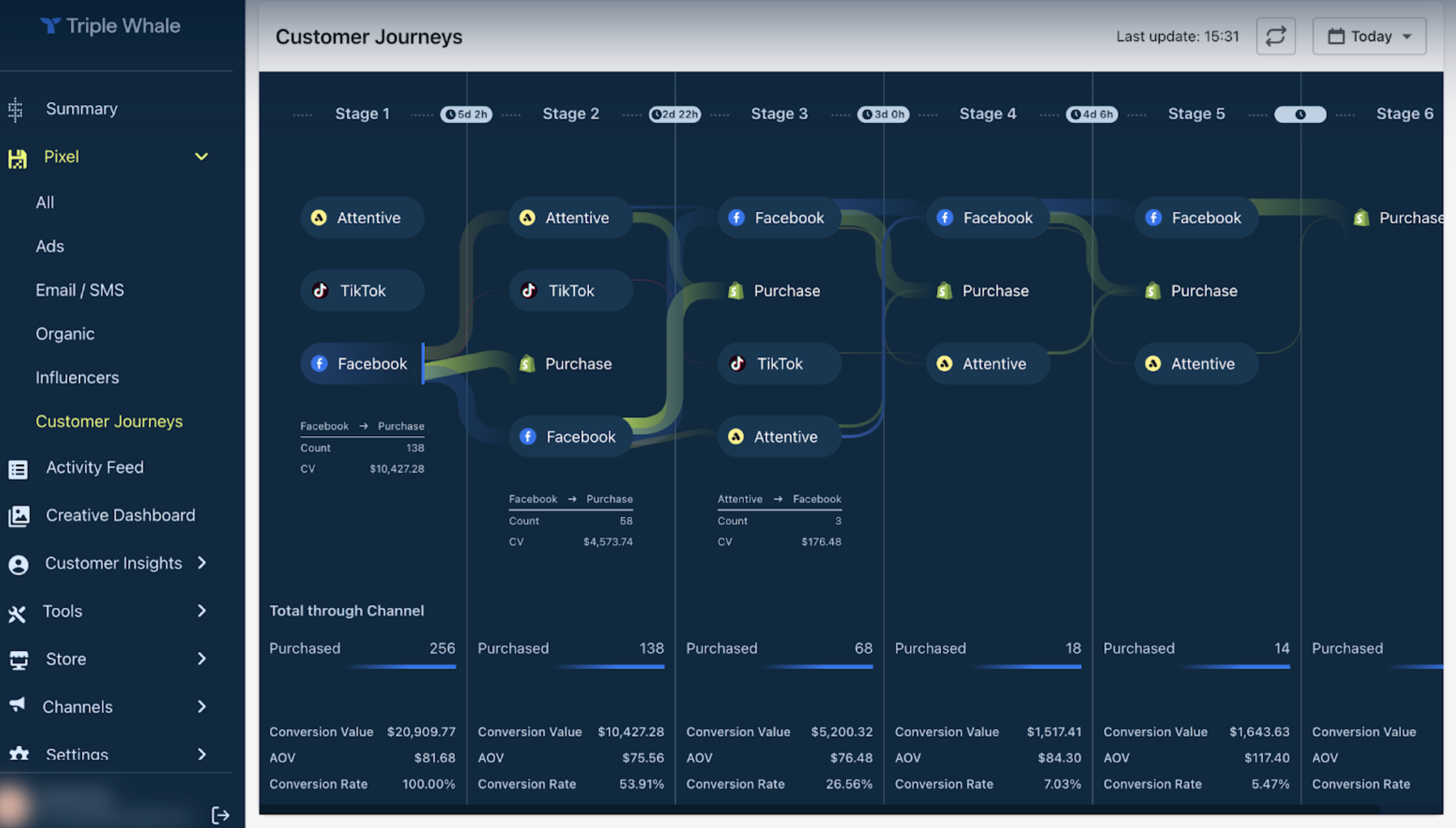
- Triple Pixel: Capture first-party behavior for cross-device and cross-platform customer journey measurement.
- Attribution models: Compare first-click, last-click, linear, multi-touch, Triple Attribution, Total Impact, and supported lookback windows.
- Post-purchase survey: Collect zero-party data about what influenced each purchase and combine it with attribution analysis.
- Business intelligence: Build dashboards, custom metrics, customer segments, and queries through a no-code interface and SQL tools.
- Customer and cohort analytics: Explore retention, repeat behavior, LTV, and customer segments over time.
- Product and creative analysis: Evaluate product-level ROAS, catalog performance, creative patterns, copy, and audiences.
- Multi-store and multi-geo reporting: Compare performance across stores, brands, markets, and regions.
- Moby AI: Ask questions in plain English, investigate performance, build reports, and support daily analysis using live business data.
- Automations: On eligible plans, schedule KPI alerts, leadership reports, campaign monitoring, audience updates, inventory tasks, and other repeatable work.
- First-party activation: Push high-intent signals and customer segments back to supported marketing platforms.
- Enterprise measurement: Combine multi-touch attribution, marketing mix modeling, incrementality testing, and advanced controls.
Moby AI and Ecommerce Automations
Moby 2 is Triple Whale’s AI teammate for ecommerce operations. It can work with connected business data and saved context to answer performance questions, investigate changes, create reports and other analytical artifacts, and recommend next steps. This makes it more relevant to ecommerce analysis than a general chatbot working without access to the brand’s live operating data.
Foundation includes Moby chat and AI-assisted analysis. Automate adds scheduled Moby Automations, governed Actions, expanded creative and landing-page workflows, and Moby Specialists as they become available. A recurring conversation can become an automation for work such as a weekly performance report, daily campaign monitoring, KPI alerts, budget-pacing reviews, or Slack and email updates.
Moby can prepare or execute supported actions in connected platforms, but availability depends on the plan, integration, account configuration, permissions, and current product rollout. Actions that affect advertising or other live accounts should use explicit thresholds, approval requirements, exclusions, and spending limits. Teams should verify the result in the connected platform instead of treating automation as error-free.
See the official Moby 2 documentation for current capabilities and access requirements.
Ecommerce Use Cases
- Daily performance monitoring: Track revenue, spend, blended ROAS, profitability, and channel performance without switching between multiple platforms.
- Media attribution: Compare attribution models and first-party signals to make more informed channel and campaign decisions.
- Creative analysis: Identify which messages, visuals, formats, and audiences contribute to stronger advertising outcomes.
- Customer retention: Analyze cohorts, LTV, repeat purchase behavior, and segments for lifecycle and audience strategies.
- Product profitability: Compare SKUs, categories, product ROAS, margin signals, and purchasing behavior.
- Leadership reporting: Automate recurring performance summaries, anomaly alerts, and business reviews.
- Multi-store operations: Consolidate reporting across stores, markets, Amazon, subscriptions, and other ecommerce channels.
- AI-assisted operations: Use Moby to investigate changes, create reports, monitor KPIs, and automate approved recurring work.
Best For
Brands spending across several advertising channels that need stronger attribution, creative, and profitability visibility.
Smaller operators can use the free plan to consolidate core metrics and basic attribution without an initial software cost.
Marketing, retention, finance, creative, and leadership teams that need shared reporting and consistent business context.
Organizations that need advanced measurement, automation, marketplaces, custom integrations, governance, and support.
Advantages and Limitations
Advantages
- Offers a permanent free plan with real-time ecommerce visibility and basic attribution.
- Combines dashboards, attribution, customer, product, creative, and AI capabilities.
- Uses ecommerce-specific data models and benchmarks rather than generic web analytics alone.
- Supports first-party measurement through Triple Pixel and post-purchase surveys.
- Can scale from founder reporting to enterprise measurement and automation.
- Unlimited users are included on paid plans, supporting cross-functional adoption.
Considerations
- Paid pricing scales with annual GMV and can increase as the business grows.
- Foundation, Automate, and Enterprise are 12-month subscriptions, even when billed monthly.
- Attribution is directional evidence, not a perfect substitute for incrementality testing or business judgment.
- Advanced features require careful setup, data validation, and consistent metric definitions.
- Moby usage, Specialists, Actions, and some add-ons have plan- or account-dependent availability and limits.
- Automated actions can affect live accounts and require permissions, approvals, and guardrails.
- The breadth of the platform can be more than a very small store needs.
Triple Whale Pricing
Triple Whale prices paid plans according to the selected package and the brand’s annual GMV. The public starting prices below are not a guaranteed quote for every business.
| Plan | Starting price | Main capabilities | Best for |
|---|---|---|---|
| Free | $0 per month | Real-time business visibility, basic attribution, Triple Pixel, AI-search visibility, and post-purchase survey tools | Founders and small teams establishing a shared performance view |
| Foundation | Starts at $219 per month | Multi-touch attribution, business intelligence, segments, first-party activation, and Moby analysis | Brands that need trusted measurement and AI-assisted investigation |
| Automate | Starts at $749 per month | Everything in Foundation plus Automations, governed Actions, creative workflows, and eligible Moby Specialists | Teams ready to automate recurring growth and reporting work |
| Enterprise | Custom pricing | Everything in Automate plus Compass, MMM, incrementality testing, multi-brand capabilities, and enterprise support | Complex organizations requiring advanced measurement and governance |
Foundation, Automate, and Enterprise are 12-month subscriptions. Customers can be billed monthly or prepay annually; Triple Whale currently advertises two months free with annual prepayment. Included Moby usage, add-ons, plan availability, and the final price may vary by annual GMV, contract, and account configuration. Check the official Triple Whale pricing page for a current revenue-tier quote.
Our Take
Triple Whale offers an unusually practical path from free ecommerce reporting to advanced attribution and AI-assisted operations. The free tier is useful for founders who need one performance view, while Foundation becomes compelling when a brand needs multi-touch attribution, flexible BI, and stronger first-party activation.
The platform creates the most value when it becomes part of a consistent operating rhythm: daily monitoring, weekly growth reviews, creative analysis, retention segmentation, and leadership reporting. Teams should avoid using one attribution number in isolation and instead combine platform data, post-purchase feedback, incrementality evidence, and financial outcomes.
Triple Whale Alternatives
- Polar Analytics — Consider it for a dedicated Snowflake-based data platform, governed semantic layer, and customizable enterprise stack.
- Peel Insights — Consider it for focused cohort, retention, customer LTV, and product journey analysis.
Frequently Asked Questions
Does Triple Whale have a free plan?
Yes. Triple Whale lists a permanent Free plan at $0 per month with real-time business visibility, basic attribution, Triple Pixel tracking, AI-search visibility, and post-purchase survey tools. Included limits can change.
How much does Triple Whale cost?
The Free plan costs $0. Foundation starts at $219 per month, Automate starts at $749 per month, and Enterprise uses custom pricing. Final paid pricing varies with annual GMV and account configuration.
Does Triple Whale offer AI agents for ecommerce?
Yes. Moby 2 can analyze connected ecommerce data, create reports, support scheduled Automations, and prepare or execute eligible Actions. Automate adds Specialists for selected ecommerce roles as they become available. Exact availability may vary by plan, integration, permissions, account, and rollout status.
What is Triple Pixel?
Triple Pixel is Triple Whale’s first-party tracking technology for capturing customer journeys across devices, channels, and touchpoints to support attribution and analysis.
What is Moby?
Moby is Triple Whale’s ecommerce-focused AI operator. Depending on the plan, it can answer questions, investigate performance, create reports and artifacts, and run approved recurring automations.
Is Triple Whale only for Shopify?
Triple Whale is strongly associated with Shopify and direct-to-consumer ecommerce, but it also supports additional ecommerce platforms, Amazon, marketing channels, subscription tools, marketplaces, and other integrations listed by the company.
Last reviewed: August 2026. Features, prices, plan limits, integrations, and AI availability may change. Confirm current details with Triple Whale before purchasing or enabling automated actions.