

What is Polar Analytics?
Polar Analytics is an ecommerce data platform that centralizes information from stores, marketing channels, lifecycle tools, marketplaces, and other business systems. It combines a dedicated Snowflake database, an ecommerce semantic layer, connectors, a first-party pixel, business intelligence, data activation products, and AI agents.
The platform is designed for ecommerce brands and agencies that need a governed source of truth across revenue, marketing, customers, products, inventory, and retention. Polar provides more than dashboards: it creates a structured data foundation that teams can use for reporting, attribution, audience activation, conversion signals, and AI-assisted analysis.
Quick Verdict
Polar Analytics is a strong option for growing and enterprise ecommerce brands that want to consolidate their data stack without building an internal warehouse and semantic layer from scratch. Unlimited users and historical data make it attractive for cross-functional teams, while dedicated Snowflake infrastructure provides a more durable foundation than a collection of disconnected dashboards.
Its main limitation is accessibility for smaller brands. Core pricing starts at $750 per month and scales with impacted GMV, so Polar needs to replace meaningful reporting work or improve high-value decisions to justify its cost. Implementation is also more strategic than simply installing a lightweight analytics app.
Key Features
- Ecommerce data platform: Centralize business data in a dedicated Snowflake environment with a structured ecommerce semantic layer.
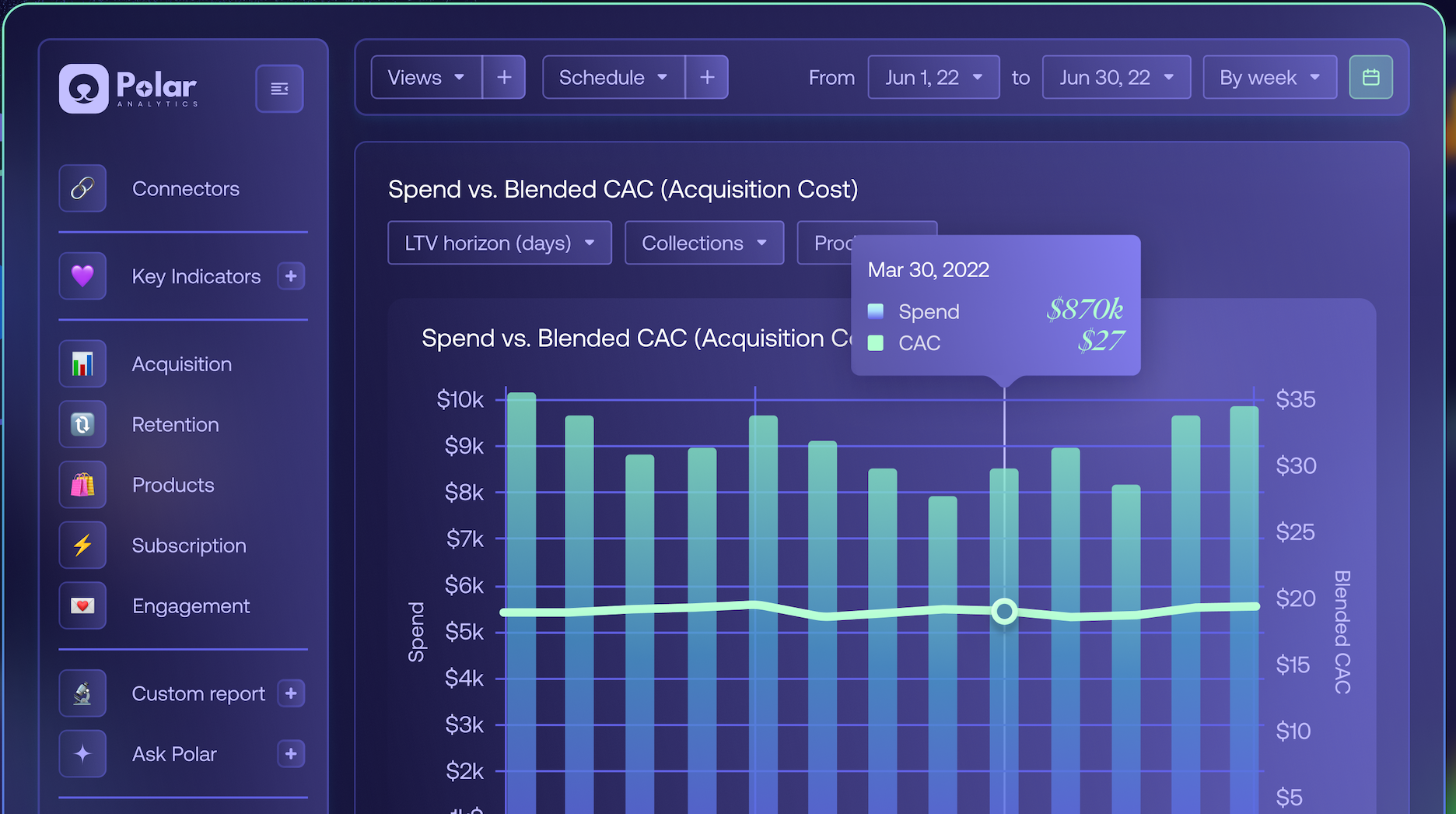
- Business intelligence: Use ready-made dashboards, custom reports, goal tracking, alerts, and scheduled reporting for recurring decisions.
- Connectors: Bring together data from ecommerce, advertising, lifecycle marketing, marketplaces, operations, and other supported sources.
- Polar Pixel and Lifetime ID: Capture first-party customer behavior and improve attribution and journey analysis.
- Custom metrics and dimensions: Adapt reporting to the definitions and operating model used by the business.
- Unlimited users and history: Give multiple departments access without user-seat limits or restricted historical data.
- Ask Polar AI and AI agents: Explore business questions, workflows, and analysis through ecommerce-aware AI products.
- Polar Headless MCP: Provide governed ecommerce data and hundreds of prebuilt metrics to compatible AI tools and agents.
- Klaviyo Audiences: Turn analytics into segments that lifecycle teams can activate in Klaviyo.
- Advertising Signals: Send conversion events to Meta and Google through supported conversion APIs.
- Incrementality testing: Measure whether marketing activity produces incremental results rather than relying only on attributed conversions.
- Roles and permissions: Control access for internal teams, agencies, and stakeholders.
Ecommerce Use Cases
- Unified performance reporting: Replace separate store, ad-platform, email, and spreadsheet reports with shared business definitions.
- Executive dashboards: Monitor revenue, profitability, acquisition, retention, inventory, and customer performance from one source.
- Marketing measurement: Combine attribution, first-party pixel data, and incrementality testing to improve budget decisions.
- Lifecycle growth: Build high-value customer segments and activate them in Klaviyo for retention and repeat-purchase campaigns.
- Conversion signal quality: Send better first-party conversion events to Meta and Google Ads.
- Product and inventory planning: Connect sales, product, customer, and inventory data to improve merchandising and forecasting decisions.
- Agency reporting: Give client teams and agency operators consistent metrics, permissions, dashboards, and reporting workflows.
- AI workflows: Make governed ecommerce metrics available to AI agents without exposing teams to conflicting definitions or uncontrolled data access.
Best For
Scaling ecommerce brands
Brands with a growing data stack, multiple channels, and enough operational complexity to require a central source of truth.
Data-led growth teams
Marketing, analytics, retention, finance, and operations teams that need consistent metrics and shared reporting.
Agencies and multi-brand operators
Organizations that manage reporting across several stores or clients and need stronger access controls and reusable workflows.
Brands building AI-enabled operations
Companies that want their AI tools and agents to work with governed ecommerce metrics rather than raw, fragmented source data.
Advantages and Limitations
Advantages
- Combines warehouse infrastructure, semantic definitions, connectors, analytics, activation, and AI capabilities.
- Includes unlimited users and unlimited historical data.
- Provides ecommerce-specific metrics instead of requiring every KPI to be modeled from zero.
- Supports both reporting and activation through audiences and advertising signals.
- Dedicated Snowflake architecture gives teams a scalable foundation for future analysis.
- Dedicated support options can reduce implementation risk for larger brands.
Considerations
- Core pricing starts at $750 per month and scales with impacted GMV.
- Smaller stores may not need the platform depth or have enough complexity to justify the investment.
- Teams still need metric governance, ownership, and a clear plan for acting on insights.
- Some products and advanced activation capabilities may require a custom plan or eligibility based on GMV.
- Implementation can involve data validation, connector setup, dashboard design, and stakeholder alignment.
Pricing
Polar uses GMV-based pricing. Its Core Plan starts at $750 per month for brands with less than $5 million in annual impacted GMV and scales across larger GMV brackets. Custom Plans combine selected products and use pricing confirmed in an order form. Polar lists unlimited users and unlimited historical data across plans. Brands should request a current quote because final cost depends on GMV, selected products, and implementation requirements.
Our Take
Polar Analytics is best evaluated as ecommerce data infrastructure rather than a single reporting application. For a scaling brand, the value comes from replacing fragmented definitions and manual data work with one governed platform that supports reporting, activation, measurement, and AI.
The strongest business case exists when several teams repeatedly use the same data for high-value decisions. Early-stage stores may be better served by simpler tools, but established brands that would otherwise assemble a warehouse, connectors, BI tools, and activation workflows may find Polar more efficient and easier to govern.
Polar Analytics Alternatives
- Triple Whale for a lower-friction entry point, a free plan, ecommerce attribution, and operational AI.
- Peel Insights for focused cohort, retention, LTV, customer, and product analytics.
Frequently Asked Questions
Does Polar Analytics offer a free plan?
Polar does not currently list a permanent free plan on its main pricing page. The Core Plan uses GMV-based pricing, while Custom Plans are quoted based on selected products and business requirements.
How much does Polar Analytics cost?
Core pricing starts at $750 per month for brands with less than $5 million in annual impacted GMV. Pricing scales with GMV, and custom product combinations receive an individual quote.
Does Polar include a data warehouse?
Yes. Polar lists a dedicated Snowflake database and ecommerce semantic layer as core parts of its data platform.
Can Polar send audiences back to marketing platforms?
Yes. Polar offers data activation products including Klaviyo Audiences and Advertising Signals for supported conversion events and destinations.
Is Polar suitable for agencies?
Yes. Unlimited users, roles and permissions, connectors, shared metrics, and dedicated reporting workflows can support agencies and multi-brand operators.
Last reviewed: August 2026. Features and pricing may change. Visit the official website for current details.