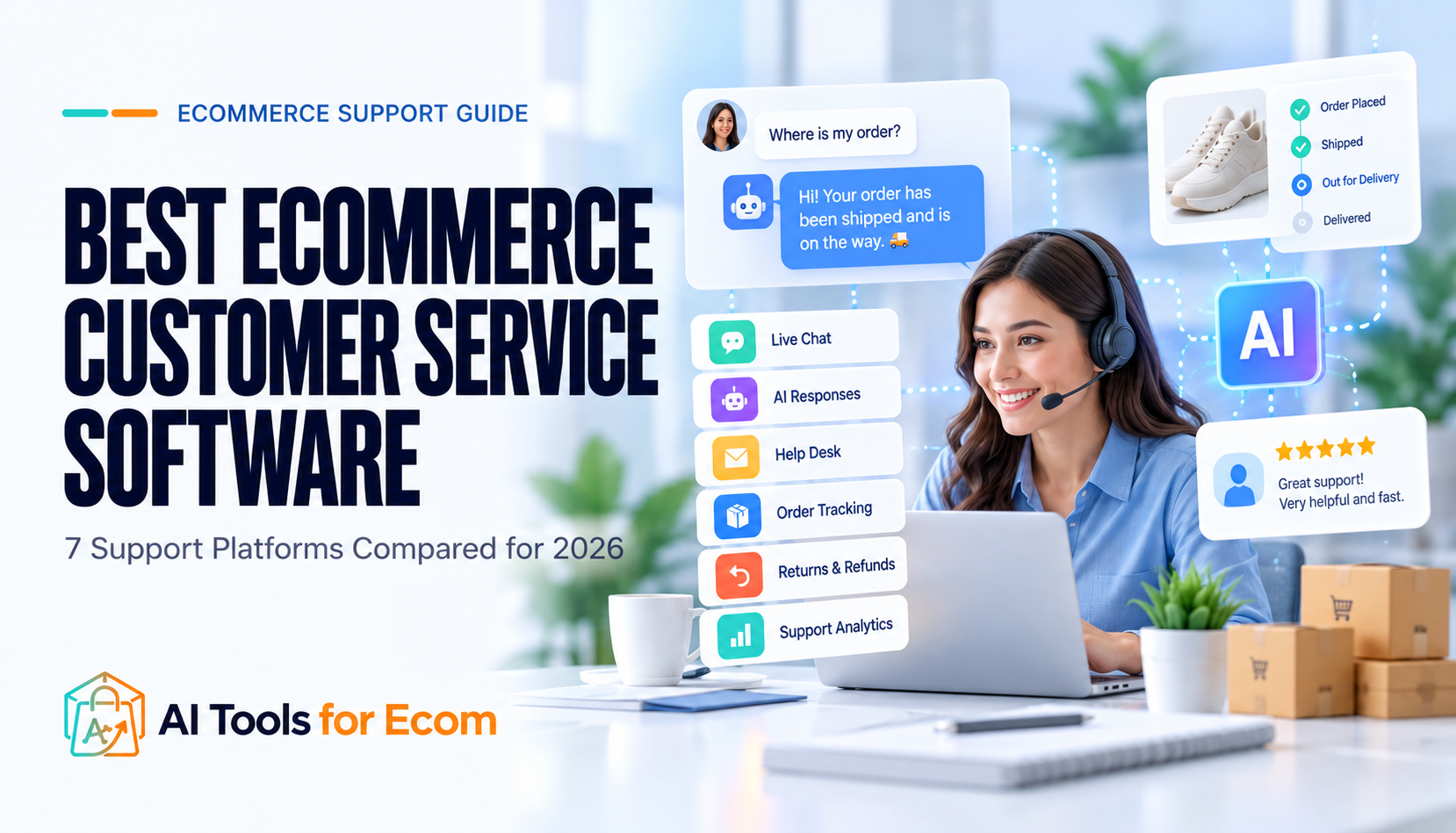
Generic customer service software can organize messages. Ecommerce customer service software has to do more.
When a shopper asks, “Where is my order?”, “Can I change my address?”, “Can you cancel this?”, or “Can I return it?”, the support team needs access to the store and order context behind the conversation. The best platform is not simply the one with the most channels or the biggest AI claim. It is the one that helps your team resolve the work your customers actually create.
For this guide, we compared seven platforms by ecommerce operating fit:
- how much customer and order context appears inside the support workspace;
- whether agents can take order actions without switching systems;
- how AI handles repetitive ecommerce requests;
- channel and marketplace coverage;
- human handoff and team controls;
- billing model;
- peak-season cost sensitivity;
- implementation burden.
We did not rank tools by review scores or generic feature count.
Quick Answer
There is no universal winner.
- Gorgias is the strongest fit for Shopify-first brands that want deep order context, order actions, and AI in the same support workflow.
- Tidio is a strong choice for smaller ecommerce teams that want live chat, ticketing, Shopify context, and AI automation without starting with an enterprise support stack.
- eDesk is the clearest fit for sellers supporting customers across multiple marketplaces and online stores.
- Re:amaze works well for DTC teams that want ecommerce integrations, multi-brand support, and a pricing model that can suit smaller teams.
- Richpanel is aimed at higher-volume ecommerce teams that want AI automation, self-service, and Shopify order operations in one platform.
- Zendesk is the broader enterprise option when customer support extends beyond ecommerce and requires deeper omnichannel, governance, and service operations.
- Freshdesk is a general-purpose value option with real Shopify order context and order actions, but its Shopify setup now requires more technical configuration than some ecommerce-native alternatives.
The right choice depends on where you sell, what actions support needs to take, and how your bill behaves when ticket volume spikes.
ATFE Ecommerce Support Fit Matrix
| Platform | Best for | Ecommerce context | Order actions | AI model | Billing model | Main limitation |
|---|---|---|---|---|---|---|
| Gorgias | Shopify-first DTC brands | Deep Shopify customer/order context | Refunds, cancellations and supported store actions | AI Agent across support and shopping workflows | Helpdesk ticket volume + AI outcomes; not per agent | Volume-based cost can rise during support spikes |
| Tidio | Small and growing ecommerce teams | Shopify cart, order history and store context | Shopify-specific actions from the inbox | Lyro AI Agent + Flows + human support | Human conversation quota + optional AI quota | More complex service operations may outgrow the simpler stack |
| eDesk | Marketplace and multichannel sellers | Built around stores and marketplaces | Ecommerce workflow support across connected channels | AI Agent priced by outcome | Per user + AI outcomes | Less compelling if you only run one simple Shopify storefront |
| Re:amaze | Multi-brand DTC and smaller support teams | Ecommerce integrations and multi-brand workflows | Ecommerce actions depend on connected store/integration | Re:amaze AI Agent | Per team member, with a flat-rate Starter option | Seat pricing can rise as larger teams expand |
| Richpanel | High-volume DTC teams focused on automation | Strong Shopify and ecommerce app context | Shopify order updates, refunds and related actions | AI agents + self-service + QA | Human seats + AI-handled conversations | Higher entry cost and more implementation commitment |
| Zendesk | Enterprise and complex service operations | Shopify integration adds order information | Refunds and cancellations through the integration | Zendesk AI agents with outcome-based usage | Suite/Support plan + AI usage/add-ons | Broader platform means more setup and less ecommerce-first simplicity |
| Freshdesk | Teams wanting a general-purpose value helpdesk | Shopify order, payment and shipping context | Refunds and cancellations from Freshdesk | Freddy AI Agent/Copilot | Per agent + AI session usage | New Shopify connections require a custom-app setup |
The key question is not:
“Does this platform integrate with Shopify?”
It is:
What customer and order context does the integration expose, and what work can your team or AI actually complete from the support workspace?
A connector that only shows order information is not equivalent to one that can safely cancel an order, issue a refund, update an address, or trigger another approved ecommerce workflow.
How We Evaluated Ecommerce Customer Service Software
We used current official product pages, pricing pages, integration documentation, and help-center documentation.
The evaluation focused on six operating questions.
1. Can the platform see the order?
Agents should be able to identify the customer and understand the relevant order without opening multiple systems.
2. Can the platform act on the order?
Viewing order data is useful. Taking approved actions is more valuable.
We looked for documented capabilities such as refunds, cancellations, address changes, order updates, and connected ecommerce actions.
3. Can AI resolve work rather than only draft replies?
An AI-generated answer is not the same as an automated resolution.
We separated reply assistance from AI systems that can use ecommerce context, follow policies, take approved actions, and hand the conversation to a human when needed.
4. Does the channel mix match the store?
Email and live chat may be enough for one brand. Another may need Instagram, WhatsApp, marketplaces, voice, SMS, or multiple storefronts.
5. How does the platform charge?
Customer service software now mixes several billing units:
- agent seats;
- support tickets;
- billable conversations;
- AI outcomes or resolutions;
- marketplace/store limits;
- channel add-ons.
Starting price alone is not enough.
6. What happens during peak season?
A pricing model that looks inexpensive in an average month can behave very differently during Black Friday, holiday returns, a delayed shipment event, or a viral product launch.
For ecommerce, the billing unit is part of the product decision.
1. Gorgias
Best for: Shopify-first brands that want ecommerce context and order actions built into support
Gorgias is the most ecommerce-specific option in this shortlist for Shopify-centric support teams.
Connecting Shopify gives agents access to customer profiles, order history, shipping information, and purchase context beside the support conversation. Gorgias documents order actions including refunds and cancellations from inside the support workflow.
Its AI Agent extends beyond draft assistance. Gorgias positions the product around pre-purchase and post-purchase conversations, with AI that can answer questions, support shoppers, use store knowledge, take configured actions, and hand off when required.
Why it stands out
The main advantage is workflow depth inside Shopify support.
For a team that spends much of the day answering:
- Where is my order?
- Can I cancel?
- Can I change this order?
- Can I return it?
- Which product should I buy?
the support workspace can carry more of the operating context than a generic ticket queue.
Pricing model
Gorgias currently prices Helpdesk primarily by ticket usage rather than by agent seat. Its pricing page says Helpdesk scales from 50 to 5,000 tickets per month and is not priced per agent.
AI Agent adds outcome-based usage. Current official guidance says most plans list $0.90 per resolved interaction, while Starter begins at $1, with included interactions and overage rates varying by plan and billing cadence.
This makes Gorgias attractive for teams that add seasonal agents without wanting a new software seat for every person.
The tradeoff is that a surge in ticket volume can increase cost.
Main limitation
Gorgias is most compelling when the store stack is strongly ecommerce- and Shopify-oriented.
Teams that need broader enterprise service management, very complex non-commerce workflows, or a different billing model should compare it carefully with Zendesk, Freshdesk, or another general-purpose platform.
Before you choose it
Model your cost with normal ticket volume and peak ticket volume, then add expected AI-resolved interactions, Voice, SMS, and any overages.
Do not compare Gorgias with a seat-priced platform using only the advertised entry plan. Use our Gorgias vs Zendesk ecommerce comparison to examine the narrower Shopify-first versus broader service-platform decision.
2. Tidio
Best for: smaller ecommerce teams combining live chat, human support, automation, and AI
Tidio is a strong fit for merchants that want to start lighter than an enterprise helpdesk.
Its ecommerce product combines live chat, ticketing, email, social messaging, Flows, and Lyro AI Agent.
The Shopify integration exposes useful commerce context. Tidio documents the ability to view carts and order history and to perform Shopify-specific actions such as cancellations, refunds, and shipping-address changes from the support environment.
Why it stands out
Tidio covers both sides of the buying journey.
Before purchase, teams can use live chat, product recommendations, cart recovery, and automated Flows.
After purchase, Lyro and the support workspace can handle common questions involving products, delivery, policies, and orders.
That makes it especially useful for smaller stores where “support” and “conversion” are handled by the same team.
Pricing model
Tidio has a free Customer Service plan and paid tiers.
Its current pricing page lists Starter from $24.17/month on annual billing and Growth from $49.17/month on annual billing, with higher plans and usage limits for larger teams.
Lyro AI Agent can also be purchased separately; current pricing starts around $32.50/month for 50 Lyro conversations.
The important point is that Tidio combines human billable-conversation limits with optional AI quotas.
Main limitation
Tidio is easier to enter than many enterprise service suites, but very complex service organizations may eventually want more advanced governance, reporting, workforce management, or enterprise customization.
Before you choose it
Estimate both:
- conversations handled by people;
- conversations you expect Lyro to resolve.
A low base plan does not tell you the eventual cost if both volumes grow. If that model does not fit, compare the best Tidio alternatives for ecommerce by the workflow you need to replace.
3. eDesk
Best for: ecommerce teams supporting customers across marketplaces and multiple online stores
eDesk is the most marketplace-oriented platform in this shortlist.
Its core proposition is a centralized support workspace for sellers operating across ecommerce platforms, marketplaces, social channels, and stores.
eDesk says it connects with hundreds of sales channels and integrations, including Shopify, WooCommerce, Amazon, eBay, Walmart, Mirakl, and others.
Why it stands out
A Shopify-only brand may not need that breadth.
But a seller handling support across:
- Shopify;
- Amazon;
- eBay;
- Walmart;
- marketplace accounts;
- multiple storefronts
has a different problem from a single-store DTC brand.
The value is not just ticketing. It is keeping support work tied to the place where the customer actually bought.
Pricing model
eDesk currently lists:
- Essential: $39/user/month billed annually
- Growth: $89/user/month billed annually
- Professional: $119/user/month billed annually
- Enterprise: custom
Monthly billing is higher.
AI Agent is available across plans and is currently priced at $0.99 per completed outcome.
Store/marketplace limits also increase by plan: current published tiers include 1, 5, and 10 online stores or marketplaces before custom enterprise arrangements.
Main limitation
If your entire business is one Shopify store with a small support team, you may not benefit from eDesk’s marketplace breadth enough to justify choosing it over a more Shopify-centered option.
Before you choose it
Count the actual marketplaces, brands, and storefronts your team needs to support now—and what you expect to add in the next year.
The store limit can matter as much as the user price.
4. Re:amaze
Best for: multi-brand DTC teams and smaller teams that want flexible helpdesk pricing
Re:amaze combines email, live chat, social channels, automation, chatbots, ecommerce integrations, and AI support.
It is particularly interesting because it offers more than one useful pricing shape.
Why it stands out
The standard plans are priced per team member, but Re:amaze also publishes a Starter plan at $59/month flat rate for unlimited team members, limited to 500 responded conversations per month.
That can be attractive for a small ecommerce operation where multiple people need access but total conversation volume remains moderate.
Re:amaze also supports multiple brands on higher plans and includes ecommerce-specific reporting and integrations.
Pricing model
Current monthly pricing is:
- Basic: $29 per team member
- Pro: $49 per team member
- Plus: $69 per team member
Annual billing reduces those rates.
Re:amaze AI Agent includes a small number of resolutions per user depending on plan, with additional AI resolutions currently listed at $0.85.
Main limitation
Per-member pricing becomes less attractive as the human support team grows.
The flat Starter plan solves that problem only while responded-conversation volume stays within its limit.
Before you choose it
Compare both pricing paths:
number of support users
versus
monthly responded conversations
The cheaper model changes as the team and ticket load grow.
5. Richpanel
Best for: higher-volume DTC brands focused on AI automation, self-service, and reducing repetitive support
Richpanel positions itself as an AI-native ecommerce helpdesk rather than a lightweight inbox.
Its Shopify integration exposes customer and order details and supports actions including order changes, discounts, refunds, and draft orders from the Richpanel dashboard.
Richpanel also combines human helpdesk seats with AI agents, self-service, QA, and optional returns/exchange workflows.
Why it stands out
The interesting part of Richpanel is the operating model:
- automate repeat conversations;
- keep human agents for exceptions;
- use self-service to prevent some tickets;
- connect order and subscription context to the conversation.
For a high-volume team, that can matter more than the lowest entry price.
Pricing model
Richpanel currently lists:
- human Helpdesk seats at $99 per seat/month on annual billing
- AI Agents at approximately $0.20 per AI-handled conversation, with the actual amount depending on token usage and a current $200/month AI minimum
Its self-service portal and QA AI are included, while returns and exchanges are a paid add-on starting at $99/month.
Main limitation
This is not the cheapest starting point.
A small store with a few hundred conversations per month is unlikely to need the same automation architecture as a brand handling thousands or tens of thousands.
Before you choose it
Run the comparison using your real support volume and payroll—not only the software price.
For Richpanel, the business case depends heavily on whether AI and self-service genuinely reduce work that would otherwise require additional agents.
6. Zendesk
Best for: larger organizations that need a broad customer-service platform beyond ecommerce
Zendesk is not ecommerce-first.
That is also why it belongs in the comparison.
Large ecommerce companies often need customer service to coexist with wider operational requirements: multiple departments, advanced routing, voice, messaging, governance, analytics, custom applications, workforce tools, and enterprise integrations.
Zendesk covers a broader service footprint than most ecommerce-native tools.
Ecommerce fit
Zendesk maintains a Shopify integration for Support and Chat.
Its current documentation says agents can view Shopify order information and process refunds and cancellations from inside the support experience.
That gives Zendesk meaningful ecommerce capability, even though ecommerce is not the center of the product.
AI model
Zendesk expanded its newer AI-agent capabilities across Suite and Support plans in 2026 and is moving toward outcome-based AI pricing.
The company now emphasizes verified resolutions rather than simple bot deflection.
Main limitation
Breadth increases implementation complexity.
A growing Shopify brand that mainly wants order-aware support may find Gorgias, Tidio, Re:amaze, or another ecommerce-focused platform easier to operate.
Zendesk becomes more compelling when customer service is part of a larger enterprise service architecture.
Before you choose it
Do not evaluate only whether Zendesk can integrate with Shopify.
Ask whether your organization actually needs the wider Zendesk platform enough to justify the additional configuration and operating complexity.
7. Freshdesk
Best for: teams that want a general-purpose helpdesk with solid Shopify order actions at a relatively accessible seat price
Freshdesk is another general-purpose platform that has real ecommerce functionality through its Shopify integration.
Freshworks documents access to:
- current and historical orders;
- order status;
- payment status;
- shipping information;
- refunds;
- order cancellations;
- multiple Shopify stores.
That is more useful than a connector that only attaches a customer profile to a ticket.
Why it stands out
Freshdesk can provide a relatively conventional helpdesk model while still supporting important ecommerce actions.
Current Freshdesk pricing lists:
- Growth: $29/agent/month billed annually
- Pro: $79/agent/month billed annually
- Enterprise: $119/agent/month billed annually
Current plan documentation also shows Freddy AI Agent availability, with the first 500 sessions included and additional usage priced in session blocks.
Main limitation
The Shopify setup became more technical in 2026.
Freshworks documentation now says new Shopify connections require creating and authenticating a custom app through Shopify’s Dev Dashboard.
That is a meaningful implementation difference compared with a platform offering a simpler native install flow.
Before you choose it
Have whoever owns Shopify administration confirm the current integration process before you sign up.
The software may fit your support operation while still requiring more technical onboarding than expected.
Ecommerce-Native vs General-Purpose Customer Service Software
A useful way to narrow the shortlist is to decide whether your support operation is primarily an ecommerce workflow or a broader customer-service organization.
Choose an ecommerce-first platform when:
- most tickets involve orders, shipping, returns, refunds, products, or subscriptions;
- the team lives in Shopify or marketplace data;
- you need fast order actions;
- customer service and conversion overlap;
- seasonal volume is a major concern.
Gorgias, Tidio, eDesk, Re:amaze, and Richpanel fit this side more naturally.
Choose a broader service platform when:
- support spans several business units;
- phone and complex omnichannel routing matter heavily;
- governance and custom workflows are more important than ecommerce simplicity;
- the organization already uses a large service stack;
- ecommerce is only one source of customer cases.
Zendesk and Freshdesk are stronger candidates in that environment.
The Billing Model Matters More Than the Starting Price
Ecommerce customer service has unusual demand patterns.
A brand may handle ordinary volume for most of the year and then see a sharp increase from:
- Black Friday;
- holiday shipping;
- a fulfillment delay;
- returns season;
- a product launch;
- a viral campaign.
That makes pricing architecture important.
Ticket-based
Gorgias primarily scales Helpdesk by replied-to ticket volume.
Risk: support spikes can push usage into higher tiers or overages.
Benefit: adding a temporary agent does not automatically create another helpdesk seat.
Seat-based
Re:amaze, Richpanel, Freshdesk, eDesk, and many enterprise systems include a significant seat component.
Risk: seasonal staff and larger support teams increase recurring software cost.
Benefit: conversation volume may be less directly tied to the base human-support bill.
Conversation- or outcome-based AI
Tidio, Gorgias, eDesk, Richpanel, Re:amaze, Zendesk, and others increasingly charge for some form of AI conversation, outcome, session, or resolution.
Those terms are not interchangeable.
Before buying, confirm exactly what creates a charge.
The ATFE Ecommerce Support Pilot
Do not choose customer service software from a polished demo.
Run a small pilot using real support work.
1. Build a 25-ticket test set
Use historical examples such as:
- Where is my order?
- delayed shipment;
- address change;
- cancellation;
- partial refund;
- full refund;
- return request;
- wrong item;
- damaged item;
- product question;
- subscription change;
- discount issue.
Remove sensitive customer information before using historical conversations in a test environment.
2. Check what appears automatically
For every ticket, ask:
- Is the correct customer identified?
- Is the correct order visible?
- Is fulfillment status visible?
- Is purchase history available?
- Does the agent still need Shopify or another system open?
3. Test real order actions
Where the integration supports it, test approved workflows such as:
- cancellation;
- refund;
- address update;
- return;
- order-status response.
Confirm permissions and guardrails before enabling AI to perform any order-changing action.
4. Test AI handoff
Give the AI examples it should not complete autonomously.
Check whether it:
- recognizes uncertainty;
- follows policy;
- preserves context;
- hands off cleanly;
- avoids inventing an answer.
5. Model peak-season cost
Calculate the bill using:
- normal monthly conversations;
- peak monthly conversations;
- current agents;
- temporary seasonal agents;
- expected AI resolutions;
- overages;
- voice/SMS or other add-ons.
6. Measure operating effort
The better platform is not necessarily the one with the most automation.
Measure:
- setup time;
- ongoing rule maintenance;
- AI review workload;
- time agents spend switching systems;
- number of cases that still require manual store actions.
How to Choose by Store Type
Shopify-first DTC brand
Start with Gorgias, then compare Tidio, Re:amaze, and Richpanel based on team size, automation needs, and billing preference.
Small Shopify store
Tidio and Re:amaze deserve a close look because the entry path can be lighter than a large enterprise service suite.
High-volume DTC brand
Compare Gorgias and Richpanel carefully.
The biggest question is not feature count. It is whether ticket-based versus seat-plus-AI pricing makes more sense at your actual volume.
Amazon, eBay, Walmart, and multichannel marketplace seller
eDesk is the most natural first shortlist candidate here because marketplace coverage is central to its product.
Complex enterprise support organization
Zendesk is more appropriate when ecommerce is part of a wider service environment.
General-purpose helpdesk buyer that still needs Shopify actions
Freshdesk can be a strong value option, provided your team is comfortable with the current Shopify custom-app setup process.
When Not to Buy a New Customer Service Platform
A platform migration may not be the right next move if:
- your real problem is missing policies or poor support content;
- the team handles too little volume to justify migration;
- most delays come from fulfillment, not the helpdesk;
- agents lack permissions to resolve issues regardless of software;
- your current tool already exposes the necessary store context;
- AI is being considered before the business has defined safe escalation rules.
Software cannot fix a broken returns policy or unreliable fulfillment process. If the real requirement is narrower conversational automation, start with the best AI chatbots for ecommerce instead of replacing the entire helpdesk.
Sometimes the correct project is operational cleanup, not a new helpdesk. Teams evaluating the wider store stack can use our best AI tools for Shopify guide as a separate starting point.
Final Recommendation
For a Shopify-first ecommerce brand, Gorgias is the strongest starting point because its support workflow is tightly connected to Shopify order context and ecommerce actions. Stores that need a different billing or service model can also review the best Gorgias alternatives for Shopify.
For a smaller store that wants live chat, ticketing, and AI in one accessible stack, Tidio is a strong alternative.
For marketplace-heavy sellers, eDesk is the better-shaped product.
For multi-brand DTC teams, Re:amaze offers a useful mix of ecommerce integrations and flexible pricing structures.
For high-volume brands prioritizing AI automation and self-service, Richpanel belongs on the shortlist.
For enterprise customer-service operations extending well beyond ecommerce, Zendesk remains the broadest option here.
For teams seeking a lower-cost general-purpose helpdesk with meaningful Shopify order actions, Freshdesk is worth evaluating—while accounting for its current Shopify integration setup.
The final decision should come from three tests:
- Can the system see the right ecommerce context?
- Can people or AI safely complete the work your customers ask for?
- Does the billing model still make sense during your busiest month?
If those three answers are strong, the platform is much more likely to fit your store than one chosen from a generic feature checklist.
Editorial Methodology
ATFE evaluated these platforms for ecommerce operating fit rather than generic customer-service feature count.
Mutable claims were checked against current official product pages, pricing pages, marketplace listings, help centers, and integration documentation in October 2026.
We distinguish between:
- verified product facts;
- vendor claims;
- ATFE editorial judgment;
- unknown or plan-dependent capabilities.
We did not run a controlled hands-on benchmark across all seven platforms, so this article does not use performance scores or claim that ATFE personally tested every product.
Pricing can change and several platforms combine base subscriptions with usage charges. Readers should verify current terms using their expected ticket, conversation, AI, seat, channel, and store volume.
Affiliate relationships do not determine inclusion or conclusions.
Frequently Asked Questions
What is ecommerce customer service software?
Ecommerce customer service software manages customer conversations while connecting them to store, order, shipping, product, subscription, or marketplace context. The strongest tools allow support teams to resolve common ecommerce requests without repeatedly switching between the helpdesk and the commerce platform.
What is the best customer service software for Shopify?
Gorgias is one of the strongest Shopify-specific options because its Shopify integration exposes order and customer context and supports ecommerce actions inside the support workflow. Tidio, Re:amaze, Richpanel, Zendesk, and Freshdesk also support Shopify in different ways.
Is Gorgias only for Shopify?
No. Gorgias lists integrations with Shopify, BigCommerce, Magento, WooCommerce and other ecommerce tools. Its deepest positioning and many of its documented workflows are strongly Shopify-oriented.
What is the best ecommerce help desk for marketplaces?
eDesk is the strongest marketplace-focused option in this shortlist because it is built around support across online stores and marketplaces such as Amazon, eBay, Walmart, Shopify, and others.
Should I choose per-seat or ticket-based pricing?
Neither is always cheaper. Seat pricing becomes more expensive as the human team grows. Ticket- or conversation-based pricing becomes more expensive as support volume grows. Ecommerce teams should calculate both normal and peak-season scenarios before deciding.
Can AI customer service agents issue refunds or change orders?
Some platforms support ecommerce actions, but exact capabilities depend on the integration, permissions, plan, policy configuration, and channel. Never assume an AI agent can safely perform order-changing actions because it can answer order questions. Verify the specific workflow and configure human approval where needed.
What should I test before switching customer service software?
Test real historical support cases, store/order context, approved order actions, AI handoff, agent workflow, reporting, integrations, and total cost under peak-season volume.
Primary Official Sources
Gorgias
- Pricing: https://www.gorgias.com/pricing
- Billing documentation: https://helpcenter.gorgias.com/en-US/how-youre-billed-for-using-gorgias-199385
- Shopify integration: https://helpcenter.gorgias.com/en-US/shopify-81814
- AI Agent: https://helpcenter.gorgias.com/en-US/ai-agent-explained-497772
- AI Agent pricing explanation: https://www.gorgias.com/blog/ai-agent-pricing
Tidio
- Ecommerce platform: https://www.tidio.com/industry/ecommerce/
- Pricing: https://www.tidio.com/pricing/
- Shopify integration: https://www.tidio.com/integrations/shopify/
- AI Agent: https://www.tidio.com/ai-agent/
- Integrations: https://www.tidio.com/integrations/
eDesk
- Pricing: https://www.edesk.com/pricing/
- Shopify: https://www.edesk.com/edesk-for-shopify/
- Ecommerce / marketplace integrations: https://www.edesk.com/marketplaces/
Re:amaze
- Pricing: https://www.reamaze.com/pricing
Richpanel
- Pricing: https://www.richpanel.com/pricing
- Shopify integration: https://www.richpanel.com/integrations/shopify
- Ecommerce integrations: https://www.richpanel.com/categories/ecommerce
- Self-service: https://www.richpanel.com/self-service
Zendesk
- Shopify integration: https://support.zendesk.com/hc/en-us/articles/4408820093850-Setting-up-the-Shopify-integration-for-Support-and-Chat
- Suite plan overview: https://support.zendesk.com/hc/en-us/articles/4408846875034-About-the-Zendesk-Suite-plan-types
- AI agents 2026 update: https://support.zendesk.com/hc/en-us/articles/10487730059034-Announcing-expanded-access-to-AI-agent-capabilities-for-all-Zendesk-customers
- AI pricing / automated resolutions documentation: https://support.zendesk.com/
Freshdesk
- Pricing/features: https://www.freshworks.com/freshdesk/helpdesk-features/
- Shopify Marketplace app: https://www.freshworks.com/apps/freshdesk/shopify
- Shopify integration documentation: https://partnersupport.freshworks.com/support/solutions/articles/195382-integrating-shopify-with-freshdesk