
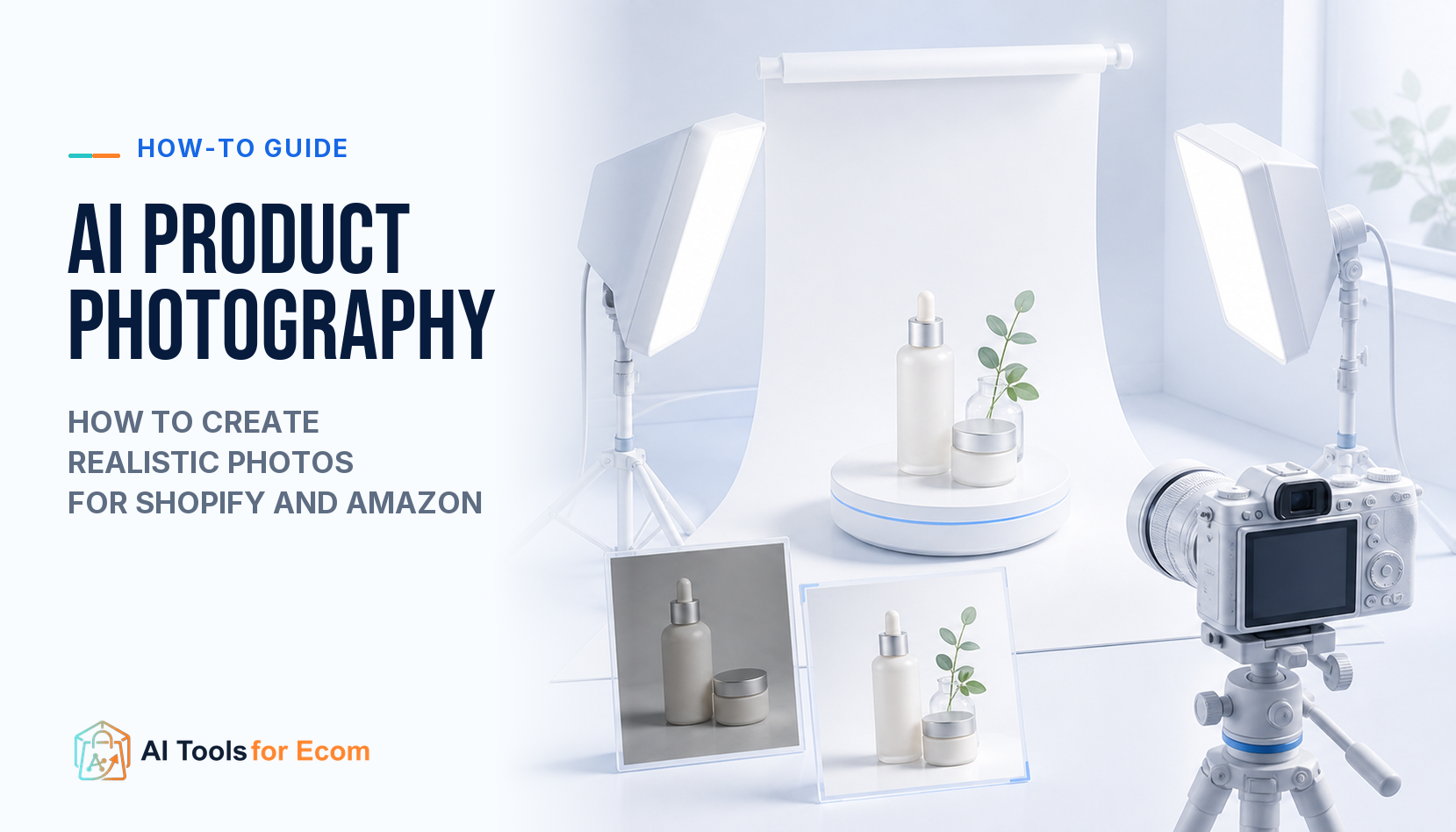
AI product photography can remove backgrounds, create lifestyle scenes, adjust lighting, produce campaign variations, and speed up repetitive catalog work. It can also change a label, color, material, dimension, accessory, or product function without making the error obvious. A realistic image is not necessarily an accurate image.
Quick answer: photograph the real sellable SKU first, preserve an untouched source master, and use AI to generate or refine the environment rather than reconstruct the product. Create separate versions for Shopify, Amazon main images, Amazon secondary images, ads, and social. Before publishing, compare every output with the source and verify marketplace rules, product claims, and asset rights.
What AI Product Photography Actually Means
The term covers three different levels of automation:
- AI-assisted editing: masking, background removal, cleanup, resizing, shadows, relighting, and other edits applied around an existing product photograph.
- AI-generated staging: new surfaces, rooms, props, backgrounds, or lifestyle contexts generated around a referenced product.
- Fully synthetic reconstruction: a model invents or rebuilds the product itself from a prompt or limited reference.
The first two approaches can preserve product truth when the original product layer remains intact and the output receives careful review. Fully synthetic reconstruction carries the highest risk because the model may create a plausible item that is not the SKU the customer will receive.
The working rule for ecommerce is simple: AI may create the environment, but the seller must protect the product.
Step 1: Decide Where the Image Will Be Used
Do not generate one master image and assume it is suitable for every channel. Write a separate brief for each use:
- Amazon main image: accurate photograph of the actual product with a pure white background and no added promotional elements.
- Amazon secondary images: accurate alternate angles, details, scale, use, packaging, or relevant lifestyle context subject to category rules.
- Shopify featured image: a consistent catalog image that clearly represents the product and variant.
- Shopify gallery: details, dimensions, product use, packaging, and verified lifestyle context.
- Advertising and social: campaign-specific compositions, formats, text-safe areas, and disclosures.
The same lifestyle scene that works in an Instagram ad may be unsuitable as an Amazon main image. A technically valid Shopify upload is not automatically truthful, legally cleared, or compliant with another marketplace.
Step 2: Photograph a Trustworthy Product Reference
Generation quality begins with an accurate source. Use the actual sellable SKU and current packaging—not an earlier sample, a similar supplier listing, or a different variant. Capture the final viewing angle whenever possible instead of asking AI to rotate the product and invent an unseen side.
Use this source-photo checklist:
- Even lighting, sharp focus, and a plain contrasting background.
- Front, back, side, top, bottom, packaging, and important detail views.
- Enough resolution to inspect small labels, seams, ports, closures, and textures.
- A color reference and written record of dimensions, quantity, accessories, and variant.
- Real in-use footage or photographs when function, fit, scale, or handling matters.
- An untouched source master retained for comparison and future audits.
Reflective, transparent, metallic, textured, unusually shaped, or text-heavy products require extra source angles and stricter review. The model cannot preserve details it cannot see.
Step 3: Isolate the Product Conservatively
Remove the background and repair mask edges before generating a new scene. Inspect the cutout at full size, especially around transparent packaging, fine jewelry, lace, fur, handles, cords, and reflective surfaces.
Avoid generative replacement of product-defining elements:
- Brand names, labels, ingredients, dosage, warnings, and regulatory text.
- Logos, patterns, artwork, serial markings, and color variants.
- Buttons, connectors, ports, seams, zippers, caps, and closures.
- Transparent, reflective, or textured product components.
- Accessories, attachments, unit count, and packaging contents.
When the mask removes a real detail, restore it from the source rather than asking a generator to guess. Keep the editable product layer separate from the generated background whenever the tool supports that workflow.
Step 4: Generate the Scene, Not a Replacement Product
A useful prompt describes the environment and photographic treatment while explicitly protecting the referenced item:
Surface and setting + camera angle + light source and direction + two or three relevant props + mood + preserve the referenced product’s exact shape, label, color, and proportions.
For example: “Warm bathroom vanity, front three-quarter camera angle, soft daylight from the left, folded neutral towel and small ceramic tray, clean premium mood; preserve the referenced bottle’s exact shape, label, cap, color, size, and proportions.”
Generate several candidates, then reject any image that requires substantial reconstruction of the SKU. Do not solve a product error with more prompting if a conservative composite using the original cutout would be safer.
Props should clarify context without implying that they are included. Avoid competitor marks, unrelated accessories, medical or performance symbolism, impossible product interactions, and settings that create an unsupported safety or durability claim.
Step 5: Composite, Relight, and Refine
A product can remain accurate and still look pasted into a scene. Match contact shadows, perspective, scale, depth of field, reflections, edge softness, and color temperature. The direction and hardness of the product shadow should agree with the generated light source.
Keep edits reversible. Retain the source, cutout, generated background, masks, retouching layers, prompt, model or tool, export settings, and final file. This makes corrections faster and preserves an evidence trail for marketplace or customer questions.
Do not over-sharpen packaging text, generate a new reflection that changes surface material, or add a shadow that alters product shape. Review at both full resolution and the small size customers will see in search results.
Step 6: Run a Product-Fidelity Review
Compare the generated image side by side with the untouched source. Use a checklist rather than relying on whether the output “looks right.”
| Review area | Questions to answer |
|---|---|
| Shape and proportion | Are silhouette, dimensions, component positions, and product scale unchanged? |
| Variant and color | Is this the exact color, finish, size, model, flavor, or pack count being sold? |
| Labels and claims | Are brand names, ingredients, dosage, warnings, certifications, and package text accurate? |
| Material | Are texture, transparency, reflectivity, softness, and construction represented truthfully? |
| Contents | Are accessories, attachments, quantity, and packaging limited to what the buyer receives? |
| Use and context | Does the scene imply only verified fit, function, safety, durability, or performance? |
| Generated additions | Has AI invented a button, handle, cap, connector, badge, feature, or result? |
Assign each output one of three results: approved, repairable, or rejected. Record the rejection reason. This reveals the true usable-output rate and the hidden retouching cost of a seemingly inexpensive generator.
Regulated, safety-related, child-focused, ingestible, cosmetic, wearable, fit-sensitive, or technical products should receive approval from the product owner or compliance reviewer rather than the image creator alone.
Which AI Product Photography Tool Fits the Workflow?
These tools serve different production roles. This workflow article does not name a universal winner or repeat a full feature and pricing comparison.
| Tool | Appropriate role | What to verify |
|---|---|---|
| PhotoRoom | Background removal, white-background preparation, resizing, batch work, and controlled product staging | Mask quality, credits, product changes, accepted SKUs per hour, and export requirements |
| Pebblely | Fast prompt or template scenes and bulk lifestyle variations for straightforward products | Label accuracy, product reinterpretation, bulk consistency, and cost per approved image |
| Flair | Art-directed layouts, props, reusable brand scenes, and selected model workflows | Setup time, composition control, product fidelity, model interactions, and rights |
PhotoRoom is often the practical starting point for repetitive listing edits; Pebblely emphasizes quick lifestyle variation; Flair offers more direct art-direction control. These are role descriptions based on documented capabilities, not independent proof of output quality or conversion performance.
Read the detailed PhotoRoom vs Pebblely vs Flair comparison or browse all AI product photo tools.
Exporting AI Product Photos for Shopify
Shopify’s current product-media guidance allows product images up to 5,000 by 5,000 pixels or 25 megapixels and under 20 MB. It states that 2,048 by 2,048 pixels usually displays well for square product images and recommends consistent aspect ratios for featured images. Shopify accepts several source formats and serves suitable formats to browsers.
Those technical specifications are not a requirement to upload every image at the maximum size. Export enough resolution for zoom and current theme needs while controlling file weight. Keep featured-image framing and aspect ratio consistent across the catalog so collection pages do not jump between unrelated crops.
Create separate Shopify exports for:
- A clear primary catalog view.
- Alternate angles and details.
- Dimensions or scale shown truthfully.
- Verified use and lifestyle context.
- Mobile-safe campaign or seasonal imagery.
Shopify’s upload support does not establish blanket approval of AI-generated images. The merchant remains responsible for truthful representation, product claims, rights, and customer expectations. Confirm current limits in the official Shopify product-media specifications.
Using AI Product Photography for Amazon Listings
Amazon requires listing images to represent the product accurately, and category-specific rules can be stricter. Its main-image requirements include a pure white background, the product occupying most of the frame, and a professional photograph of the actual product. Main images must not use graphics, illustrations, mockups, unrelated props, added promotional text, watermarks, or inset images.
Do not recommend or publish a fully generated Amazon main image. Start with a photograph of the actual sellable product. Limit AI to conservative masking, cleanup, background, and shadow work that does not alter the product. Use the current category guide as the final authority.
Secondary images can show alternate views, details, scale, packaging, use, and relevant context, but the product still must be accurate. No blanket official permission should be inferred for every AI-generated lifestyle image. Treat acceptability as conditional on the actual output, category, claim, and current policy.
A conservative export starting point is a square JPEG around 2,000 by 2,000 pixels, but the category and current Amazon guidance control. Check the canonical Amazon image requirements immediately before publishing. Amazon Ads separately requires AI-generated creative not to mislead customers and requires advertisers to hold necessary rights; review the Amazon Ads general requirements for paid campaigns.
Commercial Rights and AI Disclosure
A tool’s statement that a user owns or may commercially use generated images does not guarantee that every output is free of third-party rights. Use only product photographs, logos, fonts, models, reference images, props, and brand assets the business is entitled to use. Avoid prompting for a competitor’s distinctive campaign or copying a reference composition too closely.
PhotoRoom documents commercial-use conditions that vary by account or plan and leaves copyright clearance with the user. Pebblely states that users own generated images but does not guarantee that an output cannot infringe another party’s rights. Flair’s terms distinguish rights and commercial-use conditions across tiers and also place clearance responsibility on the user. Recheck the active contract before a campaign.
In the United States, there is no blanket rule requiring every AI-assisted ecommerce image to carry an AI label. The advertising must still be truthful, non-deceptive, and substantiated, and any necessary disclosure must be clear and conspicuous. The U.S. Copyright Office also distinguishes human-authored expression from material determined by a generative system; prompts alone generally do not establish copyright in machine-determined output.
For EU-facing commerce, transparency obligations under the AI Act can depend on the content, role, and whether an output qualifies as a deepfake or another covered category. Do not turn that fact-specific analysis into a universal label rule. Seek qualified advice for higher-risk campaigns.
A 20-Image Pilot Before You Scale
- Select products covering simple packaging, reflective surfaces, transparency, texture, small text, and difficult edges.
- Create one catalog image and two lifestyle concepts per product where appropriate.
- Review product accuracy before judging aesthetics.
- Record retries, rejections, manual repairs, generation time, credit use, and export work.
- Test actual Shopify, Amazon, ad, and social formats rather than evaluating only large previews.
- Calculate cost per approved catalog image and approved campaign image separately.
- Scale only the workflow that meets the acceptance and compliance threshold.
Accepted SKUs per hour is more meaningful than images generated per minute. A batch tool creates little value when altered products produce a larger review and correction queue.
Frequently Asked Questions
Can AI replace a real product photo shoot?
AI can reduce background, staging, resizing, and campaign-production work. Accurate source photography remains important for product truth, marketplace main images, difficult materials, fit, scale, packaging, and quality control.
Can I use AI-generated product photos on Amazon?
Do not use a fully generated Amazon main image. Amazon’s main-image rules require a professional photograph of the actual product and impose other presentation requirements. Secondary-image acceptability depends on accurate representation, category rules, the specific output, and current policy.
What is the best AI product photography tool?
It depends on the job. PhotoRoom fits broad editing and batch catalog workflows, Pebblely fast background and lifestyle variation, and Flair more art-directed compositions. Compare cost per approved image rather than raw generation allowance.
How do I stop AI from changing the product?
Use a clear real reference, preserve the original product layer, generate the environment rather than the SKU, avoid unseen rotations, and run a side-by-side fidelity checklist. Reject outputs that require major reconstruction.
Do AI product photos need a disclosure?
There is no single global rule for every image. Requirements depend on jurisdiction, platform, format, content, and how the image was created or edited. Regardless of labeling, the product representation and advertising impression must remain truthful and rights-cleared.
Protect the Product, Then Improve the Scene
The safest AI product photography workflow begins and ends with the real item. Photograph the actual SKU, preserve the product layer, generate only what the channel allows, and compare every final image with the source. The purpose of AI is to reduce repetitive production—not to replace product truth with a convincing approximation.
Review current commercial-use terms through PhotoRoom guidance, Pebblely terms, and Flair terms. For advertising and copyright context, consult the FTC advertising guide, U.S. Copyright Office AI report summary, and European Commission Article 50 guidance.
Editorial method: This workflow is based on current first-party product, marketplace, regulator, and terms documentation. Documented features do not prove product fidelity, output quality, cost savings, conversion lift, or marketplace acceptance. This is not legal advice or a claim of identical hands-on testing. Last reviewed: August 2026. Recheck current product specifications, category rules, tool terms, rights, and disclosure requirements before publication.