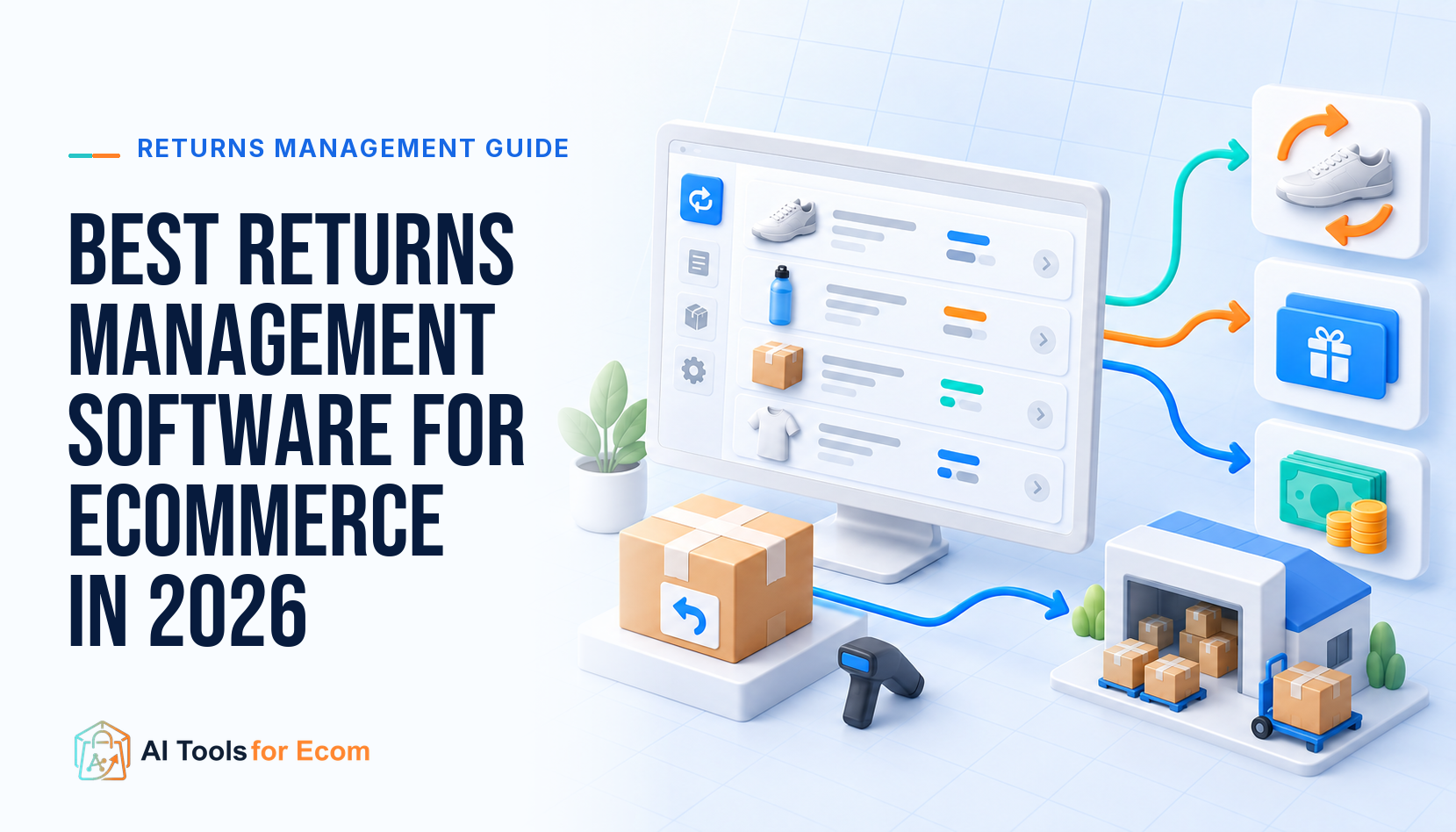
Quick Answer
For a Shopify store with straightforward policies and a team that can review requests, start with Shopify's own returns tools. Customers can submit a self-service request; a merchant can review it, add exchange items, provide return instructions, and process the return after receiving and inspecting the goods. The staff permission to create a return is separate from permission to refund to the original payment method or store credit. If that workload is manageable, another subscription may not solve a problem you have. Shopify self-service, creating returns, and processing returns describe the native path.
Consider a specialist when you need more detailed return rules, several exchange choices, a staffed drop-off network, or a clear handoff between support, payments, and a warehouse. Loop and ReturnGO are Shopify-oriented paths for rules and exchanges. AfterShip is a multichannel candidate. Happy Returns adds a US physical drop-off option and can work alongside some other portals. Narvar is a candidate for larger policy and risk workflows. ReturnLogic emphasizes RMA processing and warehouse handoff; Redo has a distinct shopper-coverage and managed-logistics model.
The seven entries are organized by workflow, not by a tested ranking. ATFE compared public official material and has not hands-on tested these products, measured refund reliability, or verified vendor claims about revenue or savings.
Returns Management Decision Matrix
The prices are public signals for the stated route, reviewed in Oct 2026. A return request, an approved RMA, a paid refund, and an item restocked in a warehouse are separate events. Confirm which one a contract counts and which event triggers money or an exchange.
| Product | Buyer fit | Platform and physical route | Resolution and human boundary | Public price signal | Main constraint |
|---|---|---|---|---|---|
| Loop Returns | Shopify exchange and policy workflows | Shopify connection; domestic US/Canada labels and Return Bar access listed on Checkout+ | Event-driven processing and manual rules require configuration | Checkout+ listed Free; Essential and Advanced starting figures shown on a region-redirected page | US currency/terms, allowances, overages, and AI access need confirmation |
| ReturnGO | Shopify portal with rules and product exchanges | Shopify integration; shipping connections and labels depend on setup | Approval and refund execution are separate; auto-refund is an add-on | Shopify listing: Premium US$147/month, 110 returns; Pro US$297/month, 300 | Created RMAs count, including later rejected or cancelled requests; labels/add-ons extra |
| AfterShip Returns | Multichannel returns with workflow and logistics connections | Shopify and other supported platforms; Tracking is a separate product | Configured auto-refund and manual flagging have plan and workflow limits | Shopify Essentials US$19/month, 20 returns; Premium US$119/month, 100 | Annual terms, overages, labels, and auto-refund eligibility differ |
| Happy Returns | US return portal plus physical drop-off | Portal, Return Bar and other routes; eligibility depends on arrangement | Physical handling and refund timing must be agreed for the route | Full contract price not publicly verified in reviewed sources | Location, item eligibility, service scope, and recovery terms need confirmation |
| Narvar | Policies and risk across a more complex operation | Shopify app; additional services and logistics have separate scope | Listing describes manual and automated refunds; exact trigger and staff roles unverified | Shopify listing says Free | This does not establish the full cost of Shield, implementation, or logistics |
| ReturnLogic | RMA, finance, and warehouse disposition handoff | Shopify and other integrations; verify each warehouse connection | Authorization, financial processing, and physical inspection remain distinct | Website lists usage-based charges and separately states a US$299/month starting figure | Public pricing descriptions conflict; the applicable route is unknown |
| Redo | Portal, shopper coverage, or managed physical returns | Shopify app; managed and cross-border routes depend on service | Manual and automated paths vary by configuration | Returns portal listed Free; Returns AI Agents listed Custom | Coverage, refund labels, AI, and managed logistics cannot be treated as one free package |
Shopify's native baseline
Shopify can collect a customer's request and allow staff to approve or decline it. Approval can lead to shipping instructions or an exchange selection; issuing a refund remains a separate financial step. Shopify distinguishes the Return permission from the permissions to refund to the original payment method and to store credit. Its return-creation guide also says exchange inventory is not reserved until processing and lists restrictions for particular orders.
An existing team may prefer this path if its policy exceptions and physical checks are manageable. Shopify's own label availability and plan conditions depend on the setup; do not assume a free label is available for every country. A third-party portal becomes worth pricing when it removes a specific bottleneck that native tools and the team's existing carrier and warehouse arrangements cannot handle.
1. Loop Returns
Where it fits
Loop is a Shopify-focused candidate for a store that wants to set location-based return policies and offer different outcomes, including refunds, store credit, and exchanges. Its policy documentation describes configuring return outcomes and processing settings. A merchant still needs to decide which returns should be processed automatically and which require staff review; an exchange option in the portal does not prove that replacement stock has been received or shipped.
Execution, people, and AI
Loop's workflow guide describes conditions and manual-review actions. Check both the Shopify installation permissions and the Loop user roles: app access to orders or returns and an employee's authority inside the app answer different questions. Identify the person who can alter rules and the person responsible for handling exceptions.
Background Agents are described as beta and early access. The documentation says merchants begin in recommendation mode; Loop controls the rollout of automatic mode. Pending recommendations show reasoning, but a merchant-facing full Run History was not available in the reviewed guide. Do not buy on the assumption that every account can enable autonomous handling or inspect a complete decision audit.
Pricing and when to pass
The pricing page lists Checkout+ as Free and shows Essential starting at $155 per month and Advanced at $340 per month. The page redirected this review to an Australian path, so the currency, US eligibility, billing commitment, included volume, overages, and cost allocation need a US-specific quote. Checkout+ lists US and Canada domestic labels; that does not settle who ultimately pays for every shipment.
Loop is less compelling when Shopify's basic process already works or a store cannot justify extra policy complexity. For a network-based alternative, ask which Happy Returns partnership route and charges apply; the two names do not automatically mean two mutually exclusive systems.
2. ReturnGO
Where it fits
ReturnGO is a candidate for a Shopify merchant that wants a self-service portal, product or variant exchanges, and configurable rules. Its RMA guide describes the request moving through review, approval, processing, and completion. Assign an operator to maintain the policy and resolve failed or exceptional requests.
Refund triggers and cost
The automation documentation lists auto-refund as an add-on. Depending on configuration, it can trigger after item validation, RMA approval, shipment in transit, or receipt, with an optional delay. These events expose different risks: an in-transit scan establishes carrier movement, not that the correct item passed inspection. ReturnGO says a pending auto-refund can be stopped before execution by marking the RMA Cancelled, Rejected, or Done. ReturnGO says an RMA marked Done cannot be reopened, although a gift card or store credit can still be issued afterward. Check the consequences before using Done to stop a pending auto-refund. That instruction does not establish a way to recover money after a refund has been paid.
The Shopify listing shows Premium at US$147 per month with 110 returns and US$1.25 per extra return, and Pro at US$297 per month with 300 returns and US$0.90 per extra return. Shopify states that recurring and usage charges are billed every 30 days. The billing guide counts RMAs when created, including those later cancelled or rejected; labels and add-ons can add charges. Compare the same monthly request volume, not only completed parcels. ReturnGO lists AI Insights as beta in its plan material; the specific AI task, contract access, and authority to execute financial actions were not established for this comparison.
Pass if the native Shopify workflow is sufficient or the required add-ons, label costs, and review effort outweigh the benefit. Confirm the exact staff roles and how a pending action is handled in your configuration.
3. AfterShip Returns
Where it fits
AfterShip Returns is a candidate for merchants using more than one supported commerce platform or connecting returns to tracking and warehouse operations. Its returns product, tracking product, and AI assistant have different responsibilities. Before purchase, map the platform, return resolution, and carrier event for each route rather than treating “AfterShip” as one undifferentiated subscription.
Approval is separate from an automated refund
For the documented original-payment auto-refund feature, AfterShip specifies Premium or Enterprise and supported platforms. The merchant can configure a trigger such as in transit, delivered, or marked as received. Automatic marking as received uses AfterShip Tracking in the documented setup; a carrier delivery event is not the same evidence as a human item inspection.
For the documented delayed-receipt workflow, an approved RMA can be flagged for review; the guide says its automation is forfeited and the request needs manual processing even after the flag is removed. That is a specific handling rule, not proof of a universal stop button for every action. The custom-workflow documentation is inconsistent about some existing-RMA behavior after a workflow is disabled. Confirm the treatment of already queued actions before relying on a toggle.
AfterShip Agent can answer questions, find RMA data, and prepare certain policy settings. Its documentation says it cannot approve, reject, or refund an RMA, or save and publish a policy on the merchant's behalf. That assistant is distinct from rule-based auto-refund. The separate AI Return Reason is a limited-organization beta. Its documented item-condition findings do not themselves trigger automatic actions; a separate setting controls whether certain risk signals are flagged for manual review.
Pricing and when to pass
The Shopify listing shows Essentials at US$19 per month or US$192 per year, with 20 returns per month and US$0.50 per extra return. Premium is US$119 per month or US$1,188 per year, with 100 returns per month and US$1 per extra return. A first-month promotion appears separately and is not the recurring rate. Return Care is described as shopper-funded return protection; compare its terms separately from the standard subscription and confirm label, tracking, seat, and add-on charges for the intended route.
If you only need a low-volume manual Shopify process, the additional configuration and possible separate Tracking subscription may not be justified.
4. Happy Returns
Where it fits
Happy Returns combines a return and exchange portal with physical return routes, including US Return Bar drop-off. The portal describes exchanges and store credit; the physical route introduces another decision about eligible products, locations, verification, consolidation, and who handles exceptions. Availability and item eligibility should be confirmed for the actual locations and merchandise.
Handoff and price boundary
A physical acceptance event is not automatically equivalent to a complete warehouse reconciliation. Ask when the refund or credit is triggered, who checks the item, what is recorded when an item is missing or different, and how a dispute is escalated. The public sources reviewed do not establish every account's staff permissions, recovery procedures, or full contract price. Portal, transport, handling, and network charges should be itemized.
Happy Returns can be paired with a compatible portal rather than replacing it: its partner directory lists Loop as a portal partner. Confirm the live integration and commercial terms for the chosen combination. If customers rarely use eligible US drop-off locations, a mail-based process may be simpler.
5. Narvar
Where it fits
Narvar is worth evaluating when return eligibility, customer policy, and risk review involve several teams or channels. The Shopify listing describes a returns and exchanges app, including manual and automated refund capabilities. Its return and exchange material also describes policy and risk controls. A risk signal can inform a review; the reviewed material does not independently establish its accuracy or show that every suspected case is handled correctly.
Execution and purchase boundary
Document the specific event that starts a refund, who can change a policy, which cases require human review, and whether the merchant can inspect and export decision history. Exact account roles, pending-action cancellation, and recovery after payment remain unverified in the reviewed public sources. Ask for the contract-specific workflow rather than inferring it from an “automated refund” feature label.
The Shopify App Store listing displays Free. It does not establish that Shield, onboarding, logistics, or the full service is free. The complete implementation and service quote is unknown. A small store that needs only an ordinary return form may not need the additional policy and integration work.
6. ReturnLogic
Where it fits
ReturnLogic is a candidate when support staff authorizing RMAs and warehouse staff inspecting and deciding disposition need a deliberate handoff. It describes integrations for Shopify and other systems; confirm the particular warehouse and platform route before including it in a plan.
Separate authorization, finance, and inventory
The automated RMA processing guide distinguishes authorization from processing. It says configured processing can issue a refund or store credit, or push an exchange draft order live, based on status. It gives inspection as an example of a later refund trigger. A live exchange order is not evidence that the returned item passed warehouse inspection or that stock was restored. Agree which team records each event and reconciles discrepancies.
The pricing page simultaneously presents a usage-based option with no subscription or platform fee and a range of US$3.90 to US$0.25 per return, while its FAQ says ReturnLogic starts at US$299 per month. Its Shopify listing describes separate app tiers. These public descriptions do not establish one universal contract or which offer applies to a given store. A per-return charge is still a charge even when the subscription fee is zero.
The reviewed sources do not establish a specific ReturnLogic AI task, staff-level financial permission model, or universal reversal after funds are paid. Avoid treating rule automation as proof of AI. A team without a separate inspection or disposition process may find a simpler portal sufficient.
7. Redo
Where it fits
Redo is a candidate when a merchant wants to compare a returns portal with a shopper-funded coverage arrangement or a managed physical-return service. These are commercial choices with different costs and responsibilities. The merchant should show customers exactly what a coverage purchase includes before using it as part of the return experience.
Coverage, AI, and managed services
Redo's pricing page labels its Returns portal Free and mentions return-specific AI agents in that section. The same page separately lists Returns AI Agents at custom pricing. The included agent capabilities and charges for a particular account are therefore not publicly established by that page. The managed service and cross-border handling also need their own scope and price; Redo's managed-returns FAQ describes physical verification, grading, and logistics as part of that service.
The coverage guide says coverage pricing can depend on return rate and average shipping-label cost. It also explains that a merchant may configure coverage for exchanges or store credit while a shopper requesting a refund still pays for a return label. A free portal does not establish a free refund label, free international handling, or a particular AI entitlement.
Ask who approves exceptions, who sends funds after verification, and which team handles lost or unsuitable goods. Pass if the store does not want a buyer-funded model and the direct merchant-paid alternatives meet its needs at a lower total operating cost.
Refund and Exchange Control Matrix
Use this lifecycle to ask each vendor for account-specific evidence. The vendor examples are limited to their cited documentation; an empty answer in a quote is not proof a control is absent.
| Stage | What changes | Confirmed example and human checkpoint | Question before enabling it |
|---|---|---|---|
| Request and authorization | Customer submits a request; staff or a rule decides eligibility | Shopify sends a request for merchant review; authorization is not payment | Who can approve, reject, or override a policy? |
| Label and carrier | A label or instruction starts a physical return | A carrier's in-transit status can be a configured ReturnGO or AfterShip trigger in supported setups | Who pays for a label, and what happens if a scan is missing or duplicated? |
| Receipt and inspection | A package arrives; someone checks the expected items and condition | Shopify describes processing after receipt and inspection; AfterShip's received status may be automated | Is the event a carrier delivery, a warehouse scan, or an item-level inspection? |
| Refund or store credit | A financial resolution is issued or initiated | ReturnGO documents an auto-refund add-on; AfterShip documents qualifying plan/platform triggers. Shopify distinguishes refund permissions by method | Who can authorize funds? How are failures, duplicate events, and reconciliation handled? |
| Exchange and stock | A replacement order is created or released; inventory must be accounted for | ReturnLogic distinguishes authorization from processing; Shopify says exchange stock is reserved when processing | When is replacement stock reserved, shipped, or restocked? Who resolves a shortage? |
| Exception and recovery | A person investigates an unusual return or reverses a pending step | AfterShip documents flagging for its specified delayed-receipt workflow; ReturnGO documents stopping a pending auto-refund | Separately confirm cancellation of an RMA, pending payment, unused label, exchange fulfillment, and recovery after payment |
Do not assume that cancelling a request voids a label, stops every queued action, recalls a shipped replacement, or recovers a completed refund. Each has a different system owner and may require a separate action. A documented pause or flag should be tested in the merchant's own authorized environment before it becomes a control in production.
How We Evaluated and How to Choose
The starting point is the work your team cannot handle reliably today. A solo Shopify operator may need a clear request queue and the right refund permissions. A multi-store team may need different policies and staff roles. A merchant using several warehouses may need return reasons, carrier events, inspection results, and disposition data to reach the right owner.
For each candidate, document three levels of authority: the commerce-platform permissions granted to the app, the vendor's internal staff roles, and the actions a rule or AI feature may execute. Ask for a concrete example of an exception: a customer sends one item from a two-item RMA, or the returned item is damaged. Who sees it, who can authorize a partial refund, and what prevents a second payment when another event arrives?
AI should be evaluated by task and availability. Loop Background Agents are early access with the documented rollout limitations above. AfterShip's assistant is not an RMA-processing actor. ReturnGO's AI Insights is listed as beta, without enough reviewed detail here to establish its actions. ReturnLogic's specific AI task was not established. Redo's agent price and included scope require confirmation. These are not equivalent capabilities, and a deterministic rule should not be described as AI.
A returns platform also overlaps with customer support: agents may already handle refund requests or use a support tool's return feature. The ecommerce customer service software guide compares the wider ticket and service workload. For payment fraud and chargeback decisions outside the return workflow, see the ecommerce fraud prevention tools guide.
Pricing and Cost Model
Request quotes for the same period and assumptions: monthly and peak RMA volume, number of items per RMA, destination countries, parcel sizes, refund versus exchange versus credit mix, inspection site, carrier integrations, and required users. State whether the vendor bills a created request, an approved RMA, a processed item, a label, or another unit. ReturnGO's created-RMA count is one example; do not impose it on the other six.
Keep two accounts:
| Merchant account | Shopper account |
|---|---|
| Subscription or implementation; RMA usage and overages; labels and transport paid by the merchant; exchange reshipment; warehouse/3PL and cross-border handling; staff time; add-ons | Any optional coverage charge, return fee, label charge, or exchange price difference charged to the shopper |
For an internal comparison, add the merchant's actual software, usage, shipping, handling, reshipment, and labor costs for the same period. Record coverage revenue or reimbursements only once and only when they belong to the merchant under the agreement. Track the buyer's charges separately rather than counting them as a reduction to both accounts. Retained exchange revenue is not net profit: replacement product cost, discounts, second shipment, handling, and any losses remain relevant.
For example, a 135-request month on ReturnGO's listed Premium allowance would exceed 110 included returns by 25. At the listing's US$1.25 extra-return rate, that is US$31.25 in usage overage before the base subscription, labels, or add-ons, assuming the requests fall within the relevant billing period and plan terms. This is an arithmetic illustration using the public rate, not a quote or an estimate of a store's return volume. ReturnGO billing explains the RMA count.
Reader-Run Evaluation Pilot
The following is a proposed merchant-run check. ATFE did not run it. Use a vendor-supported test environment and authorization from the store owner; avoid real customer payments or live shipments while confirming controls.
- Record the test order ID, item and variant IDs, original payment, expected return quantity, exchange stock, policy, and staff role. Create a standard return request and note who can approve it.
- Inspect the state after authorization, label creation, carrier event, receipt, and item inspection. For each stage, record which system and person can initiate a refund, credit, or exchange. Check whether the workflow requires an add-on or another product.
- Exercise exceptions in the supported test setup: a partial return, unavailable replacement, damaged item, and a repeated event or webhook. Verify that one RMA does not result in an unintended duplicate resolution; do not assume the vendor provides duplicate protection until observed or documented for the chosen setup.
- Flag or cancel a request before the configured action, then inspect the pending payment, label, and exchange separately. If the tool cannot safely simulate a completed payment, record post-payment recovery as unknown and obtain the documented procedure without performing a live refund.
- Reconcile the RMA, order, payment record, label status, replacement order, and stock record. Record timestamps and responsible owners, then compare the exception workload and total costs with the native baseline.
For cross-border or multi-warehouse operations, include a route or item that is not eligible for the proposed service. Confirm what the customer sees and which team must handle it. A successful workflow check does not prove improved return rates, profit, or fraud outcomes.
When Not to Buy
Keep Shopify's native process when customers can request returns, authorized staff can review and resolve them, and the existing carrier and warehouse process keeps up. There is no universal monthly order count at which a third-party app becomes necessary. Compare the workload at your own peak with the cost and risk of introducing another policy and data owner.
Also pause if a vendor cannot explain when money moves, which staff can intervene, or who pays for the physical route. A polished portal is of limited value if the team cannot reconcile the refund with the order and the item received.
FAQ
Does approving a return issue a refund?
Not necessarily. Approval establishes that a request can proceed under the configured policy. The refund or store credit is a separate action or configured trigger. Verify the specific account and plan rather than assuming the approval event pays the shopper.
Is an exchange the same as a refund to store credit?
They are different resolutions. An exchange involves a replacement item or order and may have a price difference; store credit creates a balance or other credit for a future purchase, depending on the platform. Check expiry, staff permissions, inventory reservation, and how the destination system records each resolution.
Can AI automatically process every return?
The reviewed AI features have different roles and availability. Loop describes Background Agents as early access, with automatic mode controlled during rollout. AfterShip says its Agent cannot process an RMA or publish a policy. Review the actual feature, permissions, and contract rather than inferring financial authority from an AI label.
Editorial Methodology
ATFE selected seven candidates to cover Shopify-focused rules and exchanges, multichannel workflows, physical drop-off, risk and policy operations, warehouse handoff, and shopper-funded or managed returns. Shopify's native tools provide the separate baseline. The order is an editorial organization, not a ranking based on product tests.
This comparison draws on official vendor pricing and help pages, Shopify listings, and Shopify help material reviewed in Oct 2026. Sources are linked near relevant claims. Public prices and documentation can differ by purchase route, country, configuration, and contract; unknowns remain unknown. ATFE has not installed or hands-on tested these products, executed refunds, verified vendor performance claims, or obtained private quotes for this guide.