
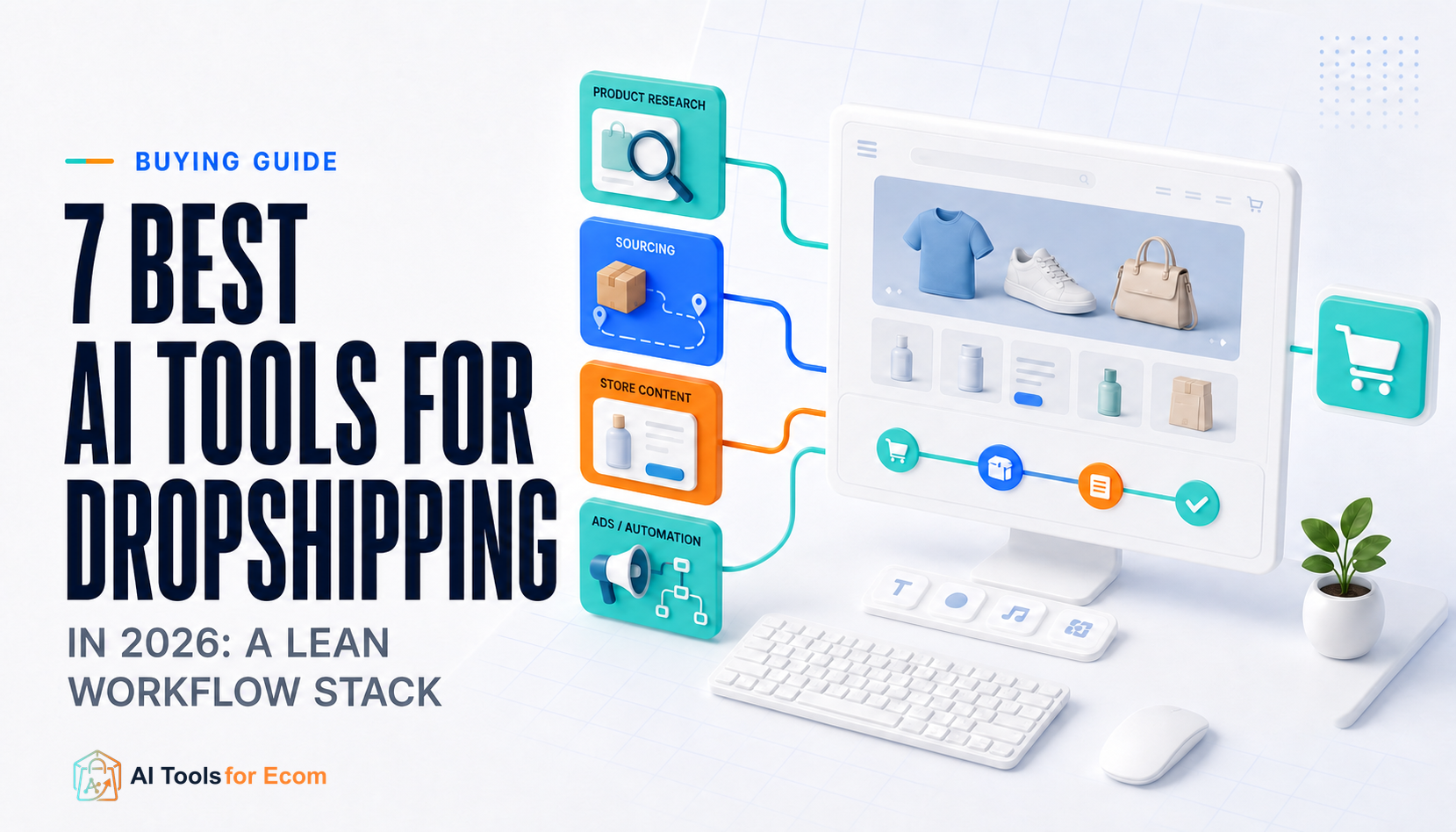
The best AI tools for dropshipping in 2026 do not run a store on autopilot. They help a merchant inspect product signals, organize sourcing, draft content, produce ad variations, answer routine questions, manage retention, and analyze performance. The difficult decisions—choosing a product, checking a supplier, ordering samples, setting margins, approving claims, and resolving exceptions—still belong to people.
Quick answer: use Sell The Trend for structured product-research signals, Zendrop for sourcing and fulfillment operations, Shopify Magic for store-content drafts, Creatify for rapid product-to-ad video concepts, Gorgias AI Agent for governed support automation, Omnisend for accessible ecommerce retention, and Triple Whale when a scaling store needs a more unified analytics layer. This is a workflow menu, not a recommendation to buy all seven.
Best AI Tools for Dropshipping at a Glance
| Workflow | Tool | Best fit | Proof metric |
|---|---|---|---|
| Product research | Sell The Trend | Merchants who need organized product, store, engagement, and trend signals | Products that survive margin, supplier, sample, and demand validation |
| Sourcing and fulfillment | Zendrop | Stores that need a connected catalog, sourcing requests, and order workflow | On-time delivery, defect rate, support burden, and true landed margin |
| Store content | Shopify Magic | Shopify merchants drafting and editing product or store content | Approved drafts, factual corrections, and editing time |
| Ad creative | Creatify | Paid-social teams prototyping product-video angles from URLs and assets | Approved concepts that reach a valid campaign test |
| Customer support | Gorgias AI Agent | Stores with enough ticket volume and reliable policies to automate narrow intents | Non-reopened resolutions, escalation rate, policy errors, and CSAT |
| Email and retention | Omnisend | Small and midsize stores building ecommerce email and SMS workflows | Deliverability, conversion, unsubscribe rate, and incremental revenue |
| Analytics | Triple Whale | Scaling paid-media stores with a repeated cross-channel decision gap | Data reconciliation and decision-cycle time |
The right stack is usually smaller than this table. A first-product test may need a research and sourcing workflow plus the tools already included in Shopify. Support automation and advanced analytics become sensible only when ticket volume, media spend, and decision complexity can justify their cost and setup.
What AI Can—and Cannot—Automate in Dropshipping
AI is useful when the input is available, the output can be reviewed, and a mistake is reversible. It can summarize product and competitor signals, draft a product description from verified specifications, convert a product page into ad concepts, classify routine support questions, propose email variations, and help an analyst investigate a known metric.
That is different from owning the business decision. A product-research score cannot prove demand. A supplier badge cannot replace samples and delivery tests. A generated description cannot establish that a benefit is true. An attribution model cannot prove that one channel caused a sale. Order routing and fulfillment automation may also be conventional software rules rather than AI.
Keep six responsibilities human-owned: supplier diligence, product and claims approval, margin calculations, customer-policy exceptions, advertising budgets, and the decision to stop an unsafe or uneconomic workflow. The best automation narrows repetitive work while making these control points clearer.
How We Selected These Dropshipping AI Tools
Each tool represents one stage of a dropshipping workflow rather than another generic writing assistant. We used seven selection tests:
- Workflow fit: it must solve a recognizable dropshipping bottleneck.
- Operational data: it should connect to useful catalog, supplier, order, customer, ad, or store information.
- Accepted-output rate: success means approved work, not raw generations.
- Human control: approvals, permissions, escalation, and rollback must remain available.
- Total cost: include credits, contacts, tickets, integrations, retries, and staff time.
- Evidence quality: documented capability is different from a vendor’s performance claim.
- Overlap: the tool must do more than a platform the merchant already owns.
Official documentation can verify that a feature exists. It cannot independently establish supplier consistency, creative quality, conversion lift, incremental revenue, or attribution accuracy for a particular store. Those outcomes require a controlled trial with the merchant’s own products and data.
1. Sell The Trend: Best for Structured Product Research
Sell The Trend positions its NEXUS platform around product discovery, store and engagement signals, supplier discovery, importing, store creation, and other dropshipping operations. Its value is organization: a merchant can inspect potential products and related market signals in one workflow instead of moving between disconnected spreadsheets, social feeds, supplier pages, and ad libraries.
Use it to form a research queue, not to outsource product judgment. Take a candidate through a separate validation gate: search demand, competitive saturation, selling price, product cost, realistic shipping expense, refund exposure, payment fees, creative difficulty, compliance risk, and support burden. Then order a sample and test the full purchase experience.
Terms such as “winning product,” predictive scores, datasets, and supplier quality are vendor claims unless independently tested. The useful proof metric is not the number of products discovered. It is the number that survive evidence review, supplier checks, sampling, margin analysis, and a controlled market test.
Confirm current capabilities on the official Sell The Trend platform page.
2. Zendrop: Best for Sourcing and Fulfillment Operations
Zendrop combines a product catalog with sourcing requests, shipping information, orders, fulfillment, and store-related operations. Its documented MCP connection also allows compatible AI assistants to work with supported Zendrop tasks. That makes it more operationally relevant than a general chatbot when a merchant needs current product and order context.
Choose Zendrop when the store needs a more connected path from product selection to sourcing and fulfillment. Before relying on it, verify the actual SKU, variant, packaging, branding options, processing time, destination-specific shipping estimate, tracking behavior, return process, and what happens when inventory or cost changes. Order samples to the markets you plan to serve.
Automation does not transfer responsibility for the customer promise. A merchant still owns the product page, delivery window, refund policy, and response when a parcel is late or the item differs from the listing. Track on-time delivery, defect and reship rates, refund rate, support tickets per order, and true contribution margin after fulfillment problems.
Review the Zendrop MCP documentation and its documented sourcing limitations.
3. Shopify Magic: Best for Store-Content Drafts
Shopify Magic provides AI-assisted features inside Shopify, including product-description generation and other content or media assistance depending on the current feature, language, device, and account. It is the sensible first writing tool for a Shopify dropshipper because it is already close to the catalog workflow and does not require another general-purpose subscription.
Start with verified source material: the supplier specification, a physical sample, packaging, dimensions, materials, compatibility, care instructions, warranty, and delivery conditions. Ask for a draft in the brand’s tone, then compare every sentence with the evidence pack. Replace copied supplier language with original, customer-focused explanations without inventing a benefit.
Shopify explicitly warns that generated descriptions can include benefits or facts that were not supplied. Do not publish medical, performance, safety, environmental, compatibility, scarcity, or shipping claims without evidence. Measure approved drafts, factual corrections, editing time, and returns or customer questions linked to unclear content.
See Shopify’s official product-description guidance.
4. Creatify: Best for Rapid Product-to-Ad Video Prototypes
Creatify turns a product URL or supplied assets into scripts, presenters, voiceovers, and short video-ad concepts. It fits a dropshipping workflow because the product page can become a fast starting input for multiple paid-social angles.
Use that URL as a draft source, not an approved brief. Build a controlled evidence pack containing the exact SKU, approved benefits, offer terms, real product photos or footage, prohibited claims, logo rules, and target placement. Test materially different messages—such as problem–solution, demonstration, objection handling, and offer framing—before multiplying presenters and cosmetic variations.
Review every generated label, quantity, product interaction, demonstration, price, and result. For fit, texture, scale, safety, or physical performance, replace synthetic proof with verified footage. Measure approved concepts that reach a valid media test, correction time, product-fidelity failures, CTR, landing-page conversion, and contribution-margin CPA. Generation speed and vendor conversion claims are not independent evidence of campaign performance.
Confirm current functions through the official features page and URL-to-video documentation. Browse more AI ad creative tools.
5. Gorgias AI Agent: Best for Governed Support Automation
Gorgias documents an AI Agent for selected pre- and post-purchase conversations, Shopify and order context, supported actions, and human handoff. It can fit a dropshipping store when ticket volume is large enough and the business has accurate product data, shipping rules, returns guidance, and an escalation owner.
Begin with narrow, low-risk intents such as order-status questions, published policy explanations, and common product information. Require human review for exceptional refunds, address changes near fulfillment, chargebacks, safety concerns, legal complaints, high-value orders, repeated delivery failures, and any request that conflicts with policy or available data.
Do not optimize only for automation rate. Track non-reopened resolutions, escalation rate, incorrect promises, policy errors, CSAT, refunds, and total cost per resolved interaction. Test the knowledge base with outdated, conflicting, and incomplete information before expanding the agent’s authority.
Read the official Gorgias AI Agent documentation.
6. Omnisend: Best for an Accessible Retention Workflow
Omnisend combines ecommerce email and SMS automation with AI-assisted content, subject lines, segmentation, and recommendations. It is a practical fit for a small or midsize dropshipping store that has moved beyond one-off campaigns and needs a manageable lifecycle system.
Start with a limited set of flows: welcome, browse or cart recovery, post-purchase education, review or feedback requests, replenishment where the product supports it, and win-back. Define consent, triggers, exclusions, delays, frequency caps, market rules, offer terms, and stop conditions before generating message variations.
AI does not fix a weak offer, poor deliverability, unreliable order events, or excessive message frequency. Measure deliverability, click and conversion behavior, unsubscribe and complaint rates, customer-service impact, and incremental revenue using holdouts where practical. Platform-attributed revenue is not automatically causal proof.
Compare Klaviyo vs Omnisend for Shopify when the store is deciding between an accessible starting workflow and deeper lifecycle complexity. Confirm current AI features on the official Omnisend AI page.
7. Triple Whale: Best for Scaling Cross-Channel Analytics
Triple Whale brings ecommerce and marketing data into shared reporting, attribution, customer, and AI-assisted analysis workflows. It belongs in a lean dropshipping stack only when a recurring decision cannot be answered reliably from Shopify, finance records, ad platforms, and the existing analytics setup.
Define the decision before buying the dashboard. Examples include daily budget pacing across channels, contribution margin after fulfillment and refunds, creative analysis, repeat purchase, and executive reporting. Reconcile a sample period against source systems and document the metric definitions before allowing the platform to guide spend.
Attribution is a model rather than causal proof, and AI summaries inherit errors in source data and definitions. Track reconciliation differences, time to investigate a question, actions taken, and whether the operating decision improves. A dashboard that adds another version of revenue without changing a repeated decision is overlap, not leverage.
Read our Triple Whale vs Polar Analytics comparison or browse AI analytics tools. Confirm the current product on the official Triple Whale site.
Three Lean AI Stacks for Dropshipping
Testing a first product
Use one research workflow, one sourcing workflow, and the native capabilities already included in Shopify. Validate the sample, economics, delivery, customer promise, and demand before adding support automation or advanced analytics. A paid creative tool is optional until the offer has a controlled testing plan.
Store building repeat sales
Keep the sourcing workflow, add Omnisend for a small set of governed lifecycle flows, and use Creatify only when creative throughput is limiting valid tests. Standardize policies and product data before automating support. Remove any general AI subscription that duplicates accepted work already produced by Shopify or another owned platform.
Scaling paid-social operation
Add Gorgias when ticket volume supports a measured support case, and consider Triple Whale when channel complexity creates a documented decision gap. At this stage, supplier redundancy, inventory and price monitoring, contribution margin, rights management, creative approvals, and data definitions matter more than generating more content.
A 30-Day Evaluation Plan
- Week 1—Baseline: choose one bottleneck and record current time, cost, error rate, accepted output, and business outcome.
- Week 2—Controlled trial: use one real product, fixed source data, a defined owner, and an explicit approval checklist.
- Week 3—Production evidence: publish or operate only approved outputs; track corrections, exceptions, customer impact, and staff time.
- Week 4—Keep, change, or cancel: compare total work and outcome with the baseline. Document permissions, review gates, integrations, export needs, and stop conditions before scaling.
A tool earns a permanent place when it reduces total work or improves a repeated decision without creating unacceptable product, supplier, customer, financial, data, or legal risk.
Frequently Asked Questions
Can AI fully automate a dropshipping business?
No. AI can accelerate analysis, drafting, creative production, support, and selected actions. Humans remain responsible for product choice, supplier checks, samples, margins, claims, policies, budgets, exceptions, customer promises, and the decision to stop automation.
Can ChatGPT find a winning dropshipping product?
It can help organize research and questions, but it cannot prove that a product will sell profitably. Demand, competition, supplier performance, landed cost, refunds, advertising economics, and creative execution require current evidence and testing.
What is the best free AI tool for dropshipping?
For a Shopify merchant, start with relevant Shopify Magic features already available in the platform. Free vendor tiers can help test a workflow, but limits, watermarks, credits, exports, data access, and commercial terms may differ from production use.
How many AI tools does a beginner need?
Usually fewer than a roundup suggests. Begin with the platform’s native tools and one solution for the current bottleneck. Add another only after the first has an owner, a proof metric, and a documented gap it cannot solve.
Is AI dropshipping profitable?
AI does not determine profitability. Profit depends on product demand, selling price, landed cost, returns, payment and platform fees, advertising, support, taxes, and operational discipline. Use contribution margin and cash flow rather than generated-content volume as the decision standard.
Build the Stack Around the Bottleneck
The best dropshipping stack is not the one with the most automation. It is the smallest system that helps the team make a better product, supplier, creative, customer, or budget decision. Start with the bottleneck, define the evidence and owner, test one tool, and remove overlap before adding the next.
For a broader view across established ecommerce workflows, read our best AI tools for ecommerce guide. You can also explore the AI tools directory by workflow.
Editorial method: This is a workflow-based selection guide, not a sponsored universal ranking or a claim that every tool was tested under identical production conditions. Official documentation establishes described capabilities and limitations; vendor statements about data, suppliers, quality, savings, and performance were not treated as independent proof. Last reviewed: August 2026. Verify current features, integrations, limits, pricing, rights, and policies before purchase or publication.