
What is Algolia?
Algolia is a hosted search and retrieval platform used to build fast search, browse, recommendation, personalization, analytics, and merchandising experiences. Ecommerce teams can index catalog records, configure relevance, collect search events, analyze shopper behavior, and create product-discovery interfaces through APIs and user-interface libraries.
The platform supports both keyword search and AI-enhanced capabilities. Higher plans add functions such as AI ranking, AI synonyms, advanced personalization, NeuralSearch, collections, and larger rule limits.
Quick Verdict
Algolia is best for a team that wants flexible search infrastructure and has the technical ownership to manage catalog ingestion, events, relevance, frontend components, and monitoring. It is not a plug-and-forget conversion tool: implementation quality and merchandising decisions determine whether the search experience improves.
Key Features
- Search APIs: Build responsive search and browse experiences across product and content indexes.
- Relevance controls: Configure ranking, synonyms, typo tolerance, filters, facets, query rules, and promotions.
- AI Search: Add AI-assisted ranking, categorization, personalization, semantic retrieval, and other plan-dependent capabilities.
- Recommendations: Serve related, trending, frequently bought together, and other recommendation types.
- Merchandising: Pin, boost, bury, filter, or promote selected results and categories.
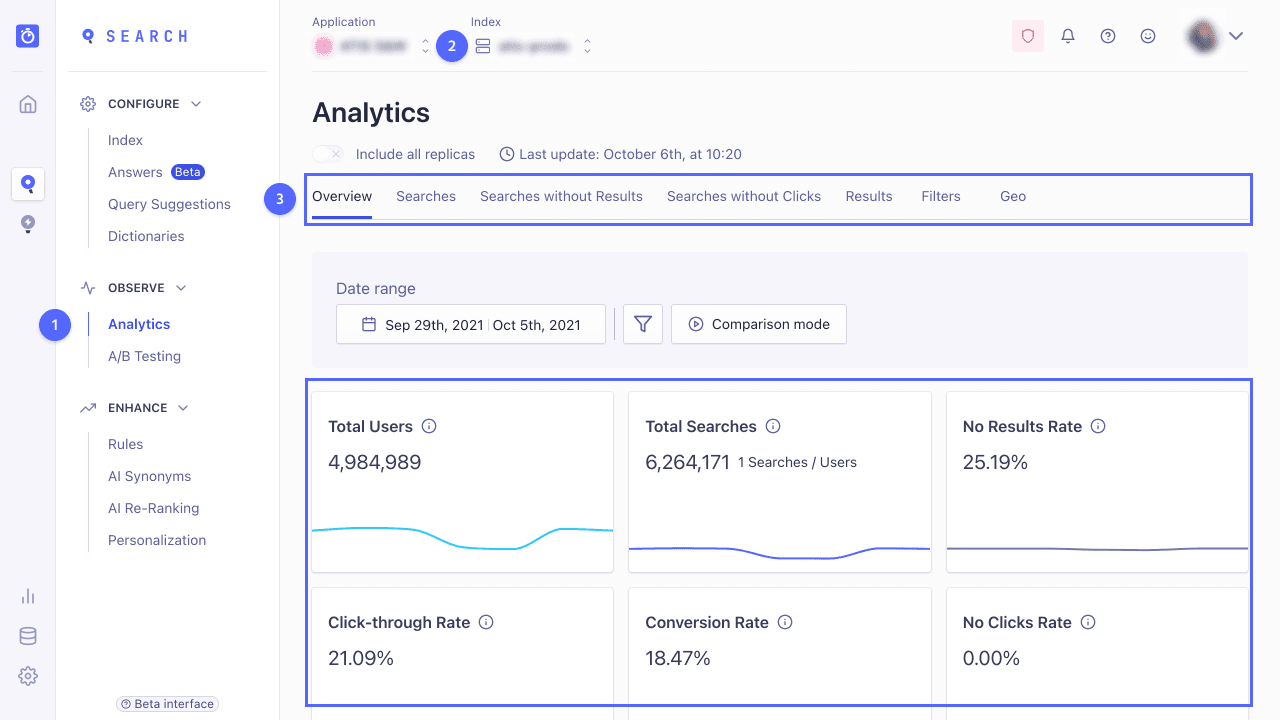
- Analytics and experiments: Track searches, clicks, conversions, no-result queries, and controlled changes.
- Developer tools: Use SDKs, UI libraries, connectors, and APIs to integrate the search experience.
Ecommerce Use Cases
- Create autocomplete and search-results pages for a large product catalog.
- Improve synonym, typo, category, filter, and zero-result handling.
- Merchandise seasonal products without rewriting the storefront.
- Build product recommendations from catalog and behavioral events.
- Measure search-to-product-view, add-to-cart, and purchase behavior.
Implementation Check
Define a catalog contract before indexing: stable object IDs, parent and variant logic, prices, inventory, locale, permissions, category hierarchy, and update frequency. Then define an event contract for query, click, conversion, add-to-cart, and purchase events. Missing or inconsistent events will weaken analytics and AI-assisted ranking.
Create a benchmark query set covering top revenue queries, long-tail requests, misspellings, attributes, SKU searches, zero-result queries, and policy-sensitive products. Review relevance with merchandisers and developers before measuring commercial outcomes.
Best For
Ecommerce teams that need customizable, API-first product search and have engineering or implementation resources to own the experience.
Advantages and Limitations
Advantages
- Flexible APIs, libraries, and relevance controls.
- Free and usage-based paths allow controlled prototyping.
- Supports search, recommendations, personalization, analytics, and merchandising.
- Can serve complex catalogs and custom storefronts.
Considerations
- Requires catalog, event, frontend, and relevance implementation.
- Usage costs can grow with records, searches, recommendations, and additional products.
- Advanced AI features vary by plan.
- Vendor performance claims do not substitute for a store-specific relevance test.
Pricing
Algolia currently offers a Free plan with 10,000 search requests, 50,000 records, 5,000 recommendation requests, and 5,000 crawls per month. Grow and Grow Plus include free usage allowances and then charge for additional requests and records. Elevate is an annual enterprise plan with custom volume and AI-search capabilities.
Our Take
Use the free tier to validate ingestion, search quality, event accuracy, and operational ownership before enabling expensive features. The first success metric should be fewer failed searches and better relevance on important queries, not a generic claim that AI search increases conversion.
Primary Official Sources
Search and pricing scope were checked against the official Algolia website, AI Search page, ecommerce search documentation, and pricing page.
Algolia Alternatives
Bloomreach offers a more sales-assisted commerce-search and personalization platform. Compare implementation control, merchandising workflow, catalog scale, contract model, and internal technical resources.
Related Guide
Compare different search architectures in our guide to the best AI search tools for ecommerce.
Frequently Asked Questions
Does Algolia have a free plan?
Yes. The current Free plan includes defined monthly limits for search requests, records, recommendations, and crawls.
Is Algolia a Shopify app?
Algolia is primarily a search platform and API service. Ecommerce integrations exist, but the exact implementation depends on the storefront and catalog architecture.
Does Algolia include semantic search?
Semantic and neural search capabilities are available in selected AI-search plans. Confirm eligibility and usage terms before choosing a tier.
Editorial method: This independent profile maps current provider documentation to ecommerce operating decisions. Official pages establish documented features, integrations, pricing mechanisms, and limits; vendor performance statements are not treated as independent proof. We did not conduct or claim a controlled hands-on test, and this is not a sponsored ranking. Last reviewed: September 2026. Recheck plans, allowances, integrations, data terms, and implementation requirements before purchase.