
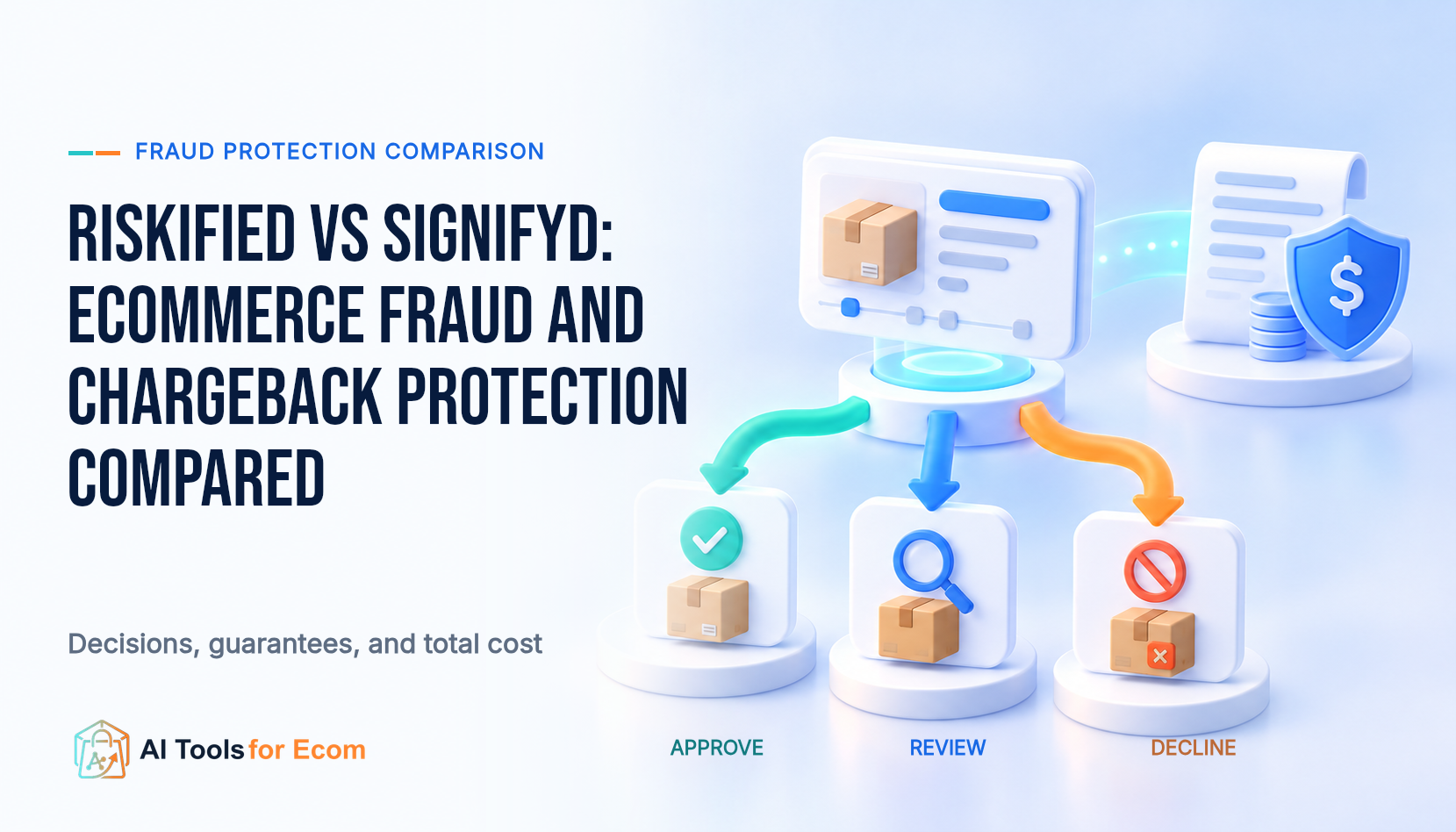
Riskified and Signifyd both offer automated fraud decisions backed by financial protection for qualifying orders. The useful comparison is not which vendor promises a higher approval rate. It is which transactions each proposed product will decide, which losses the signed agreement will cover, and what happens to legitimate customers the system declines. Riskified's Chargeback Guarantee is a starting point for a merchant seeking fraud decisioning and an eligible fraud-chargeback liability shift. Signifyd's Guaranteed Fraud Protection addresses a similar job; its broader chargeback-protection products must be scoped separately. Neither name alone tells you that every dispute, payment method, order type, or market is covered.
If you are buying for a Shopify or multichannel store, ask both vendors to evaluate the same order population, document the proposed integration, and quote the same coverage and reporting requirements. Keep your existing process if neither proposal can demonstrate a better outcome after fees, false declines, operational work, and uncovered losses. This is a procurement framework, not a head-to-head performance test: ATFE has not run these platforms on a merchant's orders.
For a broad market map, see our ecommerce fraud prevention tools guide. This page stays with the narrower Riskified-versus-Signifyd decision. If your main problem is collecting evidence and contesting already filed disputes, start with our chargeback management software guide instead of assuming a checkout guarantee solves representment.
Quick Answer: Which Proposal Should You Examine First?
| Your actual decision | Examine first | What would change the answer |
|---|---|---|
| You need an approve-or-decline decision and eligible fraud-chargeback protection | Compare Riskified Chargeback Guarantee with Signifyd Guaranteed Fraud Protection | Normalize eligible orders, decision ownership, false declines, fees, exclusions, and reimbursement terms in both written proposals. |
| Your losses include item-not-received or other non-fraud dispute reasons | Ask Signifyd to quote the specific broader coverage product; ask Riskified what separate dispute or abuse products would do | Do not treat a fraud-only guarantee or dispute-recovery service as an identical liability shift. Check reason codes, geography, payment method, and the signed contract. |
| Your team needs order-decision control, borderline-order verification, or a custom checkout route | Ask both vendors to demonstrate the exact control and fallback path; inspect Riskified's documented Recover and API routes | A product-page capability is not proof that the proposed package, integration, or operating model includes it. |
| You primarily need post-transaction evidence gathering and representment | Evaluate the distinct dispute-management workflow, not just either guarantee | A recovered dispute, a reimbursed guaranteed loss, and an avoided dispute are different financial outcomes. |
| Your fraud volume is modest and the current process is measurable | Keep the incumbent process while testing whether an added vendor clears a defined economic threshold | The integration, data-governance, contract, and review burden may outweigh covered losses. |
These are ATFE editorial starting points, not product rankings. Riskified describes Chargeback Guarantee and integration routes; Signifyd describes Guaranteed Fraud Protection, configurable coverage and pricing, and Complete Chargeback Protection. Public descriptions establish products to investigate, not the terms of your agreement.
Compare the Purchased Product, Not the Brand Name
The two vendors sell more than one risk or dispute product. A buyer can get a misleading comparison by putting a Riskified Chargeback Guarantee quote next to a Signifyd quote that also includes non-fraud chargeback protection, or by assuming a separate recovery module is included in the base fraud price.
Riskified's Chargeback Guarantee onboarding guide describes an order-review decision on whether to fulfill and an implementation path through Shopify or an API. Its product page describes payment for approved orders and places Recover alongside the guarantee. Riskified's separate Dispute Resolve onboarding page describes chargeback management for orders outside the Chargeback Guarantee. That distinction matters: handling a dispute is not automatically the same as accepting liability for it.
Signifyd's Guaranteed Fraud Protection page describes automated checkout decisions and reimbursement for fraudulent chargebacks on guaranteed approved orders. Its pricing page says the financial guarantee can range from fraud-only protection to a broader chargeback liability shift. The Complete Chargeback Protection page lists fraud and non-fraud reasons, including item-not-received and significantly-not-as-described. A separate UK and Europe product page frames parts of the coverage around regional payment conditions. Do not assume the broader page applies to your market or that its marketing list overrides the actual order form, coverage policy, and exclusions.
| Scope to put on the proposal | Riskified question | Signifyd question |
|---|---|---|
| Checkout decision | Which orders receive a final guarantee decision, and who can override or route a borderline case? | Which orders receive a Guaranteed Fraud Protection decision, and how are merchant thresholds or overrides handled? |
| Fraud-chargeback liability | Which approved orders and fraud reason codes qualify, and what event cancels coverage? | Which guaranteed approvals qualify under the purchased fraud-protection product, and what event changes coverage? |
| Non-fraud chargebacks | Is a separate product proposed, and does it reimburse losses or manage disputes? | Is broader protection actually included, for which reasons and markets, or is this a fraud-only quote? |
| Filed-dispute operations | Is Dispute Resolve included, excluded, or separately priced? | Is Chargeback Recovery or another dispute service included, excluded, or separately priced? |
| Billing and reporting | Which approved-order, minimum, cancellation, and other fees appear on the quote and invoice? | What percentage applies to which approved order value, and how do refunds and cancellations affect fees and coverage? |
Do not infer legal enforceability or regulatory compliance from this table. Have the people responsible for procurement and risk read the actual agreement and applicable coverage terms. If two official Signifyd pages describe a broad product differently, ask the vendor which product and regional policy govern your proposal rather than silently choosing the wider wording.
Order Decisioning, Review, and False Declines
Both offerings ask merchants to trust a vendor decision at a consequential moment: before an order is fulfilled. That can save manual review, but a fraudulent order approved and a genuine customer rejected have different costs. Neither a high vendor approval percentage nor a low chargeback percentage proves that the merchant's total risk cost improved. A vendor may also be evaluating a different order population than the incumbent team.
Request the decision record for every submitted order: input time, decision time, order and payment state, reason or review route where available, merchant action, later dispute, and coverage status. Riskified's onboarding documentation says its Shopify integration begins receiving order data after installation; its API guide documents post-decision actions. Signifyd describes real-time accept/reject decisions and configurable approval logic on its fraud-protection page. These are vendor-documented capabilities. The real test is whether each proposed implementation can export enough information for your team to reconcile decisions with payment authorization, fulfillment, refunds, and later disputes.
Pay special attention to three groups of orders:
- Borderline but legitimate customers. Track declined orders later confirmed legitimate, especially new customers, international buyers, gifts, high-value baskets, and fast-shipping requests. Riskified presents Recover as a way to verify borderline orders. Signifyd's pricing page says merchants can resubmit a declined order with additional information for Expert Re-review by a fraud expert. These are vendor-described review paths, not technically equivalent services. For each proposed package, confirm eligibility, who can request a review, response time, any added cost, the final decision, and any effect on guarantee coverage.
- Orders outside the guarantee. An order can be screened yet not covered because of product, payment method, geography, submission timing, merchant override, cancellation, or another contractual condition. Ask for an exportable coverage flag and the precise reason for ineligibility.
- Orders affected by a later merchant action. Refunds, cancellations, address changes, partial shipments, and modified order values can change a fee or guarantee. Riskified's API integration guide describes guarantee cancellation for a full-refund/cancel action and fee adjustment after a partial refund. Signifyd's guarantee-cancellation documentation and returns overview describe post-sale actions that can reduce the guarantee amount and create an invoice credit. The cancellation guide separately says full or partial cancellations typically do not affect chargeback claim eligibility. Do not equate a guarantee-amount or billing adjustment with automatic loss of every chargeback claim. Verify the purchased service's rules and event handling; do not let an integration silently omit these events.
A rejected order's eventual outcome may be unobservable: the customer may never appeal or buy again. Appeals, manual reviews, and subsequent purchases can help identify possible legitimate declines, but none proves that every rejected customer would have completed the original purchase. Report confirmed legitimate declines separately from explicitly labeled estimates or ranges for uncertain lost sales; do not treat a vendor's approval-rate claim as an independently measured false-decline result.
The merchant also needs a failure policy. What happens if an API call times out, an order is duplicated, a payment authorizes after a decision, or a warehouse releases an order before a result arrives? Test the fallback in staging and assign an owner. “Fast decisions” on a product page cannot substitute for an agreed latency budget and a safe order-state machine.
What Does the Guarantee Actually Transfer?
A guarantee is a defined financial arrangement, not a promise that the merchant never sees another chargeback. Riskified's chargeback-guarantee explanation describes reimbursement for approved card-not-present orders that become fraud chargebacks. Signifyd's Guaranteed Fraud Protection describes reimbursement for fraudulent chargebacks on guaranteed approved orders. Signifyd also markets broader protection under a separately scoped Complete Chargeback Protection offering. None of these public pages is your complete coverage schedule.

Before treating a loss as transferred, ask for a written answer to each of these questions:
- Which legal entity, store, territory, currency, channel, product type, and payment method are in scope?
- Which dispute reason codes are covered, and how are fraud, item-not-received, canceled-merchandise, processing-error, and return-abuse claims handled?
- Must the vendor approve the order, must the merchant follow the decision, and what happens after an override or a manual fulfillment decision?
- What evidence, submission deadline, order-status updates, tracking details, and refund notifications are required?
- Is reimbursement the transaction amount only, or are shipping, taxes, processor penalties, dispute fees, and other costs treated differently?
- How is reimbursement paid or credited, when, and how are denials or disagreements escalated?
- Are chargebacks on previously refunded, partially fulfilled, or canceled orders still eligible?
This is a contract-review checklist, not legal advice. An apparently broad public statement can narrow materially in an order form or coverage policy. Do not turn vendor marketing such as “100% protection” into an ATFE assertion that every loss is reimbursed.
Integration and Data Responsibilities
Riskified documents a Shopify integration and API route. Signifyd's pricing and integration overview lists commerce-platform, payment, and API/SDK routes. The existence of an integration is not proof that both vendors receive the same event set, make a decision at the same point in your checkout, or reconcile a dispute against the same order identifier.
Have each vendor diagram your specific order path: checkout, authorization, fraud submission, decision, capture, fulfillment, changes, refund, dispute, and claim. Ask which system is the source of truth at each step, which webhook or batch job updates coverage, and whether a failed message can be replayed without charging or deciding the order twice. For a Shopify store, test draft orders, payment methods, partial fulfillments, cancellations, and any third-party checkout route that matters to your business rather than accepting “Shopify supported” as sufficient.
Both products process order and customer-related signals to make decisions. Read the current data-access documentation and your proposed data-processing terms. Do not infer that a guarantee removes the merchant's privacy, security, retention, or customer-service responsibilities. This guide does not certify either vendor's compliance or security posture.
For more product-level context, see the ATFE profiles for Riskified and Signifyd. The profiles are not substitutes for the current contract and integration review.
Compare Total Economics on the Same Order Population
Neither vendor publishes a universal price that can be placed in a reliable side-by-side price table. Signifyd says its fee is a percentage of approved order value and varies with the purchased products and merchant profile. Riskified's billing guide describes approved-order fees and other line items that depend on the contract. Request written quotes for the same stores, order population, forecast period, coverage scope, and integration assumptions.
Use a reader-fillable worksheet, not a vendor's selected approval-rate slide:
| Measure for one agreed period | Current process | Riskified proposal | Signifyd proposal |
|---|---|---|---|
| Submitted and eligible orders, by payment method and market | Fill in | Fill in | Fill in |
| Approved, declined, challenged, and manually reviewed orders | Fill in | Fill in | Fill in |
| Confirmed fraudulent orders approved; confirmed legitimate orders declined; uncertain cases separately | Fill in | Fill in | Fill in |
| Fraud and non-fraud disputes, split by reason code | Fill in | Fill in | Fill in |
| Covered losses actually reimbursed; uncovered losses | Fill in | Fill in | Fill in |
| Vendor fees, minimums, cancellation fees, and implementation cost | Fill in | Fill in | Fill in |
| Manual-review hours, customer-service contacts, and operational exceptions | Fill in | Fill in | Fill in |
| Contribution margin on legitimate orders retained or lost | Fill in | Fill in | Fill in |
The rows are blank reader-fillable template fields, not real merchant data or ATFE test results. Segment each output by geography, payment method, new versus returning customers, and order-value band. Report the denominator: “approval rate on submitted orders” and “approval rate on orders the vendor considered eligible” are not interchangeable. If the vendor excludes a difficult segment, preserve that segment in the total-cost comparison.
Use the current process as the baseline for the same order population and evaluation period. Define net fraud and chargeback losses consistently for each option as the fraudulent or disputed transaction principal ultimately borne by the merchant after actual guarantee reimbursements and successful dispute recoveries. Track vendor fees, review/dispute labor, implementation, and other operating costs separately; place any processor or dispute fee in only one cost category.
An incremental comparison is: net incremental value versus the current process = change in contribution margin from legitimate orders + reduction in net fraud and chargeback losses − change in vendor fees − change in implementation and operating costs. For legitimate orders, include the margin from additional good orders retained and subtract the margin from additional good orders declined; do not count the same order twice. Operating costs include manual review, dispute work, customer support, and implementation, each recorded once. Each change is the proposal's difference from the baseline, not a standalone proposal total. This is an ATFE evaluation model, not a forecast or vendor pricing formula. Use observed financial outcomes where available; label uncertain false-decline losses and other unobserved outcomes as estimates or ranges, and leave unknowns visible. A reimbursement or recovered dispute enters the net-loss calculation once, not again as a separate benefit. Do not put the same fee or labor expense in two categories.

A 30-Day Evaluation Without Claiming a Head-to-Head Test
The following process is for a merchant to run. ATFE has not run it for Riskified or Signifyd.
Days 1–7: freeze the baseline and contract scope. Define the order population, fraud definition, confirmed-good order definition, dispute reasons, time window, contribution-margin method, and current manual-review policy. Reconcile order, authorization, fulfillment, refund, and dispute identifiers. Have each vendor mark the proposed covered and excluded segments in writing. If you cannot tie historical decisions to final outcomes, record that limitation rather than label disputed orders as proven fraud or every decline as a lost legitimate sale.
Days 8–14: conduct an authorized historical replay or shadow comparison. Give both vendors the same eligible data under approved privacy and contract controls. Ask them to return decisions, timing, coverage status, and missing-data flags without changing checkout. Keep final historical outcomes hidden from the evaluators until decisions are logged. Do not send unnecessary customer data to a sales demo or imply historical replay proves live causality.
Days 15–21: simulate operations. Test timeouts, duplicate submissions, cancellations, partial refunds, manual overrides, appeal paths, disputes, and reimbursement evidence. Confirm the warehouse does not release an order while the state is unresolved. Price the work needed to maintain each integration and identify who can disable it safely.
Days 22–30: consider a narrow, reversible live pilot only if permitted. Predefine eligibility, control assignment, stop conditions, order-value caps, decision latency, fraud-loss tolerance, and a customer-appeal route. Do not let both services issue conflicting production decisions on the same order. A vendor-reported uplift is not independent causal evidence; compare outcomes against a suitable merchant-controlled baseline and wait for the relevant disputes to mature before claiming a durable financial result.
At the end, preserve an explicit keep-current-process option. A prospective product can have a larger feature list and still be the wrong choice if its covered population is too narrow, its false declines are expensive, or its operating burden exceeds the value of transferred risk.
Questions to Ask Both Vendors Before Signing
- Which precise product and modules are in this proposal, and which ones shown in the demo are excluded?
- Which orders receive a decision, which are contractually guaranteed, and which are merely scored or sent to review?
- Which payment methods, countries, product classes, dispute reasons, merchant actions, and late events change eligibility?
- Can we export every decision, coverage flag, reimbursement, denial reason, and fee at order level for our own reconciliation?
- How are legitimate declines appealed, and can our team verify the result without voiding protection?
- What are the timeout, retry, duplication, manual-override, and fallback policies?
- What fees apply to approvals, cancellations, minimums, extra products, implementation, support, and renewal?
- Who collects and submits evidence for a filed dispute, and is that a separate service from the guarantee?
- Which historical data and configuration can be exported if we leave, and what does a safe rollback cost?
Do not let either vendor answer with a generic customer case study. Ask for a contract exhibit and a demonstration on the merchant's own allowed order states and operational edge cases.
Frequently Asked Questions
Does either vendor cover every chargeback?
Do not assume so. Each guarantee applies to defined products, qualifying orders, reasons, and contractual conditions. Signifyd markets products with different fraud-only and broader scopes; Riskified describes a fraud-focused Chargeback Guarantee and separate dispute operations. Read the applicable order form and coverage policy rather than treating a marketing headline as the complete term.
Is Signifyd's broader chargeback protection the same as Guaranteed Fraud Protection?
No. Signifyd's pricing page describes a configurable range from fraud-only protection to a broader shift, and its Complete Chargeback Protection page lists non-fraud reasons. Which product, territory, and exclusions are in a given quote must be confirmed in writing.
Is Riskified Dispute Resolve included in Chargeback Guarantee?
Do not assume that. Riskified's Dispute Resolve documentation describes chargeback management for orders outside Chargeback Guarantee. Ask whether it is included, separate, or unnecessary for your proposed scope.
Which vendor is cheaper?
There is no defensible universal answer from public pages. Compare written quotes on the same eligible order volume, approval mix, coverage, minimums, reimbursements, and implementation requirements. A lower fee percentage can be more expensive if it produces additional good-order declines or leaves material losses uncovered.
Did ATFE test Riskified and Signifyd head to head?
No. This article synthesizes official product and technical information into a merchant-run evaluation. It does not report controlled testing, merchant outcomes, negotiated contracts, or independent validation of vendor performance claims.
Editorial Methodology
ATFE selected this two-vendor comparison because both vendors document automated ecommerce fraud decisions with a financial guarantee, while merchants must separately resolve coverage, decision control, integration, and total economics. Sources are official product pages, help centers, developer documentation, and pricing explanations. Product capabilities are attributed to vendors; the decision framework and worksheet are ATFE editorial analysis. No controlled comparative hands-on test was performed, and vendor case-study results were not used as independent evidence. Public terms and modules can change. Fact-checked Oct 2026.