
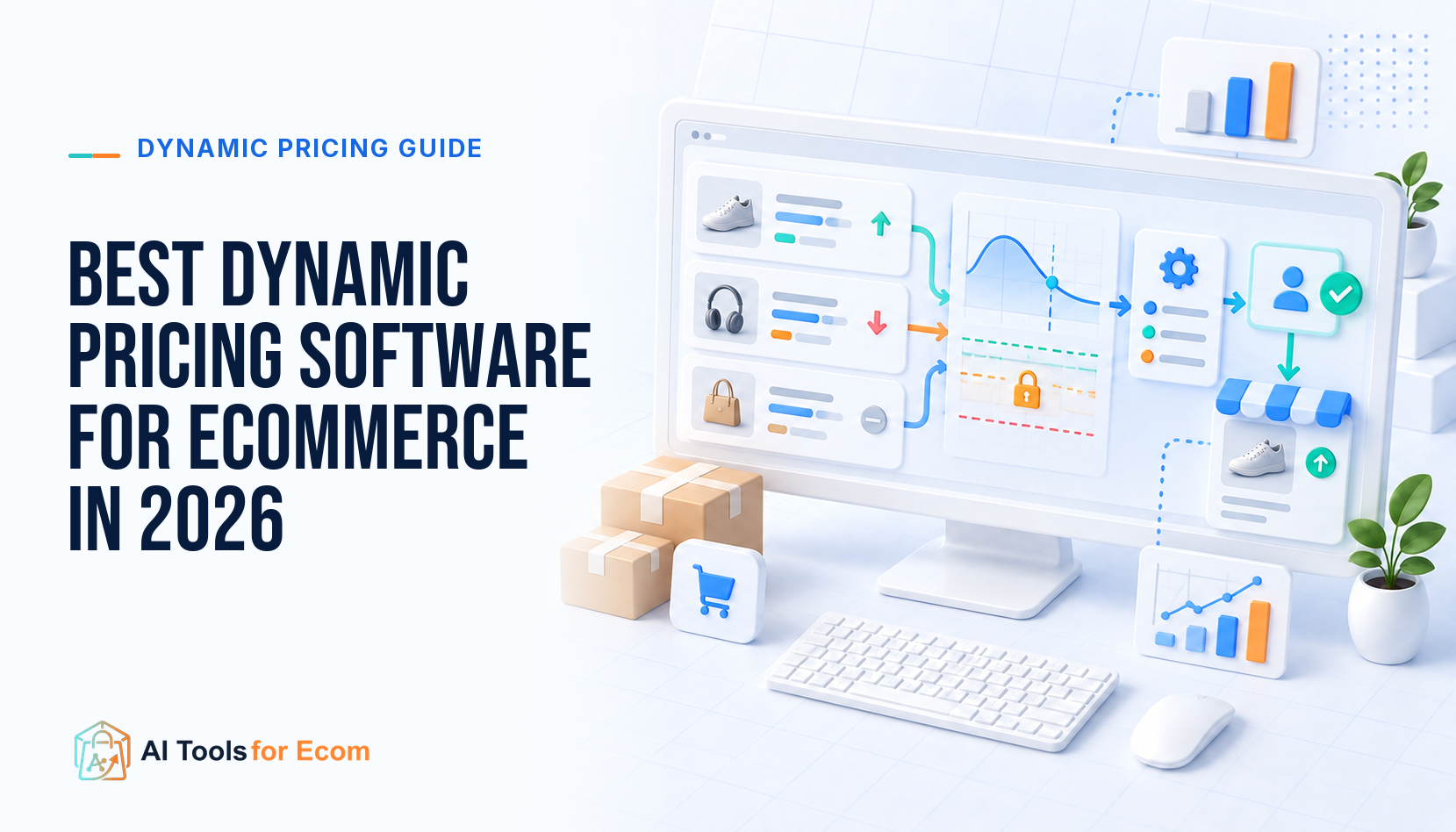
The best dynamic pricing software depends on the pricing job. Choose Prisync for competitor monitoring and rules-based repricing, especially in a Shopify workflow. Use Intelligems when a Shopify brand needs controlled price, discount, subscription, or offer experiments. Evaluate BlackCurve for competitor-led pricing workflows across commerce platforms. Larger retailers can consider Omnia Retail, while enterprise teams with broader price-management requirements may evaluate Pricefx or Zilliant.
Direct answer: competitor repricing, demand-based optimization, and randomized price testing solve different problems. Never enable automatic price publishing until cost floors, channel consistency, approvals, monitoring, and rollback have passed a shadow-mode evaluation.
Quick Answer by Pricing Job
| Pricing job | Best starting option | Critical check |
|---|---|---|
| Track competitors and apply rules | Prisync | Product matching, stock status, cost floors, update cadence, and Shopify automation |
| Run Shopify price and offer experiments | Intelligems | Implementation method, channel prices, QA, sample size, and profit metric |
| Combine market monitoring with pricing workflow | BlackCurve | Current integrations, package boundaries, and recommendation controls |
| Retail pricing automation and market intelligence | Omnia Retail | Data readiness, implementation, governance, and quote scope |
| Enterprise price management and optimization | Pricefx or Zilliant | Ecommerce fit, required data, ownership, explainability, and operating burden |
Four Types of Ecommerce Pricing Software
Monitoring collects comparable competitor prices and availability. Rules-based repricing changes or recommends prices according to explicit conditions. Optimization estimates a price using demand, elasticity, inventory, cost, and other inputs. Experimentation assigns visitors or markets to controlled price experiences and measures outcomes. One vendor may offer several types, but a feature label does not make the methods equivalent.
A merchant that wants to remain five percent below an in-stock competitor needs matching and rules. A merchant asking whether $48 or $52 produces more profit needs a valid experiment. A large catalog balancing markdowns and inventory may need optimization. State the decision first.
Prisync: Best for Monitoring and Rule-Based Repricing
Verified fact: Prisync’s official help center describes Dynamic Pricing as rule-based SmartPrice suggestions using market prices, product cost, and markup. Shopify merchants can enable automated repricing, while other ecommerce setups can use an API. This is an operational repricing workflow, not proof that a particular rule improves profit. Amazon-focused merchants should compare this approach with the native pricing layer described in our Amazon seller tools guide.
Test matching accuracy before automation. Different pack sizes, currencies, shipping, taxes, coupons, subscriptions, marketplace sellers, and out-of-stock competitors can make two visible prices incomparable. Use absolute margin floors, minimum advertised price requirements where applicable, exclusions for launches and prestige items, maximum change limits, and an approval step for exceptions.
Intelligems: Best for Shopify Price Experiments
Verified fact: Intelligems documents tests for product prices, subscriptions, discounts, and offers on Shopify. Its price-testing documentation explains test groups and traffic allocation, and its current implementation can use Shopify Cart Transform Functions, Checkout Scripts in older eligible setups, or duplicate products in certain cases. The provider’s FAQ says Shopify prices may be set to the highest test price so connected channels do not advertise a lower price than a shopper later encounters.
That implementation detail affects Google Shopping, social shops, marketplaces, email feeds, subscriptions, bundles, and customer support. Follow the official price-test QA checklist, place test orders, check mobile, carts, checkout, payment plans, shipping, line-item properties, and refill prices. Profit per visitor is usually more useful than conversion alone because higher conversion at a lower price can reduce profit.
Vendor claim: Intelligems markets price testing as a way to find prices that improve business outcomes. Treat any lift as store-specific; test design, traffic, seasonality, channel effects, and implementation quality determine whether the estimate is reliable.
BlackCurve, Omnia, Pricefx, and Zilliant
BlackCurve belongs on a shortlist when competitor data and ecommerce pricing actions need to sit in one workflow. Omnia Retail is positioned toward retail price monitoring and automation. Pricefx and Zilliant address broader enterprise price management and optimization. These are not simply more powerful versions of a small Shopify repricer: they can require data engineering, governance, training, and organizational ownership.
Editorial judgment: an enterprise platform is justified only when catalog scale, price complexity, channel count, and decision value exceed the implementation burden. Require a precise statement of which prices are recommendations, which can be published, which inputs drive them, and who is responsible when an input is wrong.
The 30-Day Shadow-Mode Test
Run a 30-day shadow-mode evaluation on a limited catalog without publishing recommendations. Select stable, seasonal, high-margin, low-margin, price-sensitive, brand-sensitive, and low-traffic products. Each day, record the current price, proposed price, product cost, margin floor, competitor price and availability, inventory position, promotion status, conversion, returns, and the rule or model reason.
Classify every recommendation as acceptable, repairable, rejected, or impossible to judge. Document why. At the end, estimate the effect under several demand assumptions; do not pretend the unimplemented price caused observed sales. Only move to a guarded live pilot when matching accuracy and rule compliance meet the preset threshold.
Separate Repricing Logic From Experimental Evidence
A repricing rule can be internally correct and still be a poor business policy. For example, “beat the lowest in-stock competitor by two percent” may execute perfectly while starting a margin race, following an unauthorized seller, or reacting to a clearance event. Review the source competitor, comparable pack size, shipping promise, seller quality, and availability before the rule is eligible for automation.
A price experiment asks a different question: what causal effect did a defined price experience have for comparable visitor groups? Preserve group assignment, avoid contaminating the test with unrelated changes, and monitor sample size and uncertainty. Do not stop as soon as one group looks favorable. Seasonal events, paid-traffic changes, inventory shortages, subscription behavior, and cross-device journeys can bias the result.
Optimization models add another layer. Ask which inputs are actually used, how missing values are treated, how frequently elasticity is re-estimated, and whether the recommendation can be reproduced. A model that cannot explain why it crossed a price threshold should remain advisory for high-risk products.
Channel Consistency Is a Pricing Requirement
Price changes can flow into shopping feeds, marketplaces, social commerce, email product blocks, subscription systems, affiliate pages, and customer-support scripts. A technically correct storefront price can still create a poor experience if an ad shows a lower amount or a subscription renewal uses an unexpected value. Inventory and tax presentation can add further differences. If stock position drives a pricing rule, first establish a reliable replenishment source using the evaluation method in our inventory forecasting software guide.
For every connected channel, document the source of truth, sync delay, compare-at-price behavior, coupon precedence, currency conversion, and rollback process. Place real test orders where appropriate. A pricing project is not ready for automatic publishing until the team can trace a displayed price from source rule to cart, checkout, order record, feed, and refund.
How to Approve a Pricing System for Live Use
Begin with a catalog map, not a vendor demo. Mark products with legal or contractual restrictions, minimum advertised price policies, prestige positioning, subscriptions, bundles, marketplace exposure, thin margins, volatile costs, or limited inventory. Decide which items may be monitored, recommended, experimented on, or automatically repriced. These are separate permissions.
For competitor-led systems, manually verify a sample of matches every day during the pilot. A valid comparison requires the same product or an explicitly approved substitute, comparable quantity, currency, tax treatment, shipping promise, seller condition, and stock status. Record false matches and missing competitors. Automation is blocked if match accuracy falls below the threshold chosen before the trial.
Build a price decision record
Every recommendation should preserve the SKU, channel, prior price, proposed price, landed cost, expected contribution margin, rule or model reason, input sources, time, approver, publication result, and rollback value. For model-based recommendations, ask how missing inventory, competitor, or demand data changes the output. “AI optimized” is not an explanation that an operator can audit.
Judge rule systems on compliance and stability: floor breaches, excessive price changes, ignored exclusions, stale competitor data, and channel conflicts. Judge experiments on assignment integrity, implementation QA, sample size, uncertainty, and profit-oriented outcomes. Judge optimization on whether recommendations remain sensible across cost shocks, stock constraints, and unusual demand. Do not collapse these methods into one accuracy score.
Use a guarded launch ladder
After shadow mode, allow recommendations for review on a small group of stable products. Next, permit automatic changes within a narrow percentage band and above an absolute contribution floor. Add daily change caps, anomaly alerts, a kill switch, and automatic reversion when source data is stale. High-value, regulated, subscription, and brand-sensitive items should remain manual until their special cases are proven.
Reconcile storefront, cart, checkout, order, product feed, marketplace, email, and subscription prices after each test. Measure customer contacts and refund disputes, not only conversion. A pricing system can increase short-term sales while damaging trust or creating operational corrections.
Score governance before predicted upside
Give substantial weight to matching quality, margin controls, approval permissions, audit exports, integration reliability, and rollback speed. Predicted revenue lift is a scenario, not evidence. Require the vendor to state which baseline, demand response, and costs support it. If the business cannot verify those assumptions, exclude projected lift from the purchasing case.
Editorial judgment: live pricing authority should go to the least complex system that passes product matching, margin, channel, experiment, and rollback tests. A platform that recommends a profitable price but cannot publish it consistently across customer touchpoints has not solved the ecommerce problem.
Pricing Guardrails
- Use landed cost and channel fees, not only product cost.
- Set absolute floors and maximum percentage changes.
- Exclude products governed by contracts, MAP policies, or launch strategy.
- Ignore competitors that are unavailable, incomparable, or untrusted.
- Log every source, recommendation, approval, publication, and rollback.
- Check consumer-protection, pricing, discrimination, and marketplace rules in each market.
- Keep one owner accountable for price integrity across feeds and channels.
Frequently Asked Questions
Is dynamic pricing the same as price testing?
No. Dynamic pricing changes prices based on rules or model inputs. Price testing compares defined experiences under an experimental design.
Can a small Shopify store automate repricing?
Technically yes, but it should first validate product matches and rules in shadow mode and use strict limits. A small merchant should also compare the subscription and operating burden with the lean options in our budget AI stack for small Shopify stores.
Which metric should a price test optimize?
Use the metric tied to the business decision—often contribution profit per visitor—while monitoring conversion, units, refunds, and customer effects.
Primary Official Sources
Repricing facts were checked against Prisync’s Dynamic Pricing documentation. Experiment implementation and QA were checked against Intelligems Price Testing, its price-testing FAQ, and QA checklist. Broader vendor scope should be rechecked on the official BlackCurve, Omnia Retail, Pricefx, and Zilliant sites.
Editorial method: This guide separates documented product functions, vendor outcome claims, and editorial recommendations. We did not run controlled comparative price experiments. Last reviewed: September 2026. Recheck integrations, implementation methods, pricing, legal requirements, and channel behavior before enabling automation.