AI shopping is moving from “ask a chatbot for ideas” toward systems that can discover products, compare options, interpret merchant policies, and in some cases help complete a purchase.
For merchants, that creates a new optimization problem.
It is no longer enough for a product page to look good to a human. Your store increasingly needs to expose enough accurate, structured, current information for an AI shopping agent to answer questions such as:
- Is this product available right now?
- Which size or variant fits the buyer's request?
- What is the current price?
- Does the merchant ship to this destination?
- What is the return policy?
- Can this product be purchased in the AI channel?
- Does the checkout support this product type?
- What happens if the item is out of stock, customized, bundled, restricted, or B2B-only?
The practical readiness model is:
catalog truth → store knowledge → channel eligibility → checkout capability → exception handling → validation → monitoring
This guide explains how to prepare that system.
It does not assume that every AI channel supports the same discovery or checkout experience, and it does not assume that every merchant is eligible for every agentic-commerce feature.
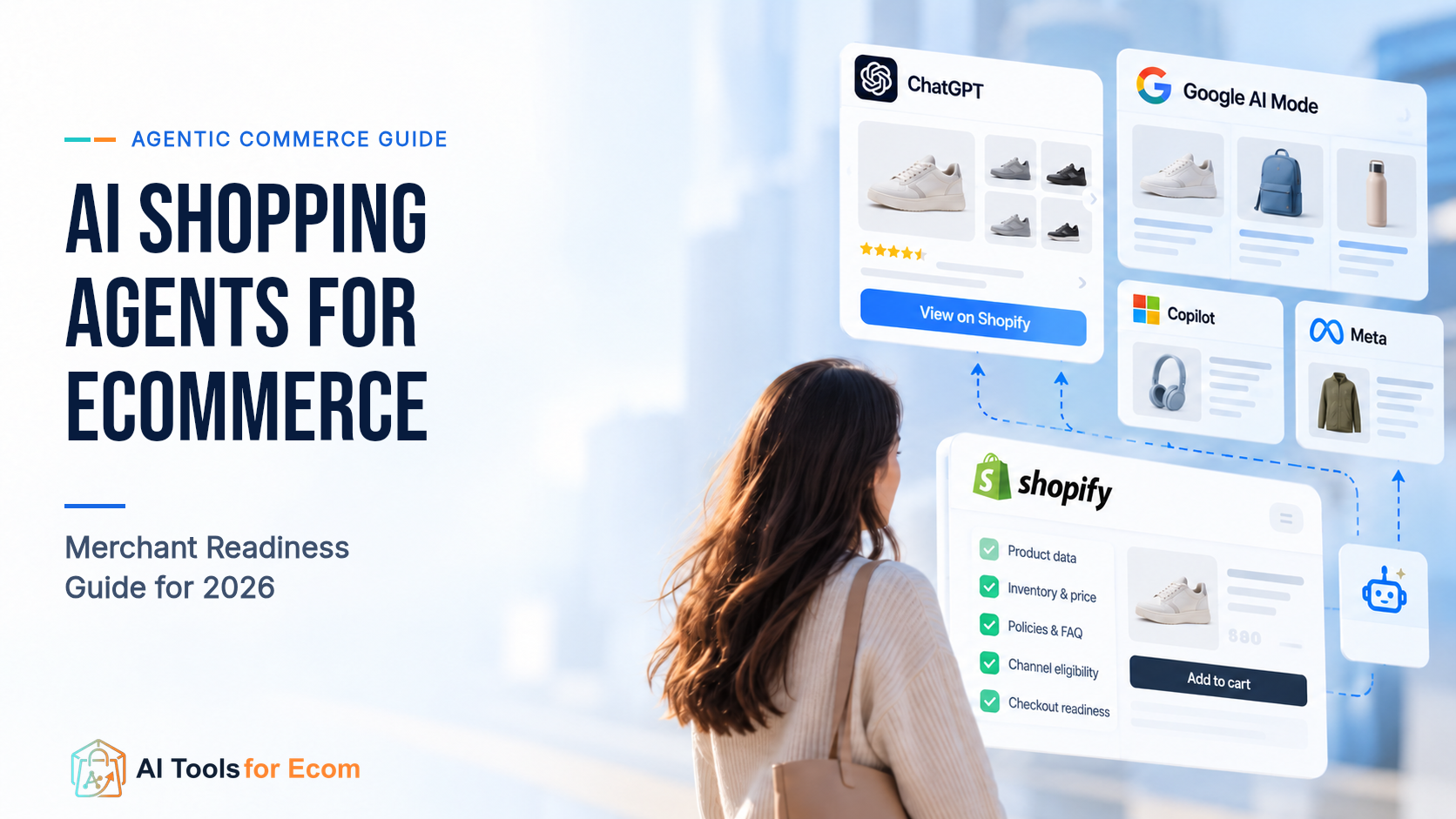
In Shopify's current implementation, ChatGPT is primarily a discovery/referral path that sends shoppers to the merchant's Shopify checkout, while eligible Google AI Mode and Gemini, Microsoft Copilot, and Meta experiences can support Shopify-powered direct checkout. Availability varies by channel, market, store setup, and rollout status.
If you are not on Shopify, the same readiness principles still apply, but the integration path can differ. OpenAI's current Agentic Commerce documentation, for example, separates structured product-feed discovery from separately enabled checkout integration.
The right question in 2026 is not:
“How do I turn on AI shopping?”
It is:
Can an AI agent accurately understand what I sell, determine whether a product is eligible and available, explain the rules of buying it, and hand the shopper into a checkout path that actually works?
Quick Answer
A merchant is not “AI shopping ready” just because its products appear in search engines or because the site has an llms.txt file.
A stronger readiness standard has six layers:
- Product data readiness — titles, descriptions, variants, images, price, availability, categories, identifiers, and custom fields must be accurate and machine-usable.
- Store knowledge readiness — shipping, returns, privacy, terms, FAQs, and customer-service facts must be current and understandable.
- Channel readiness — the store and products must meet the eligibility rules of the AI channels the merchant actually wants to use.
- Checkout readiness — the merchant must know whether each channel redirects to the online store or supports direct checkout, and what the direct-checkout limitations are.
- Exception readiness — B2B-only items, private products, subscriptions, bundles, customized products, regional restrictions, and unusual fulfillment need explicit handling.
- Validation readiness — the merchant needs a repeatable test for discovery, listing quality, policy accuracy, price/inventory freshness, checkout behavior, attribution, and exceptions.
For Shopify merchants, the key structured product source for agentic storefronts is Shopify Catalog. Shopify also provides /agents.md, /llms.txt, and /llms-full.txt, but Shopify explicitly separates those discovery files from the authoritative Catalog product-data path.
For non-Shopify merchants pursuing direct ChatGPT shopping integrations, OpenAI currently documents structured product feeds as the discovery foundation. Product-feed onboarding and Instant Checkout remain approval-gated, so merchants should not assume immediate production access.
The ATFE Merchant Readiness Framework
| Readiness layer | Merchant question | Minimum evidence of readiness | Common failure mode |
|---|---|---|---|
| 1. Catalog Truth | Can the agent understand exactly what we sell? | Accurate title, description, variants, images, price, availability, category and identifiers | Missing variant data, stale prices, weak descriptions, important facts trapped in unmapped custom fields |
| 2. Store Knowledge | Can the agent explain how buying from us works? | Current shipping, return/refund, privacy, terms and FAQ information | Policies missing, contradictory, or different across systems |
| 3. Channel Eligibility | Are our store and products actually allowed in this channel? | Merchant/store eligibility confirmed in the channel or commerce platform | Assuming web visibility equals agentic-channel or direct-checkout eligibility |
| 4. Checkout Capability | Can the buyer complete the intended purchase path? | Known redirect/direct-checkout behavior, working payment/shipping/tax setup | Depending on checkout customizations or product types unsupported by the AI channel |
| 5. Exception Handling | What happens outside the happy path? | Rules for B2B, private, restricted, bundled, customized, subscription, out-of-stock and regional cases | AI channel surfaces something that should not be sold or cannot be fulfilled |
| 6. Validation & Monitoring | Can we prove the experience stays accurate? | Repeatable query set, listing checks, checkout tests, attribution and monitoring | Launching once, then letting catalog/policy/checkout drift create bad answers |
1. Make Your Product Catalog Agent-Readable
AI shopping agents need product facts, not just marketing prose.
For Shopify agentic storefronts, Shopify Catalog currently structures key product data such as:
- title;
- description;
- options;
- images;
- price;
- availability;
- other product attributes.
Shopify says Catalog continuously updates product data to help maintain accurate inventory and pricing across AI channels.
That makes catalog quality the first readiness layer.
Start with a representative product-data audit
Select at least 20 products across different catalog conditions:
- best seller;
- low-stock item;
- multiple variants;
- seasonal item;
- sale item;
- technical product;
- product with custom metafields;
- bundle or subscription if applicable;
- B2B or restricted item if relevant.
For each product, verify:
- title is specific and human-readable;
- description states what the product actually is;
- category is accurate;
- variant names use understandable customer language;
- images match the actual variant;
- price is current;
- sale price is current;
- availability is current;
- identifiers are stable;
- required disclosures are present;
- important custom attributes are exposed to the catalog/feed.
Map important custom fields
Shopify documents Catalog Mapping for stores that keep important product information in custom structures such as metafields, metaobjects, tag prefixes, or custom grouping logic.
Do not assume:
“The data exists somewhere in Shopify, so the agent can use it.”
Verify the mapping.
Model variants explicitly
For non-Shopify merchants using structured product feeds, OpenAI's current Agentic Commerce guidance recommends modeling purchasable variants distinctly and keeping variant-specific values current when they differ.
The broader lesson is simple:
Do not make the agent infer a purchasable variant from ambiguous product prose.
2. Keep Price and Inventory Fresh Enough for a Buying Agent
Traditional SEO can tolerate some delay between a page change and an index update.
Agentic commerce has a lower tolerance for stale transaction data.
If an AI shopping experience tells a buyer that an item is in stock when it is sold out, or shows an old price that changes at checkout, the problem is not just ranking. It becomes a trust and purchase-friction problem.
Shopify path
Shopify Catalog is designed to keep pricing and availability synchronized across supported agentic storefronts.
Merchants still need to verify that:
- source product records are correct;
- variants are represented correctly;
- custom inventory logic does not create mismatches;
- third-party systems sync into Shopify quickly enough.
Direct OpenAI feed path
OpenAI's current product-feed guidance also emphasizes current price and availability.
For approved integrations, OpenAI currently recommends regular full-feed snapshots plus more frequent API updates where needed.
Readiness test
Pick five volatile SKUs:
- low inventory;
- active promotion;
- price change;
- backorder/preorder;
- variant stock difference.
Change each value in the source system and record:
- how long until the catalog/feed reflects the update;
- how long until the AI shopping surface reflects it;
- whether the checkout state still matches the surfaced product information.
Document the lag.
3. Publish Store Policies and Agent-Readable Knowledge
A shopping agent needs more than products.
It also needs authoritative answers to questions such as:
- Where do you ship?
- How long does delivery take?
- Can I return this?
- Who pays return shipping?
- Is pickup available?
- Can I cancel before shipment?
Shopify's current agentic-storefront documentation uses policy completeness as part of eligibility and listing-quality workflows.
Use Shopify Knowledge Base where appropriate
Shopify's Knowledge Base app can create and manage business facts and FAQs that AI shopping agents can use as a trusted data source.
Current documentation says these facts can draw from information such as:
- languages;
- customer-account settings;
- shipping/delivery;
- return rules;
- store policies.
Merchant policy test
Ask 10 real pre-purchase questions and confirm:
- there is an authoritative answer;
- the answer matches current store policy;
- the answer does not conflict across FAQ, policy, support, checkout, and sales-channel data.
4. Understand the Difference Between Discovery Files and Product Feeds
Merchants now encounter several machine-readable concepts:
robots.txt;/agents.md;/llms.txt;/llms-full.txt;- Shopify Catalog;
- Google Merchant Center;
- structured product feeds;
- APIs;
- UCP;
- ACP.
They are not interchangeable.
Shopify discovery files
Shopify currently serves /agents.md, /llms.txt, and /llms-full.txt for stores. Shopify describes /agents.md as the canonical agent-discovery URL, while the llms files provide compatibility with older crawler conventions.
These files can expose store context such as store name, URL, sitemap, policies, and discovery endpoints.
But Shopify explicitly says these discovery files are separate from Shopify Catalog and do not replace it.
Shopify Catalog
For Shopify agentic storefronts, Catalog is the primary structured product-data layer.
That is where product truth such as price, availability, variants, and attributes needs to be reliable.
Open-web crawling
AI channels can also discover products through normal crawling and indexing.
Turning off Shopify Catalog access does not necessarily make a product disappear from every AI system, and changing robots.txt affects open-web crawler access rather than Shopify Catalog syndication itself.
Merchant rule
Discovery documents tell agents how to understand the store. Structured catalogs and feeds tell commerce systems what products can be discovered and sold.
5. Check Channel Eligibility Before You Design the Experience
“AI shopping” is not one universal channel.
Current Shopify agentic storefronts expose different purchase paths by channel.
Current Shopify Agentic Channel Matrix
| AI channel | Product discovery path | Purchase path | Important merchant caveat |
|---|---|---|---|
| ChatGPT | Shopify Catalog for eligible products; products can also be found through other discovery methods | Merchant's Shopify checkout in ChatGPT in-app browser or new tab on web | No Shopify-powered direct checkout for ChatGPT in the current Shopify flow |
| Google AI Mode / Gemini | Google & YouTube sales channel or Google Merchant Center | Shopify-powered direct checkout for eligible stores/users where rollout is available, or redirect to store | Rollout and eligibility vary; current Shopify docs say direct checkout may not yet be available to every eligible store/user |
| Microsoft Copilot | Shopify Catalog | Shopify-powered direct checkout for eligible stores, or redirect if disabled | Direct checkout has market and feature restrictions; some product types/customizations are unsupported |
| Meta surfaces such as Muse | Shopify Catalog plus Meta product-feed requirements for shoppable ads | Shopify-powered direct checkout for eligible stores, or redirect if disabled | Geographic, catalog, policy, and Meta sales-channel requirements apply |
| Other / emerging agents | May receive Shopify Catalog access when enabled in Agentic settings | Varies | Treat each new channel as a separate eligibility and checkout decision |
This table is a readiness guide, not a promise of merchant access.
Always verify the channel status shown in the merchant's own Shopify admin.
Eligibility is not ranking
Even when a store and product are eligible, the AI channel still decides whether to show that product for a buyer request.
Merchants therefore need two separate questions:
- Can the product participate?
- Does the product rank or get selected for the shopper's request?
Do not confuse the two.
6. Use Shopify's Search Preview as a Directional Readiness Test
Shopify currently provides a search-preview experience in:
Sales channels → Agentic
Merchants can run a product or keyword query and review:
- which products could rank;
- top-ranking products;
- listing-quality indicators;
- listing insights;
- products that did not rank;
- improvement recommendations.
This is one of the most useful merchant-readiness tools available because it lets teams test discovery before relying on anecdotal screenshots from an AI chat.
What the preview can tell you
Shopify currently surfaces listing-quality factors such as:
- product information completeness;
- product reviews from trusted sources;
- variant/option completeness;
- shop policy completeness.
These signals can reveal operational gaps such as missing product descriptions, too few relevant images, incomplete variants, or weak policy coverage.
What it cannot prove
Shopify warns that individual AI channels can re-rank Catalog results using their own logic.
Therefore:
Shopify Catalog search preview is a directional signal, not a guaranteed ChatGPT, Gemini, Copilot, or Meta ranking prediction.
Use it to diagnose readiness, not as an exact AI ranking tracker.
7. Map the Checkout Path Before You Optimize for “Conversion”
The buyer journey can now end in different places.
A shopper might:
- click from an AI answer to the merchant site;
- open the merchant's Shopify checkout inside an in-app browser;
- use a Shopify-powered direct checkout inside an AI channel;
- interact with a custom protocol-based checkout implemented by a merchant or platform.
Those paths have different capabilities.
ChatGPT through Shopify
Shopify's current ChatGPT agentic-storefront flow sends the shopper to the merchant's full Shopify checkout, shown in the ChatGPT in-app browser or in a new tab on ChatGPT web.
Do not describe this as Shopify-powered direct checkout inside ChatGPT.
Google, Microsoft, and Meta through Shopify
Eligible stores can use Shopify-powered direct checkout on supported Google, Microsoft Copilot, and Meta surfaces where the feature is available and enabled.
Support can differ by:
- country;
- store eligibility;
- buyer eligibility;
- product type;
- checkout customization;
- payment/shipping configuration;
- rollout status.
Direct checkout can remove parts of your normal checkout UX
Microsoft Copilot's current Shopify documentation is a useful example.
Shopify documents that some normal checkout experiences may not be available in Copilot direct checkout, including certain:
- checkout blocks;
- upsells;
- custom fields;
- loyalty/rewards elements;
- client-side tracking/pixels;
- pickup/local-delivery methods;
- product types.
The exact list is channel-specific and can change.
The merchant lesson is broader:
Do not assume that “Shopify checkout works” means every dependency in your customized checkout works in an agentic channel.
8. Create an Exception Register Before Launch
The happy path is easy:
in-stock standard product → supported country → normal payment → standard shipping
Real stores contain exceptions.
Create an exception register with at least these categories.
B2B and wholesale
Shopify agentic storefronts currently support D2C sales.
Shopify automatically excludes B2B-only products when it can identify them through standard Shopify B2B structures.
But custom B2B setups can create risk.
If a third-party app or theme logic hides price, product, or checkout access until login, Shopify may not always identify the item as B2B-only.
Private or gated products
Products that require store password, customer authentication, or private storefront access need explicit review.
Do not assume an AI channel understands gating logic that lives only in a theme or third-party app.
Bundles and subscriptions
Some direct-checkout channels may not support the same product types your normal online store supports.
Verify each intended channel separately.
Customized products
If checkout collects engraving text, custom measurements, upload files, gift messages, or configuration choices, test whether those inputs are supported in the AI-channel checkout path.
Fulfillment exceptions
Review:
- local pickup;
- local delivery;
- pickup points;
- unusual shipping rates;
- region-specific restrictions;
- hazardous/restricted shipping;
- delivery-date logic.
Restricted products
AI commerce platforms can have prohibited-product policies that go beyond ordinary ecommerce availability.
OpenAI's current commerce documentation, for example, excludes several restricted product categories from its shopping program.
Eligibility must be checked at the product-policy level, not only at the store level.
9. Know the Non-Shopify Path: Structured Feeds First, Checkout Second
Not every merchant uses Shopify.
The readiness principles still apply.
For merchants integrating directly with ChatGPT shopping, OpenAI's current Agentic Commerce documentation separates two major layers.
Product discovery
OpenAI currently documents structured product feeds as the discovery foundation.
Feeds can include information such as:
- identifiers;
- titles;
- descriptions;
- URLs;
- media;
- price;
- availability;
- seller information;
- variants;
- fulfillment/policy fields where supported.
OpenAI's current guidance recommends keeping feed data fresh and using valid, durable merchant and policy links.
Checkout
Checkout is a separate integration.
OpenAI's current Agentic Checkout specification requires merchants to maintain authoritative checkout state, including:
- items;
- pricing;
- taxes/fees;
- shipping;
- discounts;
- totals;
- order status.
The merchant remains responsible for inventory, pricing, fulfillment, tax, payment processing, order acceptance, and order lifecycle.
Important availability boundary
The protocol is publicly documented, but production shopping access is not automatically available to every merchant.
OpenAI currently states that:
- product-feed onboarding in ChatGPT is available to approved partners;
- Instant Checkout is available to approved partners.
Do not publish a guide that says:
“Upload this feed and your store will appear in ChatGPT shopping tomorrow.”
That is not supported by the current documentation.
10. Do Not Build a New Implementation on the Deprecated Shopify Storefront MCP Tutorial
Shopify has removed the old catalog and cart tools from:
https://{shop}/api/mcp
The current Shopify developer documentation says to use Universal Commerce Protocol (UCP) instead.
The current Shopify UCP MCP endpoint is:
https://{shop}/api/ucp/mcp
Current UCP replacements include catalog tools such as:
search_catalog;lookup_catalog;get_product;
and cart/checkout tooling under the new protocol path.
Shopify's old shop-chat-agent sample app/tutorial is deprecated.
What merchants should take from this
Most merchants do not need to implement UCP themselves merely to participate in Shopify's managed agentic storefronts.
UCP is relevant when a developer is building custom agentic-commerce integrations.
For a merchant-readiness guide, the priority should stay:
catalog → policies → eligibility → checkout → exceptions → validation
not:
copy an old MCP code sample.
The ATFE 30-Query Merchant Readiness Test
Use this before calling a store “AI shopping ready.”
Do not test only branded product names.
The point is to simulate how buyers actually ask an agent for help.
Step 1: Build the query set
Create 30 queries across six intent groups.
A. Exact product queries — 5
Examples:
- “[product name]”
- “[product name] blue size M”
- “[SKU or model]”
Tests product/variant identity.
B. Category queries — 5
Examples:
- “waterproof commuter backpack”
- “wide-fit trail running shoe”
Tests category and attribute relevance.
C. Problem / use-case queries — 5
Examples:
- “laptop bag for a 16-inch MacBook and weekend travel”
- “gift for a beginner home barista under $100”
Tests whether descriptions and attributes express use cases clearly.
D. Policy queries — 5
Examples:
- “Can I return this after 30 days?”
- “Does this store ship to Canada?”
- “Is store pickup available?”
Tests merchant knowledge.
E. Transaction queries — 5
Examples:
- “Is this in stock?”
- “What is the current price?”
- “Can I buy two with this discount?”
- “Can this ship to my ZIP code?”
Tests transactional truth.
F. Exception queries — 5
Examples:
- B2B-only item;
- subscription;
- bundle;
- customized product;
- restricted destination/product.
Tests failure behavior.
Step 2: Record expected truth before testing
For every query, create a truth sheet.
Record:
- correct product(s);
- correct price;
- correct inventory;
- correct variant;
- correct policy answer;
- expected checkout path;
- whether the item should be discoverable;
- whether the item should be purchasable;
- expected exception message.
Do not judge the AI response from memory.
Step 3: Test Shopify Catalog preview where available
For Shopify merchants, run relevant product-discovery queries in:
Sales channels → Agentic
Record:
- products returned;
- listing quality;
- missing attributes;
- listing insights;
- top-ranking status;
- products that fail to rank.
Remember that downstream AI channels can re-rank results.
Step 4: Test the live channel experience separately
Where the merchant is actually eligible, repeat a subset in:
- ChatGPT;
- Google AI Mode/Gemini;
- Microsoft Copilot;
- Meta;
- other enabled channels.
Record differences.
Step 5: Test the purchase path
For each enabled channel, verify:
- redirect vs. direct checkout;
- price;
- inventory;
- variant selection;
- discounts;
- shipping options;
- tax;
- payment;
- required legal information;
- order creation;
- confirmation;
- attribution.
Do not complete a real charge unless the test plan and environment require it.
Step 6: Test failure states
Intentionally create or select:
- out-of-stock product;
- invalid variant;
- unsupported destination;
- unsupported direct-checkout product type;
- hidden/private/B2B item;
- expired promotion.
The agent should fail safely.
Step 7: Score the result
| Area | Weight | Pass condition |
|---|---|---|
| Catalog accuracy | 25 | Product/variant facts match source of truth |
| Price & inventory freshness | 20 | Transactional values match current checkout state |
| Policy/knowledge accuracy | 15 | Store-policy answers match authoritative policy |
| Eligibility/discovery | 15 | Intended products are eligible and findable; excluded products stay excluded |
| Checkout integrity | 15 | Supported purchase path works without losing required business logic |
| Exception handling | 10 | Edge cases fail safely and predictably |
90–100: Ready for controlled expansion
75–89: Pilot-ready with known gaps
60–74: Fix critical catalog/policy/checkout issues before scaling
Below 60: Not ready for production agentic-commerce expansion
This score is an ATFE operating framework, not a Shopify or OpenAI certification.
Merchant Readiness Checklist
Product data
- Product titles are descriptive and consistent.
- Every sellable product has a relevant image.
- Prices are current.
- Availability is current.
- Variants are explicit and understandable.
- Categories and product types are correct.
- Important custom fields are mapped into the relevant catalog/feed.
- Restricted/private/B2B products are excluded correctly.
Store knowledge
- Terms of service are current.
- Privacy policy is current.
- Return/refund policy is current.
- Shipping policy is current.
- High-value FAQs are current.
- Policy answers are consistent across support, site, and checkout.
Channel readiness
- Merchant understands which AI channels are active.
- Product-discovery eligibility is confirmed.
- Market/country restrictions are confirmed.
- Direct-checkout eligibility is confirmed separately.
- Channel-specific feed/sales-channel requirements are complete.
Checkout
- Payment provider works for the intended channel.
- Shipping configuration works.
- Tax setup works.
- Discounts behave as expected.
- Unsupported checkout blocks are documented.
- Unsupported product types are documented.
- Order lifecycle/refunds can be handled in the merchant system.
Measurement
- Agentic-channel attribution is visible where supported.
- Catalog search preview is monitored where available.
- A stable query test set exists.
- Price/inventory freshness is monitored.
- Exceptions and failed orders are reviewed.
- The readiness test is repeated after material catalog or checkout changes.
What Not to Optimize Yet
Do not treat llms.txt as an AI-shopping ranking hack
Shopify supports /agents.md and compatible llms files, but merchants should not confuse discovery documents with the structured product catalog used for agentic commerce.
Do not create fake conversational attributes
If an AI agent needs to know that a jacket is waterproof, wide-fit, vegan, dishwasher-safe, or compatible with a device, that attribute should be grounded in actual product truth.
Do not optimize only for one screenshot
A product appearing in one ChatGPT or Gemini conversation does not prove readiness.
Use a fixed query set and repeatable test.
Do not bypass merchant controls for “AI conversion”
If a direct-checkout path removes a required legal consent, custom input, compliance block, subscription term, or shipping restriction, the channel or product may not be ready for that checkout path.
Do not build on deprecated APIs
Shopify's old Storefront MCP catalog/cart implementation is no longer the current developer path.
Use current UCP documentation for custom Shopify agent integrations.
Final Recommendation
For most merchants, AI shopping readiness in 2026 is primarily a commerce-data and operations problem, not an AI prompt problem.
Start with the product catalog.
Make sure an agent can identify:
- what the product is;
- which variant the buyer wants;
- whether it is available;
- what it costs;
- whether it is eligible for the channel;
- what the merchant's policies say.
Then verify the purchase path.
Do not assume:
- every AI channel supports direct checkout;
- every store is eligible;
- every product type is supported;
- every checkout customization will render;
- every AI agent ranks Shopify Catalog results the same way.
For Shopify merchants, use Agentic settings and Catalog search preview as a practical operational starting point.
For custom or non-Shopify implementations, treat structured product feeds and checkout integration as separate workstreams.
And for custom Shopify development, use the current UCP path rather than the deprecated Storefront MCP catalog/cart tutorial.
The merchant that wins in agentic commerce will not necessarily be the one with the most “AI content.”
It will be the one with the cleanest product truth, clearest policies, most reliable transaction state, and discipline to test what an AI agent actually sees and can actually buy.
Editorial Methodology
ATFE wrote this guide from the merchant-operations perspective.
The primary source set is current official documentation from:
- Shopify Help Center;
- Shopify developer documentation;
- OpenAI Agentic Commerce documentation;
- Agentic Commerce Protocol documentation.
What ATFE does not claim
ATFE does not claim:
- every Shopify store is eligible for every agentic channel;
- every channel supports the same checkout flow;
- Shopify Catalog ranking predicts the exact output of ChatGPT, Gemini, Copilot, or Meta;
agents.mdorllms.txtguarantees AI visibility;- a merchant can join OpenAI product-feed or Instant Checkout programs without approval;
- every direct-checkout path supports every Shopify checkout customization;
- implementing UCP or ACP guarantees product ranking.
Channel eligibility, rollout status, direct-checkout support, policy requirements, and technical endpoints can change.
Recheck official documentation immediately before implementation.
Frequently Asked Questions
What is an AI shopping agent?
An AI shopping agent is an AI system that can help a customer discover, compare, evaluate, and in some cases purchase products.
The merchant-facing challenge is to provide enough accurate product, policy, availability, and checkout information for the agent to represent the store correctly.
What are Shopify agentic storefronts?
Shopify agentic storefronts make eligible merchant products available to AI shopping channels such as ChatGPT, Google AI Mode and Gemini, Microsoft Copilot, and Meta.
Shopify Catalog is a core product-data layer, while purchase paths and direct-checkout eligibility differ by channel.
Can customers buy directly in ChatGPT from Shopify?
In Shopify's current agentic-storefront flow, ChatGPT acts primarily as a discovery/referral channel.
The shopper completes the purchase on the merchant's Shopify checkout shown in a ChatGPT in-app browser or in a new tab on web.
Do not describe this as the same Shopify-powered direct-checkout flow documented for eligible Google, Microsoft Copilot, and Meta experiences.
Do I need llms.txt for AI shopping?
Not by itself.
Shopify currently provides /agents.md, /llms.txt, and /llms-full.txt, but Shopify explicitly says these discovery files do not replace Shopify Catalog.
For shopping readiness, accurate structured product data matters more than treating llms.txt as a ranking tactic.
How do I make my Shopify products easier for AI agents to understand?
Start with complete product titles, accurate descriptions, clear variants/options, relevant images, current price, current availability, correct categories, mapped custom fields, and complete policies.
Then use Shopify's Agentic search preview to identify listing-quality and discoverability gaps.
Does blocking AI crawlers in robots.txt remove products from Shopify agentic storefronts?
Not necessarily.
Shopify states that robots.txt controls open-web crawler access, while Shopify Catalog is a separate product-data path.
Blocking a crawler does not automatically stop Shopify Catalog syndication to an activated agentic storefront channel.
What products should I test most carefully?
Prioritize variant-heavy products, low-stock items, promotional products, B2B/private items, subscriptions, bundles, customized products, unusual shipping cases, and restricted products.
These are more likely to expose a gap between discovery and transaction capability.
Is Shopify Storefront MCP still the right way to build AI shopping?
Not for the old catalog/cart tutorial.
Shopify has removed the old catalog and cart tools from /api/mcp and moved those capabilities to UCP at /api/ucp/mcp.
Use current Shopify UCP documentation for new custom agentic-commerce development.
Can a non-Shopify merchant appear in ChatGPT shopping?
OpenAI currently documents a direct merchant integration path based on structured product feeds and the Agentic Commerce Protocol.
However, OpenAI currently states that product-feed onboarding in ChatGPT and Instant Checkout access are available to approved partners.
Merchants should verify access before planning a production launch around those capabilities.
How often should merchants repeat the readiness test?
Repeat it after material changes to catalog structure, product-feed mapping, pricing, inventory, policies, checkout customizations, sales-channel setup, payment provider, or B2B access logic.
For active programs, a scheduled quarterly review plus regression checks after major changes is a reasonable operational starting point.