

Tool Summary
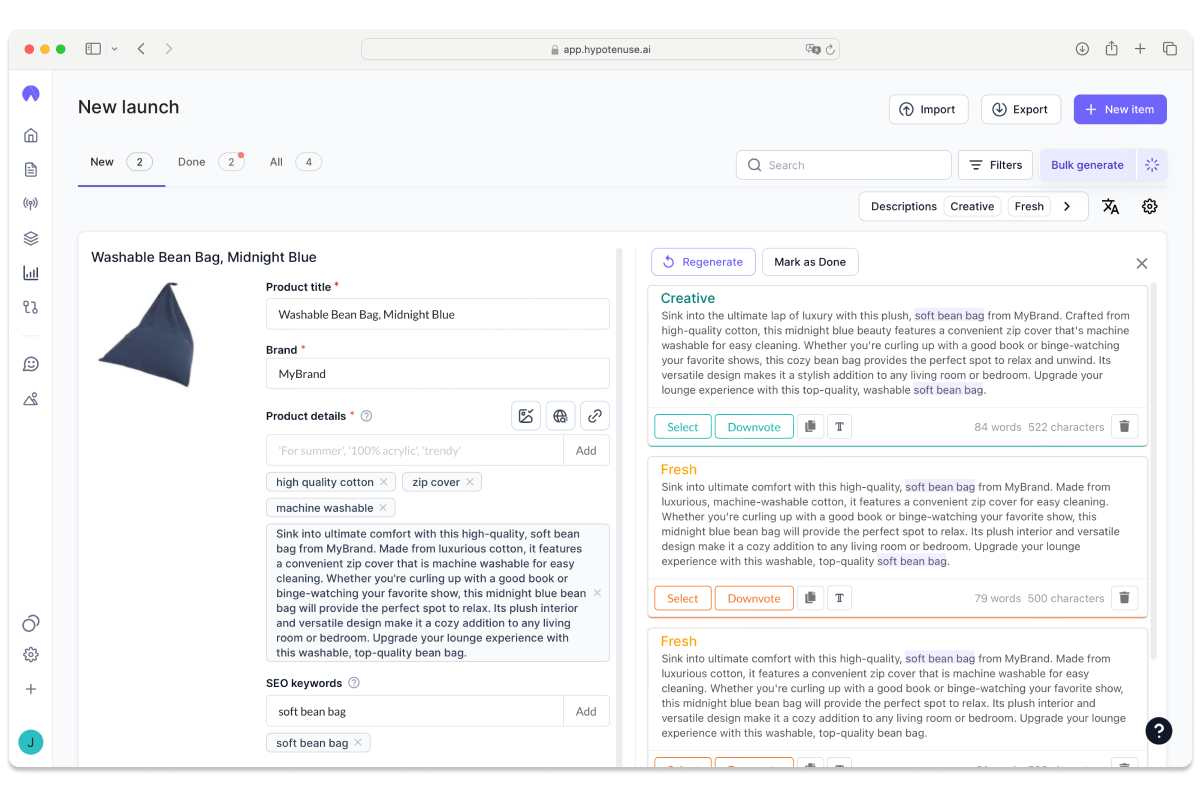
Hypotenuse AI is an ecommerce product-content platform that generates and manages product descriptions and other catalog copy using product details, brand guidance and content rules. Its product description workflow supports importing product records, generating or rewriting descriptions in bulk, reviewing and editing outputs, and exporting approved material. Direct commerce or PIM synchronization depends on the contracted tier and integration scope.
The broader platform and pricing comparison position data enrichment, product attributes, SEO-related fields, and custom enterprise integrations as distinct capabilities. The buying decision is therefore different for a one-person store writing a few listings and a retailer managing complex, multi-channel catalogs.
Key Features
Product description generation. The official workflow starts with product details, manufacturer descriptions or uploaded catalogs. Users can add SEO keywords and product features and generate individual or multiple descriptions with structured formatting.
Bulk import, review, and export. Hypotenuse describes CSV/XLSX imports, batch creation, editable drafts, review statuses, and export. The current plan comparison distinguishes Basic import/export from custom formats, site integrations, and PIM connections scoped for Enterprise. Teams can leave unfinished records separate from approved descriptions rather than automatically publishing every generation.
Brand voice and channel formatting. The platform offers custom writing rules covering voice, tone, length, headings and bullets. Its product page discusses copy for ecommerce channels including Amazon and Walmart; merchants must still verify policy compliance and actual field constraints for each retailer.
Data and image-based enrichment. Where supplier fields are incomplete, Hypotenuse describes adding attributes based on product images, web data, UPCs or factsheets. These are generated or retrieved inputs that need verification against an authoritative SKU record, especially for dimensions, safety claims and variant-specific specifications. See the pricing comparison for Enterprise enrichment scope and the image-description workflow.
SEO and multilingual product content. The product supports keyword-aware product copy and multiple languages. This is a content-production capability; it does not establish that published pages will rank better or appear in AI-generated search answers. See the description generator and plan comparison.
Enterprise catalog operations. Its Ecommerce Enterprise offering lists custom PIM, ERP and commerce integrations, product taxonomy/data management, quality checks, bespoke AI models, and team controls. These features should not be attributed to Basic unless the current official comparison specifically includes them.
Ecommerce Use Cases
- Distributor catalog enrichment: Combine manufacturer data, SKU information and approved facts before writing usable descriptions for a large inventory.
- Multi-channel descriptions: Prepare different formats of product copy for storefront pages and supported marketplace listing requirements.
- Brand-consistent launches: Apply content rules to new collections, then review for exact product claims, sizes, variants and labeling requirements.
- PIM-connected content operations: Evaluate enterprise integrations where product-data approval, taxonomy, content generation and controlled synchronization are part of the same workflow.
Pricing and Access
The current official pricing page shows Basic and Ecommerce Enterprise as custom-priced offerings. Basic lists one seat, product description access, and other ecommerce content types; the Enterprise offer adds complex catalog and integration capabilities. A free-trial call to action is available, but the site does not show a reliable fixed public starting dollar price for these current plans.
ATFE should therefore use ‘Custom pricing; free trial available’ rather than copying older dollar figures or historic word-credit subscriptions from third-party roundups. Request a quote that specifies SKU volume, generated content categories, seats, enrichment jobs, languages, integrations, support, and any usage or implementation limits.
Best For
- Ecommerce catalog teams producing many descriptions and product attributes.
- Retailers managing content variants for multiple channels and markets.
- Brands needing structured editorial approval rather than automatically pushing AI text live.
- Enterprise operators considering PIM/ERP connections, taxonomy rules and large-scale enrichment.
Less suitable without further evaluation: a budget-conscious seller that needs a publicly priced small monthly plan, or a business that expects all enterprise data integrations to be included with the one-seat Basic offering.
Advantages and Limitations
Documented advantages: A recognizable import-to-draft-to-approval workflow; configurable brand voice and formatting; bulk generation; and, under the relevant Enterprise scope, image and product-data enrichment, integrations and data controls. See the product workflow and plan comparison.
Practical limitations: Current pricing requires a quote; feature entitlements differ substantially between Basic and Enterprise; integration scoping may be complex; product descriptions and enriched attributes still need fact checks; SEO improvement and conversion outcomes are not guaranteed by generation alone.
What to Check Before Choosing Hypotenuse AI
Take a sample of 20 SKUs across simple and difficult categories. Import authentic product records and set brand rules; then review generated copy for incorrect attributes, repetitive text, product variations, marketplace field constraints, and unsupported claims. If you use a PIM, test field mapping and write-back on staging data. Ask the vendor for a complete billing and onboarding proposal before comparing it with per-SKU or per-credit competitors.
ATFE Editorial Take
Hypotenuse AI is worth evaluating where product content and catalog data are managed as an operational system, not merely as ad hoc AI writing tasks. Its broader enterprise offering may suit complex catalogs, while the public lack of fixed pricing makes a scoped demonstration and quote especially important. ATFE has not independently established the tool’s accuracy, uniqueness, SEO uplift, or time savings.
Official Sources
- Hypotenuse AI Product Description Generator — import, generation, editing, bulk workflow and marketplace formats.
- Hypotenuse AI Pricing — current Basic/Enterprise custom pricing and tier capability table.
- Product Image Description Generator — image attribute extraction workflow.
- Hypotenuse AI Tools — other content-generation tools.