

Tool Summary
Describely is an ecommerce product-content platform for teams managing many SKUs. It combines AI generation of product descriptions, titles, bullets and tags with product-data enrichment, brand voice rules, catalog auditing, and storefront connectors. Rather than starting with a blank prompt for every product, the documented workflow can start from catalog rows, supplier attributes, and approved content rules.
For merchants, Describely is most relevant when the real problem is inconsistent product data and slow catalog maintenance—not simply writing one attractive description. AI-generated product facts, specifications, claims, and search keywords still require review before publishing.
Key Features
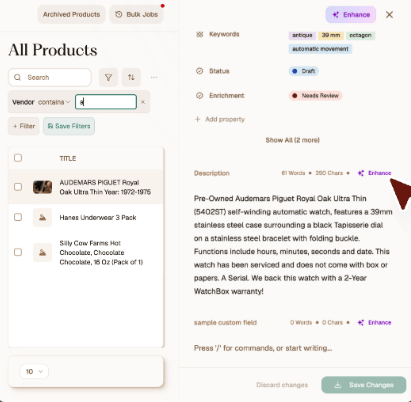
Bulk description and metadata generation. Describely lists product titles, descriptions, bullet points, tags, and product-page SEO copy. Teams can select products from a catalog, apply a Content Ruleset, generate a batch, and review the outputs. See the feature overview and bulk-generation guide.
Product-data enrichment. The software can look for missing product facts based on identifiers, manufacturer information, and other available sources. The official enrichment workflow includes review and approval before using enriched facts; merchants should not assume third-party data is correct for every product variant.
Brand rules and repeatable style. Custom rulesets govern brand tone, writing style, structure, and other constraints across multiple products. This supports consistency when descriptions must follow different brands or storefront requirements.
Catalog audits and SEO tools. Describely advertises checks for missing, thin or duplicate descriptions and SEO fields, with workflows for metadata improvement. A tool-generated SEO score is an internal diagnostic, not a prediction of Google ranking or AI-search visibility. See its SEO tools description.
Store connectors and export. The official feature overview lists Shopify, WooCommerce, Wix, Squarespace, Akeneo, and CSV-oriented workflows, with Google Sheets also referenced. After a user approves generated content, it can be exported or published through eligible connectors. Verify field mapping and permissions for the exact store.
Optional image tools and ShopAssist. Describely’s current feature catalog includes AI image capabilities and a shopping-assistant offering. These should be considered separate, secondary capabilities with their own conditions rather than proof that all features are included in base content-generation cost.
Ecommerce Use Cases
- Supplier-feed cleanup: Import SKUs with missing or inconsistent titles and attributes, enrich selected fields, and have a merchandising owner approve product facts.
- Large collection launches: Generate descriptions and bullets across a new category, maintaining formatting rules while reviewing sensitive claims.
- Multi-store catalog consistency: Maintain different stylistic rules and publish approved copy back into supported stores or through a CSV workflow.
- Product-page content refresh: Identify missing metadata and weak copy, then prioritize fields that contain verifiable product details and useful shopper information.
Pricing and Billing
Describely’s direct-site pricing page currently emphasizes pay-as-you-go. The vendor advertises five free products without a credit card, then $0.75 per product for up to 500 products. Its pricing help article explains that a purchased product credit must be activated within one year and permits unlimited content generations and audits for 30 days after the first job. This is a time-limited per-product entitlement, not unlimited access to every associated service. The vendor’s Shopify-app FAQ also describes recurring plans for that purchase channel; confirm which billing route applies before buying.
Its published additional charges include product-data enrichment at $0.55 per credit and image processing at $0.05 per credit. For catalogs of 500+ SKUs, the vendor offers custom high-volume pricing and seats. The relevant estimate is how many SKUs need content, how often new products are added, and how much enrichment or image processing the catalog requires.
Do not use older subscription-tier information for Describely without a new official check. Before purchasing, confirm how ‘a product’ is counted (including variants), what regeneration entitlement covers, and how connector writes and extra credits are billed.
Best For
- Ecommerce merchandisers maintaining catalog descriptions and attributes.
- Retailers and distributors receiving incomplete supplier data.
- Teams launching or rewriting hundreds of SKUs under consistent brand/content rules.
- Multi-store content managers who need a review-and-publish process rather than separate prompts.
Less suitable without further evaluation: very small stores with only a few descriptions to write, or sellers who require fully automatic factual accuracy without editorial approval.
Advantages and Limitations
Documented advantages: Catalog-oriented bulk operations; data enrichment; content rulesets; product-page auditing; supported store connectors; explicit review/approval workflow. See features, bulk-generation guidance, and enrichment workflow.
Practical limitations: Poor or mismatched supplier data can propagate errors; enriched fields must be verified; extra credits can alter the cost per approved SKU; SEO suggestions do not guarantee visibility; bulk publishing requires careful field mapping, permissions and rollback planning.
What to Check Before Choosing Describely
Pilot a representative group of 20 SKUs, including variants, products with sparse specifications, and items with legally sensitive claims. Record missing attributes, generated fact errors, duplicate phrasing, editing time, approval status, and the exact cost of generation plus enrichment. First publish to a draft or staging destination, verify field mapping, and maintain a rollback copy of the original catalog.
ATFE Editorial Take
Describely is a strong candidate to evaluate when the bottleneck is catalog operations and structured product copy at scale. Its pay-per-product model differs from credit-per-word AI writing tools; merchants need to compare the cost of accurate, approved SKUs rather than count raw generated paragraphs. ATFE has not independently tested Describely’s claim accuracy, SEO impact, or content-generation speed.
Official Sources
- Describely Features — product modules and integration overview.
- Describely Pricing — direct-site product-unit pricing, add-on credits and custom tier.
- Pay-as-You-Go Pricing Help — activation and 30-day generation/audit entitlement.
- Describely Shopify App FAQ — channel-specific recurring-plan note.
- Knowledge Base: Bulk Descriptions — content ruleset, generation, approval, export.
- Product Data Enrichment — source enrichment and review.
- Describely SEO Tools — audits, metadata and bulk SEO workflow.