

What is Dynamic Yield?
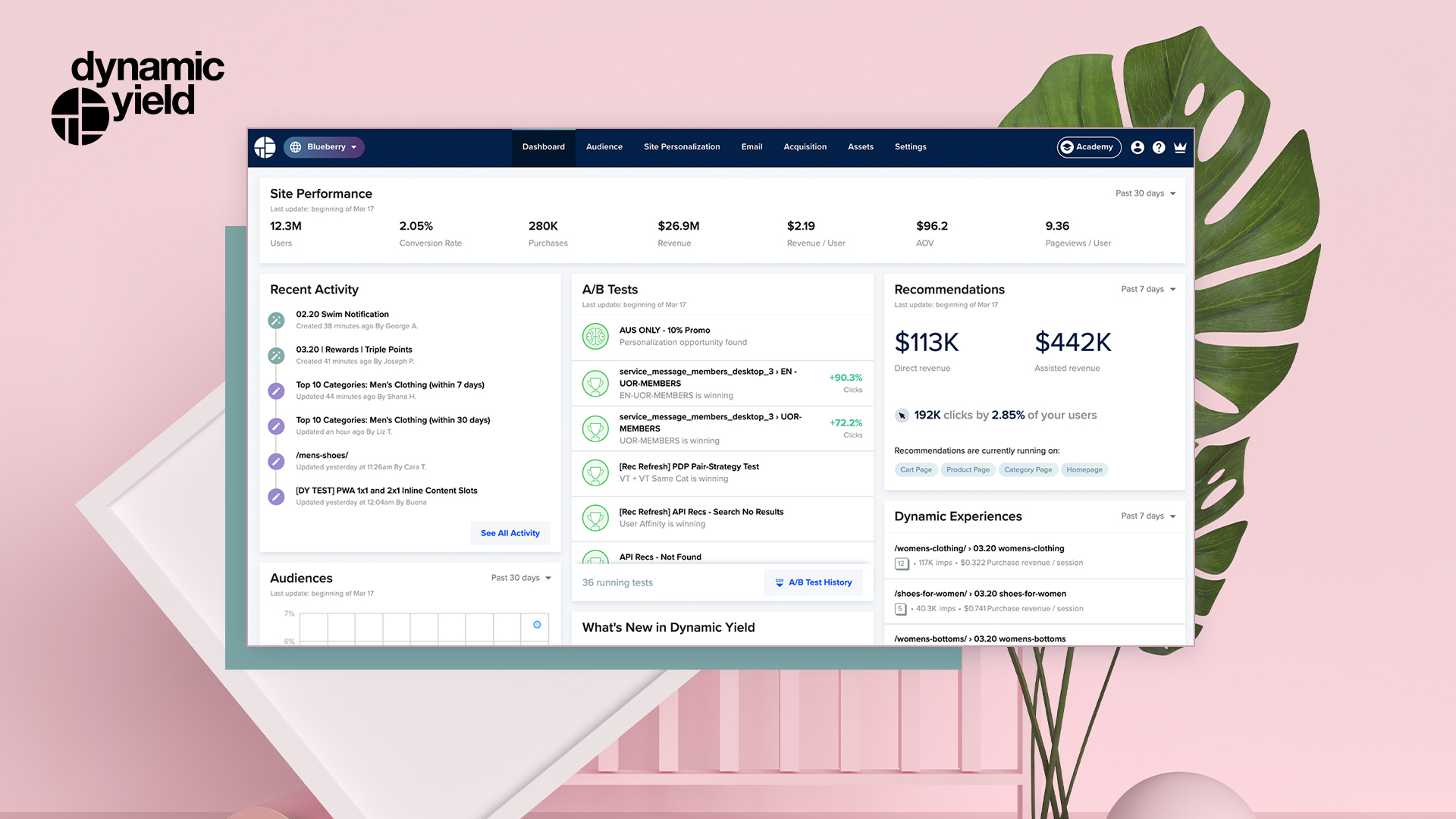
Dynamic Yield, now presented on Mastercard’s official site, is a personalization and experimentation platform. The vendor describes Experience OS as a system for building, testing, and scaling digital experiences, with segmentation, targeting, recommendations, journey orchestration, search, optimization, and APIs.
For ecommerce, its buying case is not simply “show more relevant products.” It is whether the team can consistently decide which experience to serve, evaluate that decision against a control, and maintain the required data and frontend integrations.
Quick Verdict
Dynamic Yield is a credible evaluation candidate for a retailer with dedicated experimentation and engineering capacity. It may be too heavy for a small store seeking a quick recommendation widget.
Key Features
- Recommendations: Configure product discovery strategies using available commerce and visitor signals.
- Segmentation and targeting: Decide which audiences or contexts receive a particular experience.
- Optimization: Test experience variants and compare outcomes against an appropriate control.
- Experience APIs: Integrate decisions into custom digital properties where supported.
Ecommerce Use Cases
A retailer might test alternate category-page ordering for a known customer segment, compare recommendation strategies on product pages, or coordinate a promotion across web and app. The evaluation should identify the decision owner and the baseline experience. Otherwise a platform can generate many variants without a dependable answer to whether they helped.
How to Evaluate Dynamic Yield
Bring one high-value use case to the demo: the target audience, required data, placement, control treatment, primary metric, guardrail metrics, and rollback conditions. Ask how the system handles catalog updates, out-of-stock products, consent state, and conflicts between multiple campaigns. Check whether the chosen client-side or API-based route fits your technical architecture.
For a pilot, track conversion together with margin, page speed, merchandising exceptions, and experiment quality. Do not treat a vendor case-study uplift as a forecast or a substitute for your own control group.
Best For
Large ecommerce programs that can staff personalization strategy, experiment design, integration, data governance, and ongoing QA.
Advantages and Limitations
Advantages
- Documented breadth across targeting, recommendations, optimization, and APIs.
- Suitable for teams that want experimentation embedded in personalization operations.
- Can support custom digital experiences beyond a single storefront widget.
Considerations
- Implementation and operating burden can exceed a focused app.
- Experiment results depend on design quality and data integrity.
- Public materials do not provide a simple universal subscription price.
Pricing
We did not find a single public monthly price for the full Dynamic Yield configuration on the current official product page. Request a quote that identifies included modules, usage or traffic terms, implementation services, support, contract length, and expansion costs.
Our Take
Dynamic Yield should be assessed as a decision and testing system. A buyer with no experiment owner or clean control design should establish those practices first; software breadth alone cannot create reliable evidence.
Primary Official Sources
See Mastercard Dynamic Yield and the personalization workflow overview.
Frequently Asked Questions
Is Dynamic Yield owned by Mastercard?
It is currently presented as Mastercard Dynamic Yield on Mastercard’s official website.
Is Dynamic Yield a plug-and-play Shopify upsell app?
That is not the most useful way to evaluate it. Confirm your required integration route, data work, and experiment operations with the vendor.
Editorial method: This profile evaluates implementation and measurement fit, not claimed performance superiority. Official vendor pages describe documented capabilities and terms; vendor performance claims are not independent evidence. ATFE has not conducted a controlled hands-on test of this tool. Last reviewed: October 2026. Recheck pricing, integrations, availability, and contract terms before purchase.