
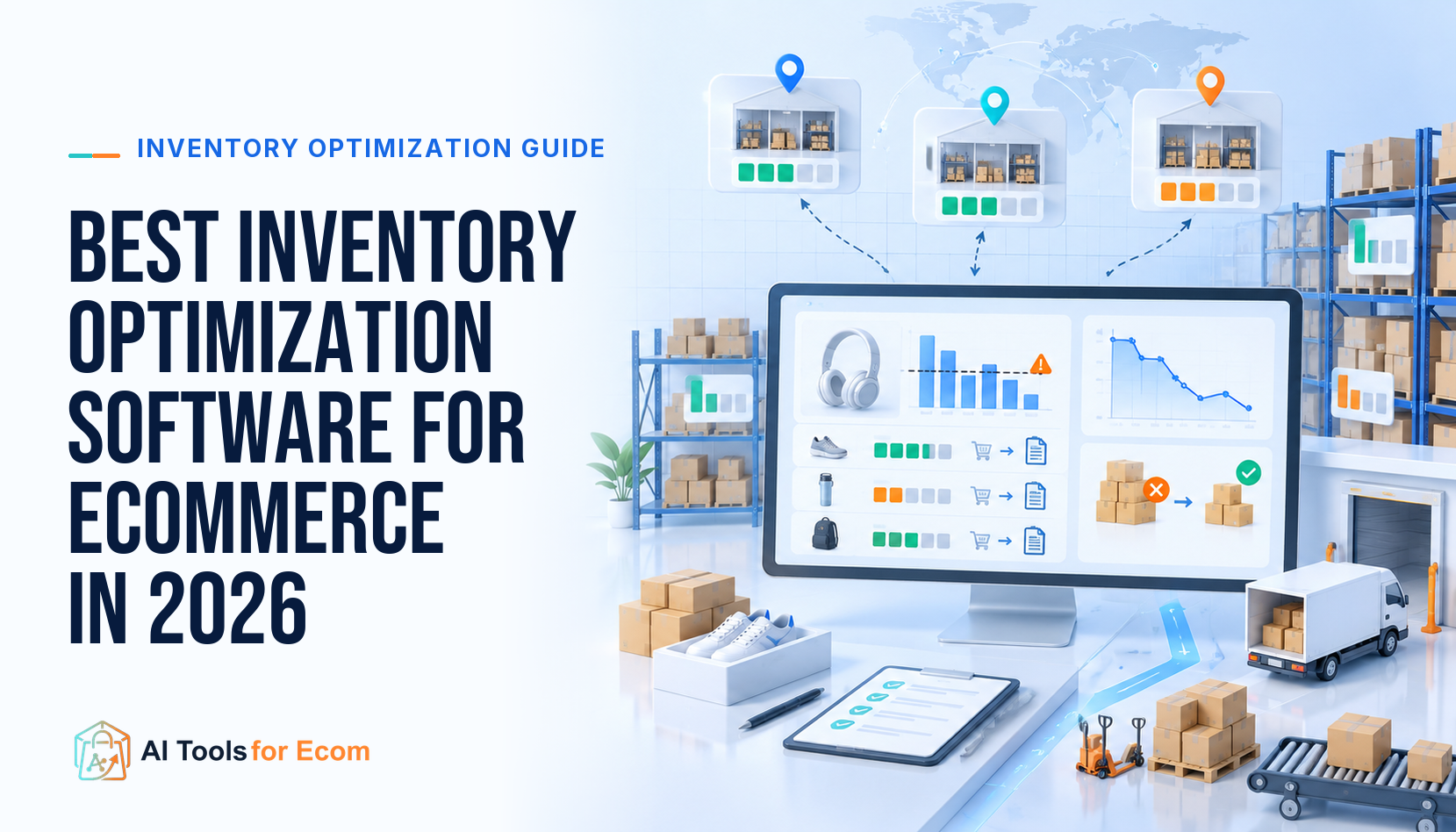
The best inventory optimization software for ecommerce depends on the decision your team cannot make reliably today. Inventory Planner and Prediko are practical starting points for Shopify-first teams. Netstock is a stronger candidate when replenishment policies, supplier risk, ERP data, and several stocking locations matter. GAINS and ToolsGroup belong on an enterprise shortlist when inventory must be optimized across a network rather than one store. Optiply targets ecommerce and wholesale replenishment with a more automated operating model.
Direct answer: forecasting estimates demand; optimization decides how much protection to hold, when to order, where to place stock, and which service-versus-cash trade-off to accept. Do not buy another forecasting dashboard if the real failure is inaccurate lead time, unrecorded stockouts, supplier minimums, or purchase orders that never reach the system.
Quick Answer by Operating Model
| Merchant situation | Best starting candidate | What must be proven |
|---|---|---|
| Shopify brand needing a buying workflow | Prediko | Reliable demand, supply, and replenishment output for real SKUs |
| Growing store with configurable replenishment | Inventory Planner | Lead-time, stock-cover, vendor, and stockout settings are maintained |
| ERP-connected distributor or multi-location merchant | Netstock | Data mapping, policy controls, write-back, and exception ownership |
| Complex multi-echelon network | GAINS or ToolsGroup | Network model, constraints, service targets, implementation resources |
| Ecommerce or wholesale team seeking automation | Optiply | Recommendations remain explainable and reversible |
Inventory Optimization Is Not the Same as Forecasting
A demand forecast says what may sell. Inventory optimization combines that expectation with uncertainty, lead time, supplier performance, order cadence, target fill rate, safety stock, minimum order quantity, pack size, current stock, open orders, location, and financial constraints. The output should be a defensible stocking policy or replenishment recommendation—not merely a new chart.
This distinction keeps the page separate from our inventory forecasting software guide. Use that guide when forecast method and forecast replay are the central questions. Use this one when the team already has a forecast but still cannot decide the reorder point, safety stock, order quantity, or placement across locations.
Netstock: Best for ERP-Connected Replenishment Policies
Verified fact: Netstock documents target fill rates, replenishment cycles, lead time, supply risk, forecast risk, safety stock, policy overrides, and recommended orders. Its help center explains a reorder point as safety stock plus lead-time demand and an order-up-to level as safety stock plus lead time plus the replenishment cycle. Its product pages describe feeding order information back to an ERP.
That makes Netstock a credible candidate when inventory policy must be explicit and planners need prioritized exceptions. The burden is operational: ERP fields, suppliers, locations, units, lead times, open purchase orders, allocations, and item status must be dependable. Ask the vendor to explain an unexpected recommendation using your own SKU history. A planner should be able to identify whether the driver was demand, lead-time risk, supplier performance, a service target, or an override.
Inventory Planner and Prediko: Best Shopify-First Options
Inventory Planner documents replenishment recommendations based on sales velocity and trend, with required inputs such as lead time and days of stock. It also computes a replenish date. That flexibility is useful, but it means setup quality determines output quality. Test how the system treats stockout periods, bundles, returns, transfers, preorder sales, seasonal items, and new variants.
Prediko describes a Demand → Supply → Replenish flow: plan sales, check whether the plan is feasible with present and incoming stock, then turn the result into required purchase orders. This is a practical mental model for a lean Shopify operations team. Verify revenue-band pricing, integrations, raw-material requirements, supplier capacity, purchase-order status, and the treatment of inventory spread across locations before committing.
GAINS and ToolsGroup: Best for Multi-Echelon Complexity
Verified vendor scope: GAINS describes inventory-policy optimization, service-level optimization, dynamic safety stock, and multi-echelon inventory optimization. ToolsGroup describes probabilistic planning across suppliers, plants, distribution centers, warehouses, stores, and service locations, with inventory and service trade-offs optimized across the network rather than each node independently.
These are not automatic upgrades for a small Shopify store. They become plausible when local reorder rules produce excess in one node and shortages in another, service commitments differ by customer or product, and a planning team can support implementation. Treat published inventory reductions and service improvements as vendor or customer claims, not an outcome your business has already earned.
Optiply: Best for an Ecommerce Replenishment Automation Shortlist
Optiply positions its product around ecommerce, retail, and wholesale replenishment, with service-level and inventory-cost trade-offs. It may fit a team that wants recommendations and automation without adopting a broad enterprise planning suite. Confirm supported commerce and ERP connections, catalog limits, supplier constraints, approval controls, exports, and what happens when the agent encounters missing or contradictory data.
Automation should begin in advisory mode. The buyer remains accountable for cash, supplier commitments, perishability, storage limits, launch inventory, and unusual events that the historical record cannot explain.
The 12-SKU Replenishment Worksheet
Build a test sheet using twelve representative SKUs: four stable sellers, two seasonal items, two intermittent sellers, one launch, one recent stockout, one long-lead item, and one bundle component. Record on-hand and allocated inventory, open purchase orders, forecast, actual demand, lead time, supplier variability, minimum order, case pack, service target, carrying cost, and stockout cost.
For each candidate, capture proposed safety stock, reorder point, order date, order quantity, arrival date, and reason. Add the planner’s override and the realized result after the evaluation window. A useful system should not merely output a number; it should make an exception review faster and reveal the assumptions most responsible for excess or shortage.
Run a Historical Replay Before Automation
- Freeze a historical date and hide later outcomes from the planner.
- Reconstruct inventory, open orders, lead times, supplier performance, and known promotions as they existed then.
- Generate recommendations without writing back to the ERP or store.
- Compare stockouts, excess units, service level, cash committed, and planner minutes against the actual process.
- Inspect results by SKU class and location; do not rely on a blended average.
- Document every manual override and whether it improved the outcome.
Reject a trial that cannot reproduce inputs, explain exceptions, or export recommendation history. Pause automated purchasing when data feeds fail, lead times change abruptly, a promotion is missing, or a supplier constraint cannot be represented.
Buying Checklist
- Does the tool distinguish sales from demand during stockouts?
- Can it model supplier and lead-time variability rather than one static number?
- Are service targets configurable by SKU, class, customer, or location?
- How are minimums, packs, budgets, storage, and purchase calendars enforced?
- Can planners see and audit overrides?
- Does it support multi-location transfers and network dependencies?
- What is written back, who approves it, and how is a bad run reversed?
- Which implementation, onboarding, and data-cleaning costs sit outside subscription price?
Frequently Asked Questions
What is inventory optimization software?
It converts demand, uncertainty, supply conditions, service targets, and constraints into inventory policies and replenishment decisions.
Can a small Shopify store use inventory optimization?
Yes, but a clean spreadsheet or Shopify-focused planner may be more appropriate than enterprise multi-echelon software.
Does AI eliminate safety stock?
No. Better information may change the required buffer, but uncertainty in demand and supply still has to be absorbed somewhere.
What metric should decide the winner?
Use total operating economics: availability, excess stock, cash, expedites, write-offs, planner time, and implementation burden—not forecast accuracy alone.
Primary Official Sources
Replenishment and safety-stock facts were checked against Netstock inventory optimization and its safety-stock documentation. Shopify-first workflows were checked against Inventory Planner replenishment help and Prediko’s planning flow. Enterprise scope was checked against official GAINS, ToolsGroup, and Optiply pages.
Editorial method: This independent guide separates verified product scope from vendor outcome claims and editorial recommendations. We did not conduct or claim a controlled comparison of every platform. Last reviewed: September 2026. Recheck pricing, integrations, implementation requirements, modules, and data terms before purchase.