
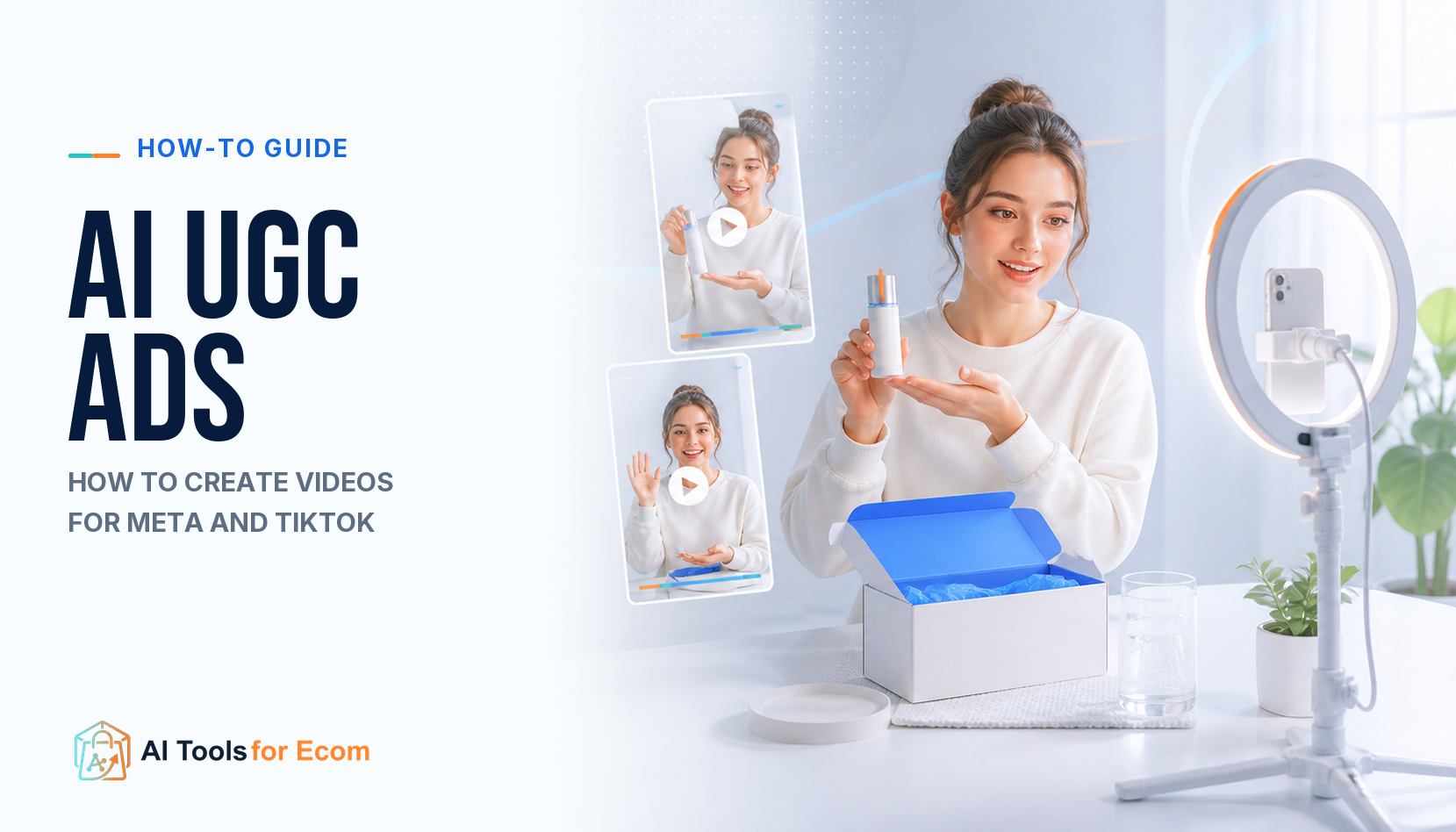
AI UGC ads are UGC-style advertisements produced partly or wholly with generative tools. They can help an ecommerce team test hooks, presenters, scripts, languages, and formats without organizing a new shoot for every variation. They are not automatically authentic customer content, and they should never be presented as proof that a synthetic speaker bought, used, or benefited from the product.
Quick answer: start with an evidence pack, choose one message angle, write a short script, and select an AI-only, hybrid, or real-creator production route. For most physical products, the safest practical workflow combines an AI spokesperson with verified product close-ups or demonstration footage. Create materially different concepts, review every claim and visual, apply required platform disclosures, and measure campaign results rather than generation volume.
What AI UGC Ads Are—and What They Are Not
Traditional user-generated content comes from a real user or creator and may describe a genuine experience. AI UGC is a production label for advertising that borrows the direct-to-camera, informal, social-first style of UGC while using synthetic presenters, voices, scripts, scenes, or edits. A more accurate description is AI-generated UGC-style advertising.
The distinction matters because an avatar can deliver a product explanation, but it cannot have a personal history with the product. A synthetic presenter may say “this organizer has six compartments” when that fact is verified. It should not say “I used this for thirty days” or “this cured my problem” unless the statement belongs to a real, documented endorser and the presentation does not mislead viewers about who had the experience.
Use AI UGC as a creative-production system: generate scripts, presenter-led scenes, voiceovers, captions, localization, and controlled variations. Do not use it to manufacture social proof.
Before You Generate: Build a Product Evidence Pack
A product URL is a convenient input, not an approved advertising brief. Product pages may contain outdated prices, copied supplier descriptions, unsupported benefits, incomplete dimensions, or language that is unsuitable for an ad. Build a small evidence pack before opening a generator:
- The exact SKU, current variant, and approved product name.
- Verified specifications, materials, dimensions, quantity, compatibility, and included accessories.
- Approved benefits and the evidence supporting each performance claim.
- Current price, promotion terms, availability, shipping conditions, and market restrictions.
- Clean product images plus real close-ups, unboxing, fit, or demonstration footage where needed.
- Logo files, brand colors, pronunciations, caption style, and prohibited language.
- Rights and permissions for every image, clip, voice, likeness, music track, font, and customer statement.
Mark every claim as approved, prohibited, or requiring review. The generator should receive only approved material. This is faster than correcting dozens of polished variations built on an inaccurate source.
Step 1: Choose One Advertising Angle
An angle is the reason the viewer should care. Select one per concept so the test can reveal which message works. Useful ecommerce angles include:
- Problem–solution: describe a recognizable situation and show how the product addresses it.
- Product demonstration: show a verified function, assembly step, or use case.
- Objection handling: answer a concern about size, setup, compatibility, delivery, or care.
- Feature-to-benefit: connect one documented feature with a practical customer outcome.
- Brand spokesperson: explain the product as a narrator, founder-style presenter, or store representative.
- Offer framing: communicate a genuine bundle, promotion, or seasonal reason to act.
Avoid starting with a fabricated review, an invented transformation, or a synthetic customer story. If genuine testimonials exist, preserve the original statement, permission, attribution, material-connection disclosure, and evidence for any result claim.
Step 2: Write a Short AI UGC Ad Script
Use a simple structure:
Hook → problem or context → product evidence or demonstration → benefit → call to action
For example, a compliant organizer script could open with a visible clutter problem, state the product’s verified dimensions and compartment count, show the actual item in use, explain the practical benefit, and close with a truthful offer. The presenter should speak as a narrator or brand representative—not claim an experience that never occurred.
TikTok’s current creative guidance recommends introducing the proposition early, prioritizing the hook in the opening seconds, using captions, and ending with a clear call to action. It also favors genuinely different creative ideas over superficial changes. These are platform recommendations, not guarantees that a specific ad will perform.
Keep the spoken script natural, but do not confuse casual delivery with unverified language. Short sentences, one idea per line, and visible product proof are more useful than slang added only to imitate a creator.
Step 3: Choose AI-Only, Hybrid, or Real-Creator Production
| Production route | Best use | Main limitation |
|---|---|---|
| AI-only | Early message tests, straightforward narration, explainers, and low-risk spokesperson concepts | Weakest evidence when the product must be touched, worn, tasted, assembled, or demonstrated |
| Hybrid | AI presenter combined with real product close-ups, unboxing, screen recordings, or demonstrations | Requires organized source footage and more careful editing |
| Real creator | Genuine experience, trust, fit, texture, taste, safety, handling, or physical results | Higher coordination cost and slower variation production |
Hybrid production is the strongest default for many physical ecommerce products. It preserves the speed of presenter and script variation while keeping the visual proof tied to the real SKU. Use a real creator when the credibility of personal experience is central to the message.
Step 4: Choose the Right AI UGC Video Tool
The tools below have different production roles. Their documented features do not establish relative realism, output approval rate, cost per usable ad, or conversion performance. Test them with the same product, approved claims, and scripts.
| Tool | Best workflow role | What to verify in a trial |
|---|---|---|
| Arcads | Ad-specialist workflow, actor variation, and UGC-style concepts | Product interaction, lip sync, usable-output rate, rights, and cost per approved ad |
| HeyGen | Avatar-led ads, presenter workflows, and localization | Delivery style, pronunciation, translation review, product handling, and export needs |
| Pippit | Product-link-to-social-commerce video workflows | Product fidelity, supported accounts and regions, publishing workflow, and revision cost |
| InVideo | Agent-led multi-scene batches from product and script inputs | Continuity across shots, product accuracy, stock selection, and manual repair time |
| Creatify | Rapid URL-to-ad scripts, presenters, and prototypes | Claim accuracy, product depiction, approval rate, and performance after launch |
Do not rank a tool from its best demo. Generate the same six concepts, count rejected or repaired outputs, record credit use and staff time, and compare only the assets that pass product, brand, legal, and channel review.
Browse the broader AI UGC video tools category when a different workflow is required. For presenter-platform purchase decisions rather than paid-social production, see HeyGen vs Synthesia for ecommerce video and our Synthesia alternatives guide.
Step 5: Generate Controlled Creative Variations
More variations do not automatically produce more learning. Change one major variable at a time so the result can guide the next decision. Start with three materially different angles and two hooks per angle. Hold the presenter, offer, call to action, audience, landing page, and production quality constant.
Once one or two angles show credible evidence, test execution:
- AI-only presenter versus hybrid real-product footage.
- One presenter or delivery-style change.
- One demonstration sequence.
- One offer-framing or call-to-action change.
Only after the angle and execution survive a valid test should the team expand presenters, languages, markets, and placements. This order reduces translation and generation work spent on a weak message.
Step 6: Edit for Meta Reels and TikTok
Create a vertical 9:16 master with clear audio, readable captions, and the product, hook, and call to action inside placement-safe areas. Watch the export on a phone without relying on the editing preview. Check caption timing, line length, interface overlap, music volume, voice clarity, logo size, transitions, and the final destination.
Meta promotes vertical video, audio, and safe-zone-aware creative for Reels based on its own platform testing. Treat any reported performance improvement as Meta’s research rather than a guaranteed outcome for another advertiser. TikTok recommends varied creative, clear propositions, captions, and calls to action. Review each platform’s current specifications and policies immediately before launch because interfaces and requirements change.
Create placement-specific exports when text or a call to action would be obscured. Do not assume one file is equally readable across TikTok, Instagram Reels, Facebook Reels, Stories, and feed placements.
Step 7: Run Four Approval Reviews
Product and offer accuracy
Verify the exact product, variant, color, dimensions, quantity, accessories, price, availability, promotion terms, shipping statement, and demonstration. Reject invented labels, controls, materials, features, or results.
Brand and visual accuracy
Check logos, colors, typography, pronunciation, spokesperson role, tone, captions, and whether the product remains recognizable. Do not approve a visually attractive scene that changes the SKU.
Rights, testimonial, and disclosure
Confirm licenses and permissions for source media, music, fonts, voice, likeness, customer statements, and generated assets. Review whether an AI label, sponsorship disclosure, or other notice is required and whether the total impression remains truthful.
Mobile and platform review
Watch the final export on a phone, test the destination, check safe zones, and review current rules for AI-generated content, restricted products, claims, landing pages, and targeting.
How to Test AI UGC Ads Without Losing the Learning
Use three rounds rather than launching a large uncontrolled batch.
- Message validation: test three angles with two hooks each while holding execution and campaign variables stable.
- Execution: take the strongest angles and test AI-only versus hybrid footage, presenter style, or one call-to-action change.
- Scale and localization: expand formats, presenters, languages, and markets only after the message has conversion evidence.
Measure the earliest useful platform retention metric, six-second or comparable view rate, outbound click-through rate, landing-page conversion rate, cost per acquisition, and contribution-margin return where reliable data is available. A high view rate can coexist with weak buying intent, while a low-cost generated video can become expensive after corrections and rejected outputs.
TikTok currently suggests several distinct creatives per ad group and emphasizes substantial creative differences. That supports a diversified starting set; it does not establish a universal budget, sample size, or refresh schedule. Refresh creative when delivery and performance evidence show a sustained decline, not because a vendor gives every ad the same expiration date.
AI Testimonials, Disclosures, and Platform Rules
The U.S. Federal Trade Commission prohibits fake or false testimonials that misrepresent that the speaker exists, used the product, or had the described experience. Its Consumer Review Rule expressly reaches AI-generated fake reviews and testimonials. Endorsements must be truthful, and material relationships require clear disclosure. Atypical results may also require information about what consumers generally can expect.
A safe operating rule is to frame a synthetic person as an AI spokesperson, narrator, or demonstrator, not a customer. Avoid first-person experience claims such as “I bought this,” “I use this every day,” or “this result happened to me.” If the script uses a genuine customer statement, retain consent and evidence, attribute it accurately, and do not make the avatar appear to be that customer.
TikTok provides an AI-generated-content disclosure option for relevant non-Spark ads and requires advertisers to follow its current AIGC and misleading-content rules. Meta describes labels for content generated or significantly edited with its own ad tools and evolving detection or transparency signals for third-party AI content. Availability and implementation can vary, so check the active account and region before launch.
Disclosure does not make a false claim acceptable. Keep a record of source assets, scripts, claim approvals, likeness and voice permissions, tool used, generation date, platform settings, and final exports.
Review the FTC Consumer Review Rule announcement, FTC endorsement guidance, TikTok disclosure instructions, and TikTok misleading-content policy.
When a Real Creator Is the Better Choice
Use a real creator when the ad depends on an actual personal experience, relationship, or physical interaction that cannot be honestly represented by an avatar. Common examples include apparel fit, cosmetics on skin, food taste and texture, assembly difficulty, accessibility, product durability, safety equipment, health-related products, and before-and-after results.
A real creator is also useful when audience trust is the variable under test. In that case, compare a documented creator execution with an AI spokesperson and a hybrid version rather than assuming one format is more “authentic.” Keep the angle, offer, audience, landing page, and measurement method as comparable as possible.
Frequently Asked Questions
Are AI UGC ads really user-generated content?
Not when a synthetic presenter and generated script replace the user. “AI-generated UGC-style ad” is more accurate. Genuine customer statements require a real source, permission, truthful attribution, and appropriate disclosures.
What is the best AI UGC tool for ecommerce?
There is no universal winner. Arcads emphasizes ad-specialist actor workflows, HeyGen broader avatar and localization work, Pippit commerce-oriented video, InVideo multi-scene generation, and Creatify rapid URL-to-ad prototyping. Test the same approved inputs and compare cost per usable output.
Can AI UGC ads run on Meta and TikTok?
They can, subject to each platform’s current advertising, AI-content, disclosure, restricted-product, and misleading-content rules. Approval also depends on the product, claim, creative, landing page, account, and market.
Do I need to label an AI-generated ad?
Requirements vary by platform, format, market, and how the content was created or edited. Use the platform’s current disclosure tools when required. A label does not cure a fake testimonial, missing sponsorship disclosure, rights problem, or unsupported claim.
Should AI actors replace real creators?
No blanket replacement is sensible. AI presenters can accelerate narration and variation. Real creators remain stronger when genuine experience, trust, fit, taste, texture, safety, or physical results are central to the message.
Create Evidence, Not Synthetic Social Proof
The strongest AI UGC workflow is not the one that generates the most actors. It is the one that turns approved product evidence into a small set of distinct, reviewable creative tests. Use synthetic presenters for narration and variation, verified footage for product proof, real creators for real experience, and campaign data for the decision.
Confirm current creative recommendations through TikTok creative best practices and Meta Reels ads guidance. Review current product capabilities on the official Arcads, HeyGen, Pippit, InVideo, and Creatify pages.
Editorial method: This workflow is based on current first-party product, platform, and regulator documentation. Documented capabilities do not prove comparative output quality, realism, cost savings, approval rate, or campaign performance. This is not legal advice or a claim of identical hands-on testing. Last reviewed: August 2026. Recheck platform policies, disclosure controls, product features, rights, and advertising rules before launch.