
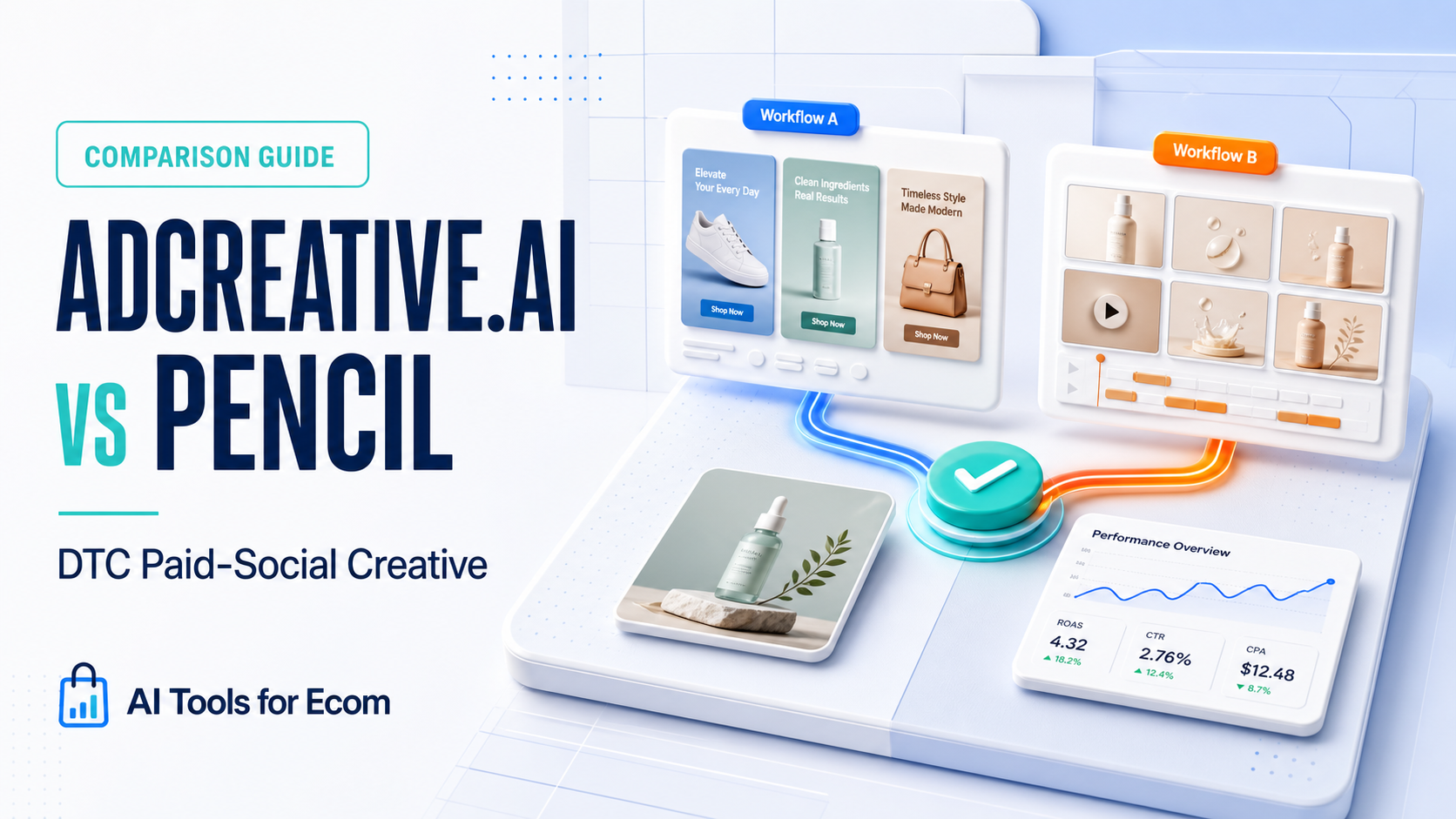
AdCreative.ai and Pencil both help ecommerce teams generate ad creative, but they organize the work differently. AdCreative.ai presents a broad self-serve suite for static ads, product imagery, video, copy, competitor research, and pre-launch creative scoring. Pencil centers the workflow on AI agents, brand assets, creative production, connected ad accounts, performance insights, and multi-channel launch.
The practical choice is not which platform can generate more images. It is which one produces more approved, on-brand ads for the formats your team actually tests. A DTC brand should compare the same briefs, products, aspect ratios, and review standards, then calculate the cost per usable creative rather than relying on vendor scores or raw generation counts.
Quick Verdict
Choose AdCreative.ai when a small or mid-sized team wants a broad, template-led creative toolkit with product photoshoots, static and video assets, copy generation, competitor inspiration, and simple self-serve entry.
Choose Pencil when the priority is a connected creative operating loop: organize brand inputs, generate text, image, and video assets, connect ad accounts, review performance insights, resize outputs, and expand across workspaces or markets.
Do not choose either platform from a predicted score alone. Creative scoring can help sort a backlog, but it cannot know your true offer strength, landing-page experience, audience saturation, auction conditions, contribution margin, or measurement quality. Use scores to prioritize tests, not to replace tests.
AdCreative.ai vs Pencil at a Glance
| Decision area | AdCreative.ai | Pencil | Ecommerce implication |
|---|---|---|---|
| Primary fit | Broad self-serve ad and product-visual generation | Creative generation tied to brand inputs, workflows, and ad performance | Choose a toolkit or an operating loop, not a universal winner |
| Output mix | Static ads, product photos, product and ad videos, copy, and creative utilities | Text, image, video, ad creatives, resizing, exports, and account launch | Map the formats to your real channel calendar |
| Research and scoring | Competitor Insights and Creative Scoring | Creative insights, predictions, and results dashboards after account connection | Both require campaign validation and human review |
| Team structure | Plan-based brand and user limits | Core workspace, Growth unlimited workspaces, and Pro governance | Count brands, users, markets, and approval roles before buying |
| Public starting access | Seven-day trial; Starter currently listed from $39 monthly | Six-ad guided tryout; Core currently $14 monthly | Entry price does not equal comparable monthly output |
| Main risk | Template similarity, credit complexity, and over-trusting creative scores | Generation limits, input dependence, and over-trusting predictions | Measure approved-output rate and production time |
Creative Generation and Format Coverage
AdCreative.ai combines several jobs in one interface. Its current official pages describe ad creatives, product photoshoots, product and fashion videos, text generation, image utilities, competitor insights, and creative scoring. That breadth is useful when a lean ecommerce team needs many common production tasks without assembling several specialist tools.
Pencil also generates text, image, and video assets. Its current pricing page lists common aspect ratios such as 1:1, 9:16, 4:5, 16:9, and 1.91:1, plus custom formats. Pencil can download outputs or launch and track ads across channels including Meta, TikTok, YouTube, Google Display, DV360, and LinkedIn. This makes it more explicit about the path from generation to activation.
Neither platform removes the need for a creative brief. Before generating, define the audience, awareness stage, offer, product truth, proof, objection, hook, call to action, and intended placement. Otherwise, a large output batch will mostly create different-looking versions of the same weak idea.
Brand Inputs and Product Accuracy
Pencil explicitly recommends a brand kit with logos, fonts, colors, brand and product descriptions, plus clean product images and video. Its documentation also states that richer connected performance data can improve its predictions. That is a strength for established brands, but it is also a dependency: poor inputs will produce poor outputs.
AdCreative.ai similarly works best when the brand profile, product assets, copy, and visual references are complete. Its product-photography and video tools can reduce production work, but generated labels, packaging, hands, shadows, and proportions still require inspection. A plausible image is not necessarily an accurate representation of the product.
Create one source-of-truth folder for each SKU: approved packshots, exact color references, dimensions, claim language, prohibited claims, logos, typography, and examples of correct product use. Review generated assets at full resolution. If a model invents text, changes a package, or depicts impossible use, reject it even when the composition looks polished.
Creative Intelligence and Performance Feedback
AdCreative.ai offers Creative Scoring and Competitor Insights. Pencil offers real-time insights and scores, and its official FAQ says connected ad accounts support results dashboards and creative insights. These tools can shorten the first pass through a large concept pool and reveal recurring visual or messaging patterns.
The limitation is causal ambiguity. A winning ad may have benefited from a stronger audience, lower auction pressure, a different offer, more favorable placement, or a better landing page. A predicted score cannot isolate those factors. Competitor research also risks turning category conventions into imitation if the team copies surface elements instead of learning from customer problems and offer structure.
Use scoring as a filter. Keep a human-written test hypothesis for every concept, run comparable media tests, and connect results to gross margin and customer quality rather than click-through rate alone. Store what was changed between variants so the team can learn which message, visual, offer, or format mattered.
Workflow, Collaboration, and Scale
AdCreative.ai uses plan-based brand, credit, and user allowances. That model can work for a small marketing team with a predictable number of brands, but agencies and multi-store operators should check which features, brand slots, and users are included at the intended tier.
Pencil’s current public plans describe one workspace on Core, unlimited workspaces on Growth, and enterprise controls on Pro. Pro includes options such as bulk generation from feeds, unlimited users and markets, role access controls, data ring-fencing, AI governance controls, and dedicated success. Those features matter only when the organization has a real approval or governance need; they do not automatically improve creative quality.
For scale, measure review capacity before generation capacity. If one marketer can approve only 20 ads per week, generating 500 creates a hidden queue and weakens quality control. A smaller batch with clear hypotheses, naming conventions, and rejection reasons usually produces better learning.
Pricing and the Cost per Usable Creative
AdCreative.ai currently lists a seven-day trial and a Starter plan from $39 per month on monthly billing, with 10 credits and one brand at that entry configuration. Higher credit, brand, user, and feature combinations change the price, and quarterly or annual promotions can change the displayed effective monthly amount.
Pencil currently lists Core at $14 per month with 50 generations and one workspace, and Growth at $55 per month with 250 generations and unlimited workspaces. Annual equivalents are displayed at lower monthly rates. Pencil also offers a guided experience for creating six ads before a paid subscription. Pro uses custom pricing and broader governance and bulk-production terms.
These units are not directly comparable. One AdCreative.ai credit is not the same as one Pencil generation, and some formats or resize operations may consume usage differently. Calculate the monthly cost of your actual mix: static ads, video versions, aspect ratios, revisions, brands, users, and approved exports.
Confirm current details on the official AdCreative.ai website and official Pencil pricing page. Promotional rates and included allowances can change.
Which Tool Fits Each Ecommerce Team?
- Lean store needing many common creative tasks: start with AdCreative.ai and test whether its broad suite replaces enough separate tools.
- Performance team connecting creative to ad results: start with Pencil and validate account integrations, reporting, and the usefulness of its insights.
- Agency or multi-brand operator: compare brand and workspace limits, user roles, governance, and bulk workflows before comparing headline prices.
- Catalog brand with many SKUs: test feed or batch workflows with a small representative product set before scaling.
- Brand with strict packaging or regulated claims: prioritize approval controls and human review; do not rely on automatic scoring.
Two-Week Evaluation Plan
- Select two products and one paid-social objective.
- Create the same brief, approved asset pack, and six test hypotheses for both tools.
- Generate matching static and video formats within a fixed time and usage budget.
- Record failures, revisions, review time, and accepted outputs.
- Launch only approved variants with comparable audiences and spend.
- Evaluate contribution margin, conversion quality, creative fatigue, and production cost.
- Choose the platform with the better repeatable workflow, not the prettier demo.
Frequently Asked Questions
Is AdCreative.ai better than Pencil?
Not universally. AdCreative.ai is a broad self-serve creative suite, while Pencil is more explicit about connected workflows, performance insights, multi-channel launch, and enterprise governance. The better fit depends on the team’s operating model.
Which is cheaper for a small ecommerce store?
Pencil has the lower published monthly entry price, while AdCreative.ai starts higher but bundles a different feature and credit model. Compare a real monthly workload because the usage units are not equivalent.
Can creative scores predict ROAS?
No score can guarantee ROAS. Scores may prioritize concepts, but actual performance also depends on audience, auction, placement, offer, landing page, tracking, and margin.
Can either platform replace a designer?
They can reduce repetitive production and generate first drafts, but brand systems, original concepts, product accuracy, accessibility, legal review, and final art direction still need human ownership.
Explore More Ecommerce Ad Tools
Read the individual AdCreative.ai review and Pencil review, browse AI ad creative tools for ecommerce, or see our AI marketing tools for DTC brands and ecommerce product-launch stack for broader workflow choices.
Editorial method: Independent comparison based on current official product and pricing pages; it is not a sponsored ranking or a claim of controlled hands-on testing. Last reviewed: August 2026. Features, prices, credits, integrations, and promotional terms may change, so confirm current details before purchasing.