
What is Pencil?
Pencil is an AI creative marketing platform for generating, editing, launching, and analyzing advertising content. It combines text, image, video, and audio models with brand assets, AI agents, workflows, a professional editor, connected ad accounts, creative scoring, and performance insights.
Ecommerce teams can use Pencil to create static and video ad concepts, apply product and brand references, resize assets for different channels, build bulk variations, collaborate on approvals, and compare creative with campaign results.
Quick Verdict
Pencil is a strong option for ecommerce brands that want creative generation connected to real advertising workflows. Its main advantage is the connection between brand inputs, AI production, editing, launch channels, and performance data rather than relying on generation alone.
The platform still depends on high-quality source assets and human creative judgment. Predictions and scores become more useful when a brand connects sufficient performance data, while small or new advertisers may receive less value from that layer. Generated product imagery, copy, and videos also need final human approval.
Key Features
- AI creative agents: Use ready-made or custom agents for text, image, video, strategy, analysis, and advertising tasks.
- Agent Chat: Develop and revise creative concepts through a conversational workflow.
- Ads Editor: Arrange and refine layers, assets, copy, formats, and visual details in a dedicated editing environment.
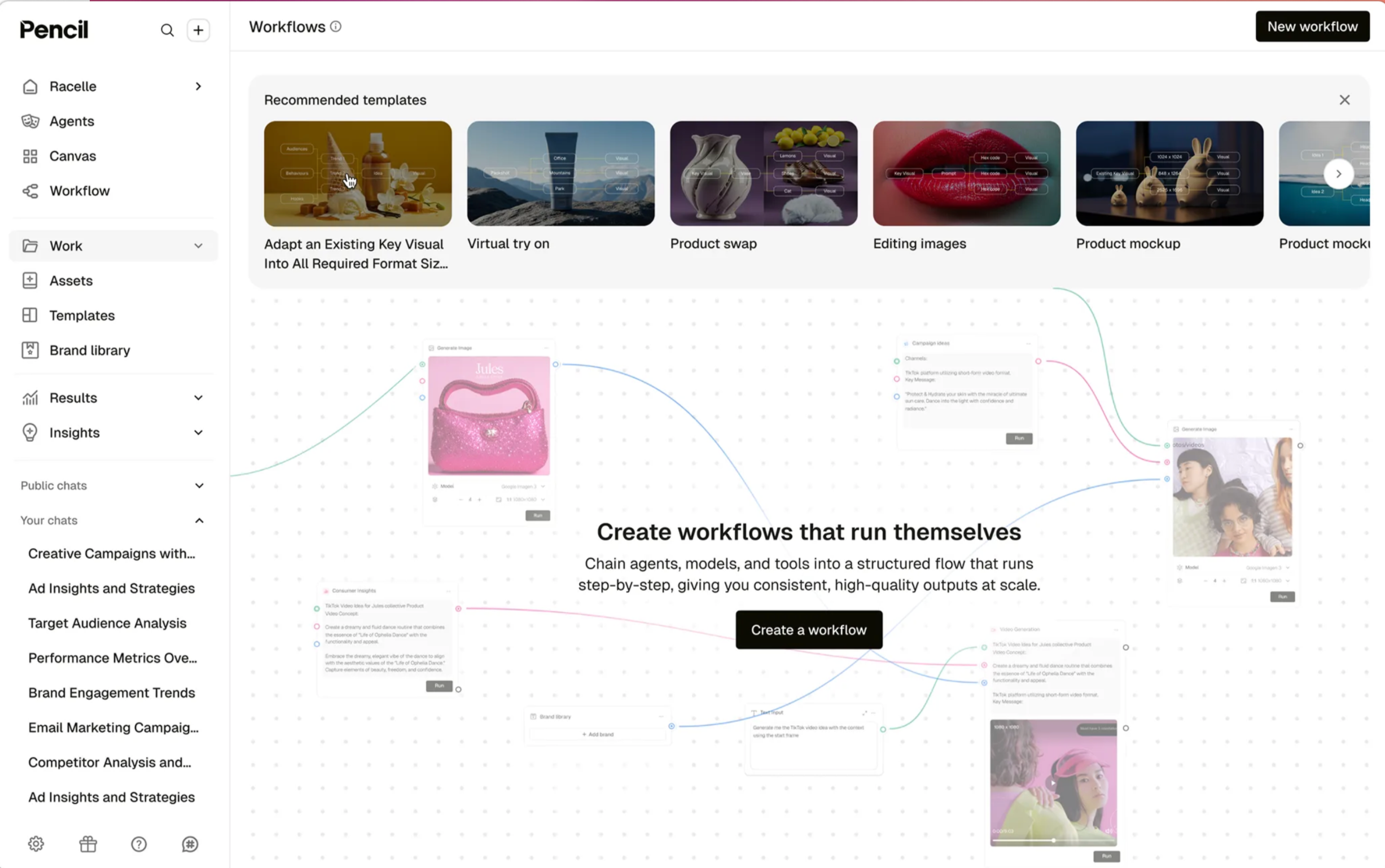
- Workflows: Build node-based production processes that connect prompts, tools, agents, models, and reference assets.
- Sheets and Feed Variations: Generate creative at scale across products, audiences, markets, and structured variations.
- Brand library: Supply logos, fonts, colors, guidelines, product images, videos, and reference creative.
- Creative scoring and insights: Connect ad accounts to review results and receive AI-assisted performance analysis.
- Multi-model generation: Access models from several AI providers for text, image, video, audio, and enhancement tasks.
- Auto Resize: Adapt creative to common and custom aspect ratios while preserving editable layers.
- Launch integrations: Prepare or launch creative across Meta, TikTok, YouTube, Google Display, DV360, LinkedIn, and other supported channels.
- Enterprise governance: Higher plans add role controls, data ring-fencing, no-train commitments, IP terms, AI governance, and custom integrations.
Ecommerce Use Cases
- Paid-social creative: Generate static and video variations for product offers, launches, promotions, and retargeting.
- Product-image generation: Use clean packshots and product references to create new visual concepts and placements.
- Cross-format adaptation: Resize one campaign concept for feeds, stories, reels, video placements, and display inventory.
- Creative performance analysis: Connect ad accounts and compare creative patterns with actual delivery and outcome data.
- Catalog-scale variation: Use Sheets or feeds to adapt creative across products, audiences, markets, and messages.
- Brand-controlled generation: Apply approved visual and messaging guidelines across internal and agency teams.
- Creative refresh: Produce new hooks, layouts, scripts, visuals, and video treatments when an existing campaign starts to fatigue.
- Agency collaboration: Organize workspaces, approvals, assets, and outputs across several clients or markets.
Best For
Performance marketing teams
Teams that want generation, launch connections, creative insights, and advertising data in the same workflow.
Established ecommerce brands
Brands with strong product assets, clear guidelines, and enough campaign history to benefit from performance-informed creative analysis.
Agencies and multi-brand teams
Organizations managing creative production across several brands, products, audiences, and markets.
Enterprise marketing organizations
Teams requiring governance, security, role controls, custom integrations, model controls, and structured high-volume production.
Advantages and Limitations
Advantages
- Connects AI generation with editing, launch channels, performance data, and creative insights.
- Supports both individual ad creation and structured bulk variation.
- Offers agent, workflow, canvas, editor, and spreadsheet-style production methods.
- Aggregates multiple AI models instead of locking every task to one model.
- Provides entry plans for individuals and growth teams plus enterprise governance.
- Supports many languages, channels, aspect ratios, and ad formats.
Considerations
- Pencil is paid after a limited guided free experience; it does not offer an ongoing full free plan.
- Core and Growth have monthly generation limits, and unused generations do not roll over.
- Creative scores and predictions are signals, not guarantees of campaign performance.
- Performance-informed features are more useful when the brand has enough connected advertising data.
- High-quality product and brand inputs are required; poor source assets produce weaker outputs.
- Dynamic product ads and some platform-specific formats have limited support in imported creative reporting.
- All generated product visuals, claims, copy, translations, and disclosures require human approval.
Pricing
Pencil currently lists Core at $14 per month on monthly billing with 50 generations, one workspace, AI agents, realtime insights and scores, launch and tracking integrations, and chat support. Growth is $55 per month with 250 generations, unlimited workspaces, and lower generation costs. Annual billing reduces the effective prices to about $11 and $44 per month.
Pro uses custom pricing and supports unlimited generations, bulk generation using feeds, unlimited users, brands and markets, governance controls, enterprise terms, training, and dedicated success. Pencil also lets new users create six ads through a guided free experience before a paid subscription is required. Confirm current allowances on the official Pencil pricing page.
Our Take
Pencil is most compelling when a brand wants to connect creative production with measurable advertising results. Before subscribing, prepare a clean brand kit, several high-quality product images and videos, approved copy and claims, and clearly structured ad accounts. These inputs make the generation and insight layers more useful.
Start with one workspace and a focused campaign. Compare the time saved, number of usable concepts, editing effort, generation consumption, and live campaign results against the existing workflow. Keep humans responsible for strategy, product accuracy, brand safety, and final publishing decisions.
Pencil Alternatives
- AdCreative.ai for simpler ad-creative generation, product photos, copy, and creative scoring.
- Quickads for ad inspiration, self-service generation, publishing, and optional managed creative services.
- Creatify for product URL video ads, AI actors, and UGC-style creative production.
- Predis.ai for social content creation, captions, scheduling, and multi-channel publishing.
Frequently Asked Questions
What does Pencil do?
Pencil uses AI agents and multiple generation models to create text, image, and video ads, then helps teams edit, resize, launch, track, and analyze creative.
Is Pencil suitable for ecommerce?
Yes. Pencil supports product images, brand libraries, ad variations, cross-format resizing, connected ad accounts, creative insights, and catalog-scale production workflows.
Does Pencil have a free plan?
Pencil offers a guided experience that allows a new user to create six ads for free. Continued access to the full platform requires a paid subscription.
How much does Pencil cost?
Core currently costs $14 per month and Growth costs $55 per month on monthly billing. Annual billing lowers the effective monthly prices, while Pro uses custom pricing.
Can Pencil predict which ads will perform?
Pencil provides creative scores and performance-informed insights after connecting advertising data. These are prioritization signals and cannot guarantee results.
What inputs does Pencil need?
Pencil recommends a brand kit, clear brand and product descriptions, high-quality product images, lifestyle assets, product or UGC videos, and connected ad accounts for the strongest workflow.
Last reviewed: August 2026. Prices, generation limits, supported models, channels, and enterprise terms may change. Confirm current details directly with Pencil.